Showing posts with label China. Show all posts

Monday, August 31, 2026

Avalanche pressures Shah reform agenda in Nepal

Mount Kailash, 2016
Jean-Marie Hullot via Wikimedia Commons CC BY-SA 4.0
The devastating avalanche in Nepal is pushing the country's infrastructure to the limit and confronting the reform administration of Balen Shah with an overwhelming challenge.

I was in Nepal for the national election in March that catapulted rapper-politician Shah to the prime minister's office. Last week, an avalanche of ice, rock, and water tore through the Bhote Koshi and Trishuli river systems, pouring out of the Lhende River in Tibet and sweeping away downstream Nepali villages. The death toll is expected to top 1,000 easily and soon, as hundreds missing are likely buried beneath mud and debris.

(Two CCTV captures from the China-side border crossing at Gyirong Port have been widely shared and are public domain. They're disturbing, so I'm placing them at the bottom of this post and not higher up, for any reader who wants to view them. They do demonstrate the shocking speed and power of the avalanche. The videos are available from Wikimedia Commons (1, 2).) 

Pilgrims circumnavigating Mount Kailash, 2016
Jean-Marie Hullot via Wikimedia Commons CC BY-SA 4.0
Pilgrims, including tourists, visiting Mount Kailash are among the missing. Mount Kailash is believed to be the home of Lord Shiva and his wife Parvati. The mountain is a holy site in Hinduism, Buddhism, Jainism, and Bon, an indigenous Tibetan spiritual tradition.

As I've watched the coverage, I'm reminded that infrastructure was a key issue in the March election. Nepal has asked for foreign aid with rescue and recovery, including genetic testing to identify victims, and resources for reconstruction. Reuters reported the need is on the scale of billions of dollars.

And time is of the essence. Nepali rescuers now are drilling through the baking, hardening surface of the mudflows to try to reach survivors who might be trapped underneath. The rapid advance of ice and earth likely left pockets of air in what used to be vehicles, buildings, and tunnels.

Getting to the northern border region of Nepal is no small feat. Flights to Kathmandu are limited in the best of times. In March, I took one of few large carrier approaches, Cathay Pacific via Hong Kong; Middle East connections were closed because of the U.S.-Iran War. Most flights into Kathmandu are regional connections. Closer Tibetan airports pose prohibitive barriers with prerequisite visas, travel permits, and border crossings.

The Nepali side of the border area is another six to eight hours' drive from Kathmandu. And that doesn't take account of conditions on two-lane roads amid the crisis, nor time to acclimate to altitude. Arriving at Kathmandu already puts one at about 4,400 feet (1,300 meters). The border town of Rasuwagadhi is at 6,000 feet (1,830 meters).

Hiking near Nagarkot, east of Kathmandu, 2026
RJ Peltz-Steele CC BY-NC-SA 4.0
In the election in March, Shah supporters worried whether they could marshal the youth vote precisely because of limited transportation infrastructure. Nepali law required that votes be cast in a person's home district. But more than a million Nepali people, especially young voters, left their home villages to seek employment in Kathmandu.

I wrote in March about a medical student I met in Kathmandu on election day who, representatively, was not voting, because he could afford neither the time nor expense to reach his home village, 16 hours away by bus. Anger over undeveloped infrastructure in Nepal is thus tied closely to the familiar economic issues of jobs and educational opportunity.

Shortly before the election, in February, Shah's party had released a 100-point "manifesto" (Nepali language) outlining the policy changes a Shah administration would implement. Anti-corruption measures in the judiciary, for example, were to include meritocratic appointments, live broadcast of court proceedings, and statutory enhancement of judicial independence. The manifesto promised to get monied influences out of politics and to beef up the economy through apolitical partnerships with China and India. (Nepal News.)

Home construction near Nagarkot, 2026
RJ Peltz-Steele CC BY-NC-SA 4.0
A bold economic development agenda included measures such as rapid growth of capacity in electricity generation, airports, and rail networks. Some of this work was under way; hydropower operators and construction workers at existing and new facilities are a significant number of the hundreds now missing.

Painfully apropos of the present circumstances, the manifesto called for "major reforms in mountain tourism safety and management," according to Nepal News, including "modern technologies such as drones and digital monitoring systems ... to strengthen safety, search, and rescue operations," especially in the Himalayan region on the Nepal-China border, and "hill stations in mountainous areas located within 1.5 hours of the India-Nepal border."

It's early to be Monday-morning quarterbacking what went wrong in the instant disaster—besides that climate change generally is melting glaciers and destabilizing permafrost at high altitudes. We know that affected Nepali villages received no early warning of the avalanche. Commenters have said that existing early warning systems are sparse, too widely dispersed, and depend on primitive and inadequate measurements, such as water levels. Moreover, sensitive technologies with communication capacity and weather resilience are difficult to install at high altitudes, and national borders complicate installation and communication.

An informative assessment of the early warning angle was posted Saturday by "The Honest Broker," political scientist and American Enterprise Institute senior fellow Roger A. Pielke Jr. He quoted a regional news source explaining that existing sensors, such as they were, ordinarily reporting every ten minutes, were simply swept away and silenced by the flash flood.

At 0.9 kmh, the record 200 million liters of water (52.8 billion U.S. gallons, filling 80,000 Olympic-sized swimming pools) reportedly traveled at twice the speed of past floods.

Residential woodpile, Nagarkot, 2026
RJ Peltz-Steele CC BY-NC-SA 4.0
Before the avalanche, when the Shah administration marked 100 days in office, on July 4, there was ample optimism and satisfaction in Nepal; Shah supporters generally were pleased. The party claimed meaningful progress on 70 to 90 manifesto points, according to various reports. A Kathmandu Post analysis pegged achievement at more like 38. But really, that's not bad for a start.

A range of initiatives already are transforming healthcare. Digital tools have been deployed to facilitate access to hospitals, an air ambulance system has extended its capacity to remote locales, and burn units and pharmacy services are expanding.

The administration reimbursed small-account holders who lost money in a public savings corruption scandal and compensated families of persons killed in the Gen Z protests (more on the protests in my earlier posts). Government offices have been streamlined, reducing backlogs and wait times on services such as passports, driver licenses, and business licenses. Legislative groundwork has been laid for constitutional and economic reforms.

There has been pushback and controversy. The administration has implemented a range of anti-corruption initiatives, including investigation and arrest of the prior prime minister. I'm not a fan of criminalizing politics, but in this case, the move is not unwarranted.

Nevertheless, and perhaps predictably, legislators are fretting over Shah's imperiousness. And outcry is coming not only from opposition parties, as Shah upends the status quo. Though I figure that's to be expected when a serious reformer takes on corruption. Imagine if Bernie Sanders had won the U.S. election in 2020. Opponents in his own party fretted that he would get nothing done with a recalcitrant Congress, but I thirsted for the effort and the naming of names it would entail.

The Shah administration also has drawn displeasure by seizing land, even if the takings are legitimate. Some seizures represent claw-backs of public lands that were sold off or given away as a function of government corruption (Yosemite, anyone?). Some seizures are lawful takings for infrastructure development. The problem arises in that with a downtrodden working class, much land is occupied by squatters, and the government has not always been gentle with their removal. Human rights advocates have criticized the Shah administration for forgetting the people whilst helping The People.

Notwithstanding political discontent, reasoned criticism, and media impatience, to my mind, Shah has been on a tear. Now the disaster poses a test. 

Of course, no one will blame Shah for the avalanche, nor for melting glaciers. Rather, if he plays his cards right, he can blame the West for global warming, China for lack of early warning, and his predecessors for the weak infrastructure that is aggravating rescue and will dog recovery. 

Rather, his problem is a plain old economic one. Collecting billions in foreign aid will be a chore in the present batten-down-the-hatches transnational zeitgeist. And focusing efforts on the relatively small and remote northern border region where the disaster occurred will mean a major drain on national resources, diverting focus and finance from the prime minister's agenda. 

Natural disasters have undone chief executives before. Ready or not, Nepal is going to find out whether Balen Shah has the right stuff to overcome.

CCTV Capture 1 at Gyirong Port

CCTV Capture 2 at Gyirong Port


Monday, May 11, 2026

In row with Zambia, NGO abruptly cancels world human rights conference, points to Chinese interference

A gateway near Lusaka's Kenneth Kaunda International Airport
marks Zambia independence from Britain in 1964.

RJ Peltz-Steele CC BY-NC-SA 4.0
Blaming interference by the Chinese and Zambian governments, global digital rights organization Access Now canceled the 2026 meeting of RightsCon, one of the largest human rights conferences in the world, on April 29, just days before thousands of delegates were to converge on host city Lusaka, Zambia.

I was already in southern Africa for RightsCon when the announcement came. I thought it prudent not to write about the cancellation until I left Zambia. I am home in the United States now.

Those of us in Lusaka naturally were in contact with one another. We agreed that our exchanges of information would be subject to the Chatham House Rule, and furthermore, that we would be non-specific about the nature—time, place, medium, scope—of our communications. Accordingly, there is information in this account that is not attributed but comes from reliable sources.

RightsCon returns to Africa 

RightsCon has been a gathering place for international leaders, thinkers, and organizations to discuss digital rights policy, including internet censorship, electronic surveillance, and technology ethics, almost every year since the first conference convened in Silicon Valley in 2011. Also founded in California, in 2009, global nonprofit Access Now takes the lead in organizing RightsCon, with tech companies and allied civil society organizations around the world contributing expertise and resources.

I was in Tunis, Tunisia, for the first RightsCon meeting in Africa, in 2019; I wrote about it here at The Savory Tort. The 2026 meeting in Lusaka, the capital of Zambia, was to mark the first meeting of RightsCon in sub-Saharan Africa. Access Now anticipated 2,600 in-person participants in Lusaka, besides 1,100 more online, representing 150 countries and 750 organizations in more than 500 sessions.

Generally, large, world conferences of any kind are exceedingly difficult to locate in sub-Saharan Africa, outside of South Africa, if only because of infrastructure limitations—airline routes, meeting space, accommodations, food preparation, security. The challenge is often cited as a chicken-or-egg factor in stalled African development, as the lucrative likes of business and medical conferences pass on the region even when they have development on the agenda.

Add to the mix the human rights focus of RightsCon, and its 2026 location amid the fragile democracies, such as Zambia's, in central Africa, and the conference was set to be an especial boon to the region. RightsCon Zambia was conceived to be a game changer, to show what could be done.

The RightsCon ethos condemns rights-oppressive digital manipulation such as internet shutdowns, which are an authoritarian go-to in regimes across sub-Saharan African (e.g., The Guardian). RightsCon also prizes equity in online participation, thus embracing expression by and about women and minority groups, including the LGBTQ community. That's sensitive subject matter in a region in which child marriage, female genital mutilation, and criminalization of same-sex relations are live, hot-button issues.

Access Now was keenly aware of all of these challenges and worked hard to coordinate RightsCon in constant collaboration with Zambian officials, since a first meeting in 2024. More than a few rights activists were critical of Access Now, preferring to eschew sub-Saharan Africa on the theory that the economic advantages and favorable press of a global human rights conference should be withheld from the region.

I rather agree with Access Now that the social and economic opportunity of an event such as RightsCon should be positioned to counterbalance anti-democratic incentives. After all, civil society organizations that advocate for human rights and the protection of women and minority persons continue working in these countries, placing themselves at grave risk, regardless of whether activists from abroad turn up in solidarity. So better to turn up.

RightsCon 2026 goes south

Access Now described what happened in late April in a detailed May 1 statement. According to the statement: "On April 27, one day after a government press release endorsed RightsCon, we received a phone call from MoTS [Zambian Ministry of Technology and Science] about an urgent issue and were told that diplomats from the People’s Republic of China (PRC) were putting pressure on the Government of Zambia because Taiwanese civil society participants were planning to join us in person."

RightsCon 2025 was held in Taipei, Taiwan. I was there and wrote about the conference here at The Savory Tort last year. The programs I highlighted at that RightsCon covered topics such as Chinese surveillance technology, opportunistic Chinese technology investment in Africa, and the vulnerability to malicious actors of undersea information infrastructure in the Pacific.

I was surprised then that such conversations could happen with impunity in Taiwan, just offshore from watchful mainland China. Now, it seems, they could not, not without consequences.

It wasn't Access Now that first called off RightsCon Zambia. After the MoTS phone call, Access Now sought to open dialog with Zambian officials and Taiwanese delegates. Then, on April 28, Access Now was blindsided by a government announcement that RightsCon was "postponed"—a logistical impossibility. Access Now also "received reports of immigration officers telling participants as they arrived that RightsCon had been cancelled."

In Zambian news outlets, Technology and Science Minister Felix Mutati said that "additional time is required to ensure all preparatory arrangements fully align with national procedures, diplomatic protocols, and the broader objective of promoting a balanced and consensus-driven platform."

The "postponement" was restated in an April 29 press statement by the Zambian Ministry of Information and Media. Information and Media Secretary Thabo Kawana wrote: "The postponement was necessitated by the need for comprehensive disclosure of critical information relating to thematic issues proposed for discussion during the Summit. Such disclosure is essential to ensure full alignment with Zambia's national values, policy priorities, and broader public interest considerations."

Access Now learned through informal channels, it wrote in its statement, that "for RightsCon to continue, we would have to moderate specific topics and exclude communities at risk, including our Taiwanese participants, from in-person and online participation."

To do so would have been antithetical to Access Now and RightsCon's very mission. So Access Now itself then canceled RightsCon and urged delegates to abort travel to Zambia.

China pulls strings

When I first read the information ministry release and its reference to "Zambia's national values," I did not yet know about the role of China behind the scenes. I rather suspected that Zambia was turned off by the friendliness of the RightsCon agenda to expressive freedom for women and the LGBTQ community. No doubt my perspective is colored by my own past research on civil rights in East Africa (presented at a Law and Society conference at the University of Cape Town in 2016). 

I wasn't entirely wrong, though. Zambian discontent with other aspects of RightsCon programming meant that officials did not have to have their arms twisted too hard to nix the conference.

Nearly a quarter of girls in Zambia marry before they turn 18, though, it must be acknowledged, that percentage has fallen more than 15 points in recent years thanks to government efforts. Gay sex is illegal in Zambia and punishable by imprisonment. The LGBTQ community is persecuted by blackmail and criminal prosecution (more at Amnesty International). Needless to say, these matters are not mentioned on Zambia's tourism website.

Another source of contention, which I had not recognized, is labor rights, especially in extraction. Weak regulation and abundant unlicensed operations leave quarry and mine workers, sometimes including child laborers, plagued with accidents, yielding some hundred injuries and fatalities annually, besides social and environmental damage. Every year brings a new horror story—a landslide at an open-pit copper mine in 2023 (AP), a quarry collapse in 2024 (Africa News), a pit collapse in 2025 (IJHub).

Chinese interests moreover are implicated in mining hazards. In 2025, a dam collapse at a Chinese-state-owned mine in the Zambia Copperbelt wrought environmental catastrophe. Fifty million liters of toxic waste poured into rivers that supply more than half of Zambians with water. Mass die-offs of fish and birds were immediate, and Kitwe, a city of 800,000, had to shut off its water supply.

Lawsuits have been brought against mine owner Sino-Metals Leach Zambia, and the long-term environmental impact in the Kafue River Basin is still being assessed. The Kafue River flows south from the Copperbelt through ecologically critical and touristically important Kafue National Park. Sino-Metals promised to compensate victims, but is implicated in covering up the scope of the disaster.

A campaign-season banner in Lusaka touts incumbent achievements.
RJ Peltz-Steele CC BY-NC-SA 4.0
Access Now in its explanation of the RightsCon cancellation fairly chose to emphasize Chinese interference as dispositive, and to gloss over other issues. Rights advocates were concerned, especially after the information minister's reference to "values," that authorities would aim to distract from their subservience to China by scapegoating the LGBTQ community. Such a move is known in the government playbook, as when previous crackdowns on political dissent were willfully mischaracterized as protecting traditional Zambian society from western liberal deviance.

Election season is under way in Zambia with the presidency and legislature in play. Voters go to the polls in August. The cancellation of a conference as large as RightsCon is wreaking adverse economic impact in Lusaka and across the country, in tourism and support-service sectors, not to mention leaving Zambia with an embarrassing black eye among nations. The incumbent president could lose his narrow lead in the polls were the public to come to understand as well that China, author of the Kafue disaster, was pulling Zambia's puppet strings.

Whither America?

When I learned of the RightsCon cancellation, I was not in Zambia, but in neighboring Malawi. Oddly enough, I went to Malawi before RightsCon to have a look at the substantial impact of Chinese infrastructure investment in that country.

I have written here at The Savory Tort before about the dangers to global security of strategic Chinese investment in the developing world, for example, two years before RightsCon Taiwan, in places such as Maldives. I hope to write about what I saw in Malawi later, my experience there being overshadowed now by the RightsCon story. 

Meanwhile, the coincidences piled up when, on April 30, a different story from Zambia broke in international news. Unexpectedly that day, outgoing U.S. Ambassador to Zambia Michael C. Gonzales delivered a farewell speech that sparked a conflagration of domestic debate and intensified discord with Washington. The Lusaka Times described what happened:

What was expected to be a routine diplomatic send-off quickly became a national political flashpoint after Gonzales questioned the credibility of anti-corruption efforts, raised concerns about institutional accountability and warned about governance weaknesses that continue to undermine investor confidence. His remarks landed at a time when political temperatures were already rising and economic frustrations remained deeply embedded among voters confronting high living costs and employment pressures. 

Gonzales was a Biden appointee, but he signed on to the new agenda when Trump went back to Washington. After the radical rollback of U.S. foreign development aid, in statements in 2025 and earlier this year, Gonzales expressed regretful support for the suspension of aid to Zambia for purported reason of the country's inability to corral corruption.

As The New York Times described the situation late last week, Gonzales's remarks came at a critical juncture in negotiation between the United States and Zambia over what "America First" economic relationship will replace the dismantled USAID model. Like China, the United States is eyeing Zambian mineral reserves and, observers allege, seeks to strike a deal on favorable terms of access in exchange for at least a billion dollars in health aid. 

Gonzales denied that mineral access is a bargaining chip in U.S.-Zambia aid negotiations. But a draft State Department memo leaked to The New York Times suggested otherwise. The Times reported plainly in March, "The State Department is considering withholding lifesaving assistance to people with H.I.V. in Zambia as a negotiating tactic to force the government of the southern African country to sign a deal giving the United States more access to its critical minerals."

The U.S. has renegotiated health aid with 20 other African countries, the Times reported, usually upon receiving the nation's commitment to shoulder more of the burden itself on healthcare. Ghana and Zimbabwe walked away from renegotiation. Nations have balked at U.S. demands that they share healthcare data and biological samples, sometimes for longer than the aid term, and without converse guarantees of access to research findings. These issues are at play in U.S.-Zambia negotiations.

Yet the renegotiation with Zambia seems specially to incorporate mineral access, too, according to Times reporting on the leaked draft memo: "[T]he United States is trying to use the deal it is negotiating with Zambia to address a longtime source of frustration: what is sees as China's unfettered access to the country's mineral wealth. Zambia is one of the world's major copper producers, and also has huge reserves of minerals like lithium and cobalt, all of which are key in the green energy transition."

According to Times reporting, some 1.3 million Zambians rely on daily U.S.-funded antiretroviral therapies, besides the country's dependence on U.S. aid to hold tuberculosis and malaria at bay. The United States is threatening cuts on a "massive scale," according to the leaked memo. A Zambian official condemned the equation of mineral access with lifesaving aid, the Times reported—though I saw no public recognition of Zambia's parallel arrangements with China.

On the street in Lusaka, I heard mixed feelings about the U.S.-Zambia row. I expected to hear disappointment and frustration at the termination of USAID and the threatened loss of health aid. But the outrage I heard was directed at Zambians' own government.

Many people I talked to framed their assessments with the experience of family members who depend on aid to live with HIV. Even what would seem a modest cost to a U.S. taxpayer for prescription drugs, mere dollars a day, would put treatment beyond reach for many in Zambia, where median income is about $4 per day.

Though U.S. threats to stop HIV assistance pointed to a deadline in May, Zambians told me that the drugs already are becoming scarce. It's possible that healthcare providers and corrupt officials are hoarding supply.

And therein lies the source of Zambians' frustration. People I talked to agreed with Gonzales and echoed U.S. allegations that aid is improperly diverted by corruption. Characteristically, one man expressed his support for President Trump, saying he liked that Trump "is his own man." Zambians seemed willing to go along with at least economic aid cuts if it would mean an end to corruption and more assistance hitting the ground in the long run.

In retrospect, it makes sense that anti-establishment Trump rhetoric would resonate with African constituents accustomed to self-reliance amid weak public institutions and politicians who promise much and deliver little. Still, I'm not sure an all-access pass for American corporations to Zambian natural resources is going to leave Zambians any better off than they are under the Chinese yoke. 

Zambians I spoke to had little more regard for China. They regarded Chinese investment as having proved self-serving of both Chinese laborers and investors, and having added little to Zambians' economic prosperity. That's pretty much the story on Chinese investment as I've found it elsewhere on the continent. I wonder whether Zambians will be surprised to find that that's now the American strategy, too.

A baobab tree says good night at South Luangwa National Park.
RJ Peltz-Steele CC BY-NC-SA 4.0
Sub-Saharan Africa navigates new world

Persons working on rights issues in and about Africa agreed that the cancellation of RightsCon under these circumstances is a devastating blow to democracy in Africa and the developing world. Conference organizers boldly endeavored to show that it could be done, that sub-Saharan Africa has the maturity and sophistication to take its seat at the table and to join the global dialog on human rights in the technological age. Now the takeaway is confirmation for the naysayers: reinforcement of the dangerous trope that Africa is a backwater, inexplicably mired in underdevelopment. It will be a generation, one activist lamented, "before anyone tries this again."

I worry even more about the confirmation of the Chinese foreign policy model. The cancellation of RightsCon at the behest of Chinese political demands, while Zambian natural resources are plundered and human capital exploited—soon by America also?—seems to confirm our global retreat from "the end of history" in western liberalism, and, in its place, a terrifying, seemingly inevitable human tendency to cling to the primacy of might.

Tuesday, March 4, 2025

Digital rights defenders gather in Taipei to tackle mass surveillance, online propaganda, authoritarianism

Culled from my notes, here are some of the most interesting things I heard last week in Taipei at RightsCon, the world's leading summit on digital rights for technology, commercial, civil society, and government sectors.

A dragon towers over the 2025 Taiwan Lantern Festival in Taoyuan.
RJ Peltz-Steele CC BY-NC-SA 4.0
Chinese Surveillance Technology

China is methodical in suppressing conversation around the world about the repression of the Uyghur people, according to representatives of the World Uyghur Congress (WUC). Within days of her speaking at the Hudson Institute, WUC Chair Rushan Abbas said, her sister and aunt in China disappeared. Chinese officials sometimes approach venues hosting conferences that will discuss the Uyghurs and offer them double the price to cancel the conference contract, according to Haiyuer Kuerban, director of the WUC Berlin office. Now governments in England and Germany are keen to buy from Chinese firms such as Huawei the very tech that Chinese authorities use to surveil Uyghur activists and their families, Kuerban said, a perverse reward for the facilitation of human rights abuse.

Linjiang night market bustles in Taipei.
RJ Peltz-Steele CC BY-NC-SA 4.0
If you use a China-based media service such as WeChat even outside China, you might be helping the Chinese surveillance apparatus. Open Technology Fund Fellow Pellaeon Lin explained that censors scan files shared online and "fingerprint" them to tailor the blocking of sensitive content from recipients in China. Scanning and fingerprinting happens on Chinese tech even when users share content wholly outside China. Chinese users, meanwhile, can't penetrate "the great firewall" as easily as in the past, Lin explained. Authorities can see when a VPN is used, if not the content, and that's reason enough to bring someone in for questioning. Tor is better than a VPN because it wraps and disguises internet traffic within innocent transmissions. But Lin warns, it's a game of cat and mouse; the censors are always refining their methods.

Undersea Infrastructure

Remember that all of these panels took place in Taiwan, so criticism of China carried a grave sort of resonance. While discussion of digital rights naturally suggests the metaphysics of cyberspace, the infrastructure of the infosphere exists very much in the real world. One fascinating panel of experts fretted over the vulnerability of the world's undersea cables. Recent outages, such as the cut cable in the Gulf of Finland at Christmas, concerningly exhibit indicia of human agency. Professor Yachi Chiang, of the National Taiwan Ocean University, said, to my surprise, that Taiwan is located at right about the world's highest-density crossroads of undersea traffic. She's right; you can see it at the Submarine Cable Map by TeleGeography:

Submarine Cable Map CC BY-SA 4.0

The security challenges of this network are massive. About 20% of damage results from natural forces, such as deterioration and shark bites, Chiang said; sharks like to bite cables. About 70% of damage is caused by people. A lot of that is inadvertent, anchoring by fishing vessels. But there's no easy way to determine whether there was a malicious act, much less a nation behind it. In the Christmas incident, Finnish officials have alleged a deliberate anchor drag by a Cook Islands-flagged vessel doing Russia's bidding, NPR reported in December.

Taiwan had five incidents already in 2025, Chiang said, with four domestic lines and one international line disrupted. In one incident, the Taiwan Coast Guard took a vessel into custody and detained the crew. That incident was suspicious, because the boat had irregular routing for fishing and inexplicably bore a changeable nameboard. But the capture was exceptional, only possible because the ship was in Taiwanese waters, Chiang explained. On the high seas, ships bear flags of convenience, and any claim against the vessel must be taken up with the flag nation. Those claims in distant and ill developed bureaucracies go nowhere. So some better coordinated legal response is needed to protect the undersea information infrastructure, Chiang concluded.

Authoritarianism in Africa

While the United States retreats to some amalgam of isolationism and opportunism, China is dominating the developing world technologically. China built more than 70% of the 4G network in Africa, Amnesty International's Sikula Oniala said, and now is working on 5G. Chinese-made TVs are flooding the market, Oniala said, but to work, they must be connected to the internet via their Chinese software, raising specters of surveillance and control.

Starlink deployment over
Rhode Island,
February 2025.
RJ Peltz-Steele CC BY-NC-SA 4.0
Authoritarian impulses in Africa are ever more complemented by Chinese technology and strategies. Governments control the gateways for internet access; last year, protests were met with internet shutdowns in Kenya, Mozambique, Tanzania, Mauritius and Equatorial Guinea, VOA reported. Amid the civil war in Sudan, both sides have used internet shutdowns strategically, cutting off information about unfriendly protests, permitting access when it undermines the enemy, and charging usurious rates for access to vital information, according to Hussam Mahjoub, co-founder of Sudan Bukra, an independent television channel.

While Starlink seems to promise liberation from government gateways, authorities in countries such as Sudan refuse to license the service and are pressuring the company to limit roaming access for accounts opened abroad, such as in neighboring Kenya, Mahjoub said. Worse, Tor Project Executive Director Isabela Fernandes warned, beware the gift bearer. The Bolsonaro regime in Brazil used Starlink data to track down and kill indigenous activists, she said.

Correspondingly, public access to information (ATI, freedom of information, or FOI) law is on the wane. In Kenya, Uganda, and Zimbabwe, mass surveillance is chilling human rights activism. And governments—even Kenya, the ATI law of which, on paper at least, I praised—are following Chinese examples in ATI law, Oniala said, reducing transparency purportedly in the name of national security.

Data Protection in Africa

Even with the best of intentions, African governments hardly can be expected to stand up to tech giants such as Meta, with turnovers that dwarf nations' GDPs, Open Technology Fund Fellow Tomiwa Ilori said. Speaking to African countries' efforts to establish meaningful enforcement of data protection laws, Ilori analogized: "You only get to kill snakes because they don't move together." In other words, African countries must coordinate their efforts. Franco Giandana Gigena, an Argentine lawyer and policy analyst for Access Now, described a similar dynamic in Latin American countries' inability to resist incentives from the U.S. government and American corporations to look the other way on data protection enforcement.

In the vein of collective action, the African Union Convention on Cyber Security and Personal Data Protection came into force in 2023, upon accession by Mauritania. However, the convention, adopted in 2014, already is dated. Ilori suggested it would benefit from optional protocols on extraterritorial application and stronger enforcement, and overall, African people need more education about their rights.

At that, there might be cultural impediments to EU-style data protection. Thobekile Matimbe, a senior project manager for the Nigeria-based Paradigm Initiative, said that the convention perspective on privacy, while inspired by the EU General Data Protection Regulation (GDPR), is more communitarian than individualist. Curiously, the African perspective, which prizes the integrity of the family, for example, over self-determination or the right to dissent, marks the same ground from which the human right of data protection emerged in the European tradition. The problem, Matimbe explained, is that authoritarians invoke the communitarian perspective to subordinate personal freedoms to the purported imperative of national security. That rationalization has seen surveillance deployed in Malawi, for one example, targeting human rights advocates, critics of government, and journalists, Matimbe said.

Disinformation Regulation

The classical dichotomy between true and false no longer works to balance free expression and disinformation regulation, according to Lutz Güllner, head of the European Economic and Trade Office in Taiwan. As Ukrainian journalist and Public Interest Journalism Lab CEO Nataliya Gumenyuk put it, debunking just isn't working anymore.

The problem, Güllner said, is that disinformation can have truth at its core, but the dis arises in the spin. That's why, he said, the EU's new Digital Services Act (DSA) aims not at content, but at manner of presentation: imposing on Big Tech a responsibility to police platforms for manipulative amplification of speech or suppression of others' speech (for example, planting an item of disinformation in a flood of mundane but accurate news). That isn't to say that the DSA strikes the right balance. Dionysia Peppa, a Greek lawyer and senior policy analyst for Beirut-based SMEX, said that the DSA rule on takedown of illegal content does not define "illegal," devolving authority to member states. In a time of right-leaning elections in Europe, states might disagree sharply over politically charged questions, such as when policy criticism of Israel becomes illegal hate speech.

In a similar vein, Liliana Vitu, chair of the Audiovisual Council of Moldova, talked about the challenges of combatting Russian propaganda in mass media. Banning "primitive propaganda" in "news" and talk shows was easy, she said. The devil lay in entertainment. For example, Russia-originating programs might consistently portray European characters as gay, effeminate, or weak, playing to stereotypes, she explained, while Russian characters appear masculine and strong.

Ukrainian journalists Nataliya Gumenyuk and Angelina Kariakina
talk about The Reckoning Project, which trains conflict journalists
in the preservation of evidence to prosecute war crimes.

RJ Peltz-Steele CC BY-NC-SA 4.0
As mere debunking doesn't work, Gumenyuk described research from The Reckoning Project seeking to figure out how journalists should combat disinformation. Viewers suffer from "compassion fatigue" at all the suffering in the world, she said. So when confronted with fact-based news accounts, such as the appearance of a drowned Syrian boy on a Bodrum beach, or the torture and murder of civilians in Bucha, Ukraine, viewers resisted and complained that journalists are out to manipulate them emotionally. The same viewers, though, proved receptive to people's firsthand accounts in documentaries. Gumenyuk described her astonishment at one study subject's testimony that he trusted the documentary more than the news because journalists were not telling the story. He seemed utterly unaware that the documentary form is a product of journalism and no more or less capable of conveying viewpoint than a news story.

The Reckoning Project, which Gumenyuk co-founded, occupies a compelling position at the junction of journalism and law. Gumenyuk said she tired of seeing reports collected by journalists excluded from war-crime investigations and prosecutions because the journalists did not understand rules of evidence. The Reckoning Project brings together journalists and lawyers to accomplish their complementary missions in seeking truth and justice. Gumenyuk gave as an example the questions a journalist might ask of a witness of atrocities, such as those committed by Russian forces against civilians in Bucha. Ordinarily, a journalist might ask, "How did the Russian soldiers kill this man?" But a leading question yields exclusion of the response as evidence in a legal proceeding. So journalists are trained to ask instead, "Tell me what happened that day."

Apropos of lawyering skills and picking up on the point that tech and its ill-intentioned users evolve faster than law and regulators, Armenian attorney and former head of the Armenian Data Protection Authority Gevorg Hayrapetyan played my tune when he told an audience:

One of the most important disciplines in law is philosophy of law, what law is and what it ought to be. One of the most important steps in developing human rights is recognizing the right.

Data protection, after all, was not a thing until someone thought of it. Maybe that's why it's not a thing in the United States. If we strip black-letter law of theory and policy and dumb down the American law school curriculum to comprise a glorified bar course and skills-training program, then we're headed in the right direction. Right? Asking for a friend.

Time to Save the World

Even were we all so inclined, is there time yet to save the world? Probably not. Law and regulation can't keep up, Güllner said, so the answer has to come from education, to develop people's sensory reflexes to detect disinformation. That will take a generation. "Ask my Ukrainian colleagues," he said. "We don't have that long."

Vitu described complex Moldovan legislation with multi-factor tests to determine whether disinformation conveys falsity and threatens national security. But that took years to develop with civil society stakeholders at the table to protect free expression; propaganda meanwhile grew yet more sophisticated. "Moscow never sleeps," she lamented. 

And Raša Nedeljkov, with the Serbian Center for Research, Transparency and Accountability, summed up the anxiety wracking the world:

A beacon of light for us was U.S. democracy. Now look what is happening.

Maybe that's the silver lining, journalist Tess Bacalla of the Asia Democracy Network suggested: The rest of the world, especially the European Union, will have to step up.

Wednesday, January 31, 2024

Taxpayers help to fatten Big Law in prosecution that Chinese community chalks up to racial profiling

Rawpixel CC0
The American trend to embrace attorney fee-shifting is a cash cow for the corporate defense bar. A pending case speaks to the problem, as the Government seeks more than $600,000 in fees on behalf of white-shoe law firms from a man whom civil rights advocates say was racially profiled.

Waning of "the American Rule."  The American legal system is unusual in the world for its default rule that every party pays its own way in litigation. This "American rule" contrasts with "the English rule," adopted in most of the world's jurisdictions, by which "loser pays."

But in part in acknowledgement of the abnormally high transaction costs, especially attorney fees, of litigation in the United States, some statutory systems have adopted the English rule. In civil rights, for example, key federal statutes require fee-shifting to victorious plaintiffs. The concern is that the victims of civil rights violations will not otherwise be able to incentivize lawyers to take their cases.

That logic has leached out of civil rights, though, into ever more adjacent areas of legal practice. Most civil claims are filed against corporations, and most civil claims are unsuccessful. So corporations and their lawyers have been keen to think of new ways to be paid for their trouble, if not to deter lawsuits to begin with. 

A key such area is anti-SLAPP, that is, legal measures against "strategic lawsuits against public participation." Anti-SLAPP, about which I have written many times, is wildly popular with lawmakers: now the law in a majority of states, perennially proposed in Congress, and presently being drafted into EU law.

Anti-SLAPP began as a modest and rational means to deter corporations from weaponizing frivolous litigation against protestors, silencing them with legal fees. Thus, many anti-SLAPP laws penalize unsuccessful civil plaintiffs by charging them for the defendant's attorney fees. But the corporate media defense bar fell in love with anti-SLAPP. It's now a potent weapon for corporations to silence persons who dare say they've been defamed, or had their privacy invaded, in mass publication. 

It's important to remember that just because a plaintiff is unsuccessful in civil litigation does not mean that the plaintiff was not wronged. Defamation and privacy law is rife with defendant-friendly mechanisms designed to over-protect media defendants from even meritorious claims, from evidentiary privileges, to limitations on discovery, to daunting burdens such as the New York Times Co. v. Sullivan (U.S. 1964) "actual malice" standard. Anti-SLAPP piles on another prophylactic defense, one that works so fast, a defendant need not even answer the complaint.

I've been consistent in my opposition to anti-SLAPP's poisonous growth, especially its fee-shifting penalty. Frequent litigant Donald Trump, by the way, has been on both sides of anti-SLAPP fees, having been awarded nearly $300,000 in attorney fees against Stormy Daniels in response to her claim of defamation. It sometimes amuses me and sometimes saddens me to see civil rights advocates, journalists, and media law professors align themselves with mega-corporations in publishing, eager to line the pockets of Big Law.

United States v. Yu. The instant case is criminal, not civil. But the case involves a civil restitution statute that allows for a criminal defendant to be charged with the legal fees incurred by a "victim." 

Haoyang Yu, a naturalized U.S. citizen of Chinese descent, was a Boston-area engineer charged with 21 crimes in connection with his work developing chip technology for Analog Devices, Inc. (ADI). The court dismissed one charge and acquitted Yu of another before submitting 19 charges to the jury. The jury acquitted Yu of 18 charges and convicted him of one only: illegal possession of trade secrets. 

More or less, Yu took his work home with him, and his work included a proprietary chip design. The government had accused Yu of much worse: intention to steal ADI tech either to start his own company or to pass research to the Chinese government. Yu was caught up in a government crackdown amid fear of foreign espionage in the American tech industry. The evidence did not bear out the suspicion.

Critics point to Yu's Chinese origin and ancestry to allege that he was a victim of racial profiling. The trial judge in the case even acknowledged, "It's hard to say that Mr. Yu’s race or ethnicity was not a factor here" (Lexington Observer, June 2, 2023). APA (Asian Pacific American) Justice has tracked Yu's case. The Intercept covered the case in 2022. Critics pointed out that allegations such as those in Yu typically are resolved in mere civil litigation over theft of trade secrets. Yu was sentenced to six months' imprisonment and a fine, and then was sued by ADI.

The part of the case pertinent here is the Government's motion in federal district court that Yu be ordered to pay $606,879 to ADI attorneys at high-end firms WilmerHale and Quinn Emanuel. The Government invoked the Mandatory Restitution to Victims Act (MRVA).

The MRVA was enacted in 1996. A U.S. Department of Justice (DOJ) summary of the law doesn't much conjure a corporation as the kind of "victim" the law was meant to help. DOJ imagined "[v]ictims of crimes such as telemarketing, child exploitation, interstate domestic violence and sexual assault." The summary contemplates victims' "lost income and necessary child care, transportation, and other expenses related to participation in the investigation or prosecution of the offense."

In contrast, the fat legal bills in Yu include, according to, e.g., Brian Dowling at Law360 (subscription), $1,865 per hour for a Quinn Emanuel partner to watch the trial from the gallery. Other hourly rates at Quinn range from $320 for a paralegal, $880 for a second-year associate, and $1,095 for a fourth-year associate, to $1,440 for "counsel."

When I was in practice in the mid-1990s, as a first- and second-year associate, my billing rate with Big Law in Baltimore and Washington, D.C., was in the neighborhood of $120 per hour. I made about $25 per hour. Today, in academics, I make about $115 per hour (unrealistically assuming I work only 40 hours per week for nine months). According to public data, my students graduating UMass Law today will make about what I did in 1995, public or private sector. No adjustment for inflation.

Multiplying out the Quinn counsel rate yields $2.88m per year. Even if only 20% is paid out in salary, that's $576,000 per year. Not bad. I bet, though, that the $1,865/hr. attorney, a former Acting U.S. Attorney, takes home better than 20%. I guess the difference between the 1990s and now is that back then, shame was still a thing. 

Meanwhile, the bar is eager to tell law schools that it no longer can afford to mentor and train lawyers on the job, and that we should purge from the curriculum the esoteria of legal theory and public policy in favor of producing "practice ready" billing machines.

Quinn Emanuel has an entertainment and media litigation group that defends defamation and privacy claims for mass-market publishers. If I find myself defamed or otherwise wronged by a Quinn Emanuel media client, I shudder to think what the tab might be if I sue, but can't prove actual malice. Thanks to anti-SLAPP fee-shifting, Quinn Emanuel can be very well compensated even if one of its clients is negligent in decimating a person's reputation.

Next time a purported champion of the First Amendment or Fourth Estate tells you what a good idea anti-SLAPP is, think about the mahogany furniture and extravagant lifestyle of the Big Law Boston lawyer.

In an MRVA case, Big Law even gets the benefit of taxpayer-funded litigation to get paid, as the Government carries on the demand on behalf of the "victim."

The parties in Yu are now wrangling over the fee demand. The court asked the Government to break down the ask in a spreadsheet. The Government filed a data disc in December.

The case is United States v. Yu (D. Mass. indictment filed 2019), Judge William G. Young presiding.

Thursday, April 6, 2023

Chinese aid in foreign development, Taiwan's dwindling number of allies warrant Western concern

Honduras severed ties with Taiwan and doubled down on ties with China just days before House Speaker Kevin McCarthy met in California with the president of Taiwan.

The severing of diplomatic relations between Honduras and Taiwan is an important sign for global security, well beyond the bilateral significance. The People's Republic of China (PRC) has been executing a methodical campaign to isolate Taiwan from the world, a potential preliminary step to an assertion of control that would test the U.S. pledge to defend the disputed territory.

Chinese development policy is a fascinating subject; I take it up each year in one hour with my Comparative Law class.  Evidence abounds to support disparate theories on what the PRC means to achieve with its foreign aid packages. From well meaning humanitarian goals to Machiavellian world domination: it's anybody's guess what's being said in the highest levels of Beijing briefings. I'll paste below the reading list my class used this year to get a handle on this wide-ranging sub-subject. The discussion always is the best of the course.

Around the world, I have seen the vast reach of renminbi. The infrastructure projects alone are simply stunning. Chinese flags boast of telecommunication investment in distant and dusty towns in West Africa and South America. Bridges soar in Croatia and Montenegro; dams in Thailand and Sudan. Glassy government buildings adorn capitals such as Windhoek and Harare. And then there are the ports, from Togo to Sri Lanka to Peru. That's just a sampling of what I've seen with my own eyes.

A Dutch friend working in the aid sector in the Middle East was puzzled when I first asked for his appraisal of Chinese objectives. It's obvious, he opined. They just don't say it.

He and I were in the remote Indian Ocean island nation of the Maldives in March, where I witnessed Chinese-funded projects: a shining national museum, a bridge connecting the capital to the airport island across open ocean, and a massive new airport under construction. 

The Sinamalé Bridge, or China-Maldives Friendship Bridge, links capital Malé to Hulhulé Island.
RJ Peltz-Steele CC BY-NC-SA 4.0
Velana International Airport at left; the new Maldives airport under construction at right.
RJ Peltz-Steele CC BY-NC-SA 4.0
The Maldives National Museum, Malé, opened in 2010.
RJ Peltz-Steele CC BY-NC-SA 4.0

The list of countries that have severed ties with Taiwan upon PRC quid pro quo has grown so long that it's difficult to track, and countries in Latin America and the Caribbean are well represented. I was in Paraguay last year not long after it asked Taiwan for $1bn to remain friends. Typically of countries in the mix, Paraguay is trying to play both sides for the best deal, which, in the end, probably means just using Taiwan as leverage to get the best deal from the PRC. Heritage reported in late February that Paraguay was one of only 14 remaining countries, then, still maintaining ties with Taiwan. 

Last week, Honduras renounced that club. NPR contextualized the move:

Honduras had asked Taiwan for billions of dollars of aid and compared its proposals with China's, Wu said. About two weeks ago, the Honduran government sought $2.45 billion from Taiwan to build a hospital and a dam, and to write off debts, he added....

Taiwanese President Tsai Ing-wen said her government would not "engage in a meaningless contest of dollar diplomacy with China." ....

For decades China has funneled billions of dollars into investment and infrastructure projects across Latin America. That investment has translated to rising power for China and a growing number of allies.

In Honduras, it has come in the form of construction of a hydroelectric dam project in central Honduras built by the Chinese company SINOHYDRO with about $300 million in Chinese government financing.

Honduras is the ninth diplomatic ally that Taipei has lost to Beijing since the pro-independence Tsai first took office in May 2016.

Taiwan still has ties with Belize, Paraguay and Guatemala in Latin America, and Vatican City. Most of its remaining partners are island nations in the Caribbean and South Pacific, along with Eswatini in southern Africa.

As Reuters put it in a headline yesterday, "US, Taiwan seen powerless to stem island's diplomatic losses in Latin America."

When Taiwan President Tsai Ing-wen met with McCarthy in California, she was on her way back from visiting Belize and Guatemala. Media reports tended to spin the meeting as a show of tough-on-China Republican policy. I rather assumed the view I heard from one commentator, that meeting in California was a way not to meet in Taiwan, thus, not to poke the dragon as Nancy Pelosi did.

Schooled on 1970s détente, I'm not much of an American imperialist, and these days, I'm not much of an American exceptionalist. But I do worry that we will one day wake up to find ourselves a quirky outpost of remnant democracy in a world of purported harmony under authoritarian paternity.

Here's your Comparative Law homework for two hours on law and development, including a discussion of the PRC.

Historical and theoretical:

Policy:Cheeseman here summarizes his remarks at a University of Birmingham debate in 2019. The whole debate is on video on YouTube, so you can watch it if you like (cued to Cheeseman, who spoke first).

PRC:

If you'd like to dig into the numbers of Chinese development aid, have a look at the Global China Initiative at Boston University, especially its recent (Jan. 2023) policy brief.

The older BRI exists alongside more recent, if less extravagant, Chinese policies in the Global Security Initiative (GSI) and the Global Development Initiative (GDI).  The GSI and GDI raise analogous questions. If you would like comparable overviews, I recommend Michael Schuman for The Atlantic (July 13, 2022) on the GSI; Joseph Lemoine and Yomna Gaafar for New Atlanticist (Aug. 18, 2022) on the GDI (pro-Western perspective); and Professor Amitrajeet A. Batabyal for The Conversation (Aug. 4, 2022) on the GDI.

If you would like to learn more about the Chinese debt cancellations in Africa mentioned in the N.Y. Times article, there's a good and fairly even-handed article from Voice of America News (Aug. 25, 2022). One thing I have not given you here is any of the abundant statements from Chinese authorities and state-sponsored media defending Chinese policy; you can find them readily online yourself if you wish to get a flavor.

Conclusion:

Engage with this compelling perspective piece authored by a Harvard law student in 2018. Attorney Sabrina Singh is now an associate in the ESG group at Latham & Watkins in New York City.

A thanks to my Dutch friend (whom I'm not naming for security) for joining the class from the Middle East via Teams to discuss the delivery of humanitarian aid in conflict zones.

Wednesday, February 1, 2023

EU leverages trade for sustainable development

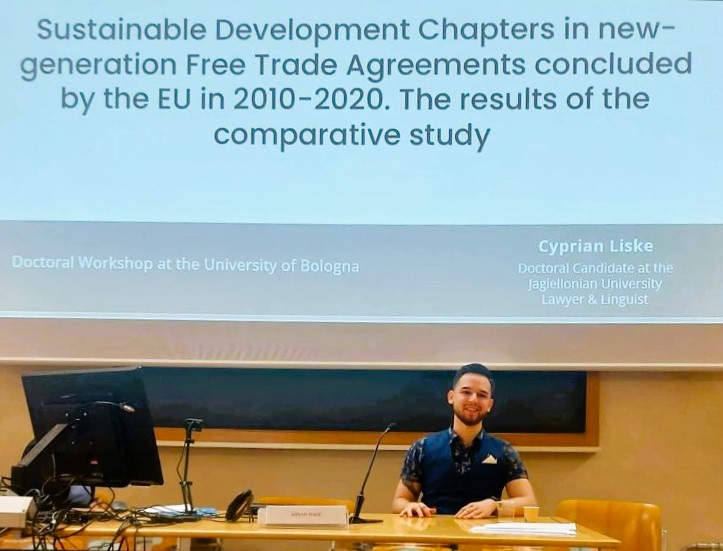
Attorney Cyprian Liske presents at the University of Bologna.
Used with permission.
"Sustainability" is the word of our times, and the European Union has more than a decade's experience building sustainability expectations into trade agreements.

At the University of Bologna in October, for a program of the Guild of European Research-Intensive Universities, doctoral candidate Cyprian Liske, my friend, colleague, and former student, presented his research on sustainable development provisions in EU trade agreements concluded from 2010 to 2020. Here is the abstract:

On 27th November 2019, Ursula von der Leyen, at that time President-elect of the European Commission, delivered a speech in the European Parliament, in which she set a concise programme for the next 5 years of her term of office. "Sustainability" was mentioned in this speech no less than 8 times. "We have to bring the world with us and this is already happening," Ms. President said. "And Phil Hogan [at that time Commissioner for trade] will ensure that our future trade agreements include a chapter on sustainable development."

Indeed, the EU has been including trade and sustainable development (TSD) chapters in new-generation trade agreements since the Free Trade Agreement with South Korea (2010). However, such TSD chapters, devoted to the realisation of the Sustainable Development Goals, including environmental protection, preventing resource depletion, or protecting workers' rights, differ substantially in agreements concluded with particular countries....

The goal of the project was to comparatively analyse TSD chapters in trade agreements concluded by the EU in 2010-2020, pointing out common elements and differences. The analysis will let us critically explore what the reasons for those differences may be (e.g., the course of negotiations, economic dependency, trade partners’ level of development) and whether the EU is consistent in its sustainability requirements set towards its trade partners. It will also allow us to depict the current tendencies in the way how such TSD chapters are shaped by the EU in comparison with the global trends. The comparative analysis of the EU TSD chapters was conducted by the researcher qualitatively and quantitatively with the use of software (MAXQDA 2022).

The research parses the interests advanced by EU agreements..
© Cyprian Liske; used with permission.
The Biden administration lately has redoubled the U.S. commitment to the developing world, announcing at a December summit, for key example, an investment of $55bn in Africa over the next three years.

Development aid is often viewed skeptically by American taxpayers. That's understandable when the homeland is plagued by homelessness and financial insecurity. Isolationism streaks run through both libertarian and conservative ideologies, evidenced lately by Republican skepticism even of aid to Ukraine. But development aid can be justified with reference simultaneously to socioeconomic benevolence and to the donor's national security, thus, appealing to priorities both liberal and conservative.

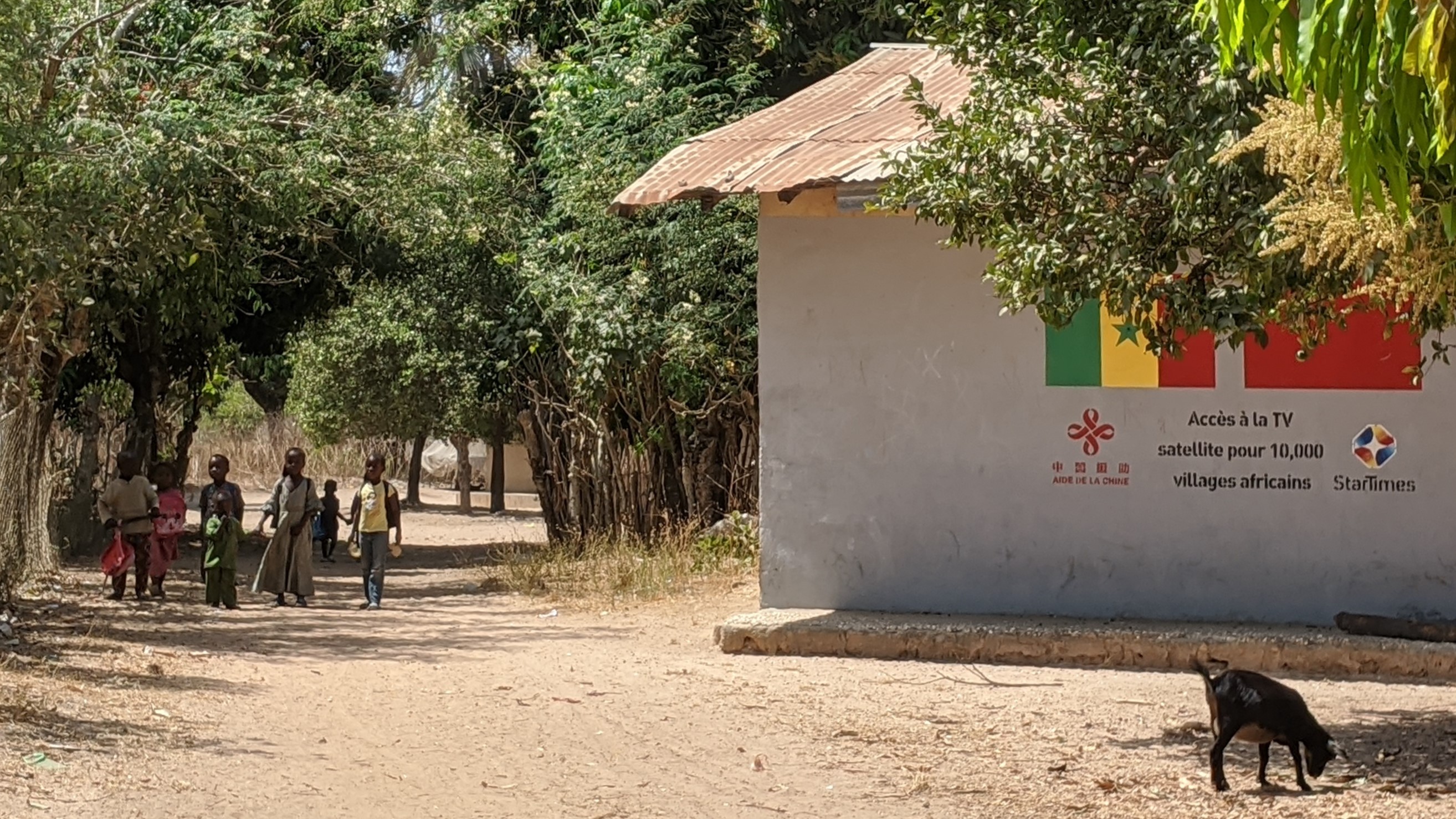
Literal signs of Chinese investment are ubiquitous throughout Africa, as here,
in the rural community
d'Oukout in the Casamance region of Senegal, 2020.
RJ Peltz-Steele CC BY-NC-SA 4.0
The United States has a lot of catching up to do. With hotly debated motive, China has invested heavily in the developing world, near and far from its borders. Chinese presence in Africa is ubiquitous, from massive infrastructure projects such as ports and bridges to telecommunication access in the remotest of villages. Russia, too, has lately gone all-in on Africa: a "charm offensive," researcher Joseph Siegle wrote last year, and "[t]he reasons aren't pretty."

Incorporating sustainable development into trade agreements allows western powers to facilitate development goals at less cost than direct investment, and even with potential gains through free trade. There's still a lower-common-denominator problem when competing against proffered Chinese and Russian agreements that attach browbeating strings only on the back end. But access to Western markets brings some incentive to the table.

A practicing lawyer and legal translator, Liske is pursuing his doctorate on the nexus between sustainable development and international trade law in the context of EU external policy. He graduated in law from Jagiellonian University and in business linguistics from the Tischner European University, both in Kraków, Poland, and both with distinction. He also is an alumnus of the American Law Program of the Columbus School of Law of the Catholic University of America, and of the English Law and Legal Methods International Summer Programme of the University of Cambridge.