Showing posts with label foreign aid. Show all posts

Monday, May 11, 2026

In row with Zambia, NGO abruptly cancels world human rights conference, points to Chinese interference

A gateway near Lusaka's Kenneth Kaunda International Airport
marks Zambia independence from Britain in 1964.

RJ Peltz-Steele CC BY-NC-SA 4.0
Blaming interference by the Chinese and Zambian governments, global digital rights organization Access Now canceled the 2026 meeting of RightsCon, one of the largest human rights conferences in the world, on April 29, just days before thousands of delegates were to converge on host city Lusaka, Zambia.

I was already in southern Africa for RightsCon when the announcement came. I thought it prudent not to write about the cancellation until I left Zambia. I am home in the United States now.

Those of us in Lusaka naturally were in contact with one another. We agreed that our exchanges of information would be subject to the Chatham House Rule, and furthermore, that we would be non-specific about the nature—time, place, medium, scope—of our communications. Accordingly, there is information in this account that is not attributed but comes from reliable sources.

RightsCon returns to Africa 

RightsCon has been a gathering place for international leaders, thinkers, and organizations to discuss digital rights policy, including internet censorship, electronic surveillance, and technology ethics, almost every year since the first conference convened in Silicon Valley in 2011. Also founded in California, in 2009, global nonprofit Access Now takes the lead in organizing RightsCon, with tech companies and allied civil society organizations around the world contributing expertise and resources.

I was in Tunis, Tunisia, for the first RightsCon meeting in Africa, in 2019; I wrote about it here at The Savory Tort. The 2026 meeting in Lusaka, the capital of Zambia, was to mark the first meeting of RightsCon in sub-Saharan Africa. Access Now anticipated 2,600 in-person participants in Lusaka, besides 1,100 more online, representing 150 countries and 750 organizations in more than 500 sessions.

Generally, large, world conferences of any kind are exceedingly difficult to locate in sub-Saharan Africa, outside of South Africa, if only because of infrastructure limitations—airline routes, meeting space, accommodations, food preparation, security. The challenge is often cited as a chicken-or-egg factor in stalled African development, as the lucrative likes of business and medical conferences pass on the region even when they have development on the agenda.

Add to the mix the human rights focus of RightsCon, and its 2026 location amid the fragile democracies, such as Zambia's, in central Africa, and the conference was set to be an especial boon to the region. RightsCon Zambia was conceived to be a game changer, to show what could be done.

The RightsCon ethos condemns rights-oppressive digital manipulation such as internet shutdowns, which are an authoritarian go-to in regimes across sub-Saharan African (e.g., The Guardian). RightsCon also prizes equity in online participation, thus embracing expression by and about women and minority groups, including the LGBTQ community. That's sensitive subject matter in a region in which child marriage, female genital mutilation, and criminalization of same-sex relations are live, hot-button issues.

Access Now was keenly aware of all of these challenges and worked hard to coordinate RightsCon in constant collaboration with Zambian officials, since a first meeting in 2024. More than a few rights activists were critical of Access Now, preferring to eschew sub-Saharan Africa on the theory that the economic advantages and favorable press of a global human rights conference should be withheld from the region.

I rather agree with Access Now that the social and economic opportunity of an event such as RightsCon should be positioned to counterbalance anti-democratic incentives. After all, civil society organizations that advocate for human rights and the protection of women and minority persons continue working in these countries, placing themselves at grave risk, regardless of whether activists from abroad turn up in solidarity. So better to turn up.

RightsCon 2026 goes south

Access Now described what happened in late April in a detailed May 1 statement. According to the statement: "On April 27, one day after a government press release endorsed RightsCon, we received a phone call from MoTS [Zambian Ministry of Technology and Science] about an urgent issue and were told that diplomats from the People’s Republic of China (PRC) were putting pressure on the Government of Zambia because Taiwanese civil society participants were planning to join us in person."

RightsCon 2025 was held in Taipei, Taiwan. I was there and wrote about the conference here at The Savory Tort last year. The programs I highlighted at that RightsCon covered topics such as Chinese surveillance technology, opportunistic Chinese technology investment in Africa, and the vulnerability to malicious actors of undersea information infrastructure in the Pacific.

I was surprised then that such conversations could happen with impunity in Taiwan, just offshore from watchful mainland China. Now, it seems, they could not, not without consequences.

It wasn't Access Now that first called off RightsCon Zambia. After the MoTS phone call, Access Now sought to open dialog with Zambian officials and Taiwanese delegates. Then, on April 28, Access Now was blindsided by a government announcement that RightsCon was "postponed"—a logistical impossibility. Access Now also "received reports of immigration officers telling participants as they arrived that RightsCon had been cancelled."

In Zambian news outlets, Technology and Science Minister Felix Mutati said that "additional time is required to ensure all preparatory arrangements fully align with national procedures, diplomatic protocols, and the broader objective of promoting a balanced and consensus-driven platform."

The "postponement" was restated in an April 29 press statement by the Zambian Ministry of Information and Media. Information and Media Secretary Thabo Kawana wrote: "The postponement was necessitated by the need for comprehensive disclosure of critical information relating to thematic issues proposed for discussion during the Summit. Such disclosure is essential to ensure full alignment with Zambia's national values, policy priorities, and broader public interest considerations."

Access Now learned through informal channels, it wrote in its statement, that "for RightsCon to continue, we would have to moderate specific topics and exclude communities at risk, including our Taiwanese participants, from in-person and online participation."

To do so would have been antithetical to Access Now and RightsCon's very mission. So Access Now itself then canceled RightsCon and urged delegates to abort travel to Zambia.

China pulls strings

When I first read the information ministry release and its reference to "Zambia's national values," I did not yet know about the role of China behind the scenes. I rather suspected that Zambia was turned off by the friendliness of the RightsCon agenda to expressive freedom for women and the LGBTQ community. No doubt my perspective is colored by my own past research on civil rights in East Africa (presented at a Law and Society conference at the University of Cape Town in 2016). 

I wasn't entirely wrong, though. Zambian discontent with other aspects of RightsCon programming meant that officials did not have to have their arms twisted too hard to nix the conference.

Nearly a quarter of girls in Zambia marry before they turn 18, though, it must be acknowledged, that percentage has fallen more than 15 points in recent years thanks to government efforts. Gay sex is illegal in Zambia and punishable by imprisonment. The LGBTQ community is persecuted by blackmail and criminal prosecution (more at Amnesty International). Needless to say, these matters are not mentioned on Zambia's tourism website.

Another source of contention, which I had not recognized, is labor rights, especially in extraction. Weak regulation and abundant unlicensed operations leave quarry and mine workers, sometimes including child laborers, plagued with accidents, yielding some hundred injuries and fatalities annually, besides social and environmental damage. Every year brings a new horror story—a landslide at an open-pit copper mine in 2023 (AP), a quarry collapse in 2024 (Africa News), a pit collapse in 2025 (IJHub).

Chinese interests moreover are implicated in mining hazards. In 2025, a dam collapse at a Chinese-state-owned mine in the Zambia Copperbelt wrought environmental catastrophe. Fifty million liters of toxic waste poured into rivers that supply more than half of Zambians with water. Mass die-offs of fish and birds were immediate, and Kitwe, a city of 800,000, had to shut off its water supply.

Lawsuits have been brought against mine owner Sino-Metals Leach Zambia, and the long-term environmental impact in the Kafue River Basin is still being assessed. The Kafue River flows south from the Copperbelt through ecologically critical and touristically important Kafue National Park. Sino-Metals promised to compensate victims, but is implicated in covering up the scope of the disaster.

A campaign-season banner in Lusaka touts incumbent achievements.
RJ Peltz-Steele CC BY-NC-SA 4.0
Access Now in its explanation of the RightsCon cancellation fairly chose to emphasize Chinese interference as dispositive, and to gloss over other issues. Rights advocates were concerned, especially after the information minister's reference to "values," that authorities would aim to distract from their subservience to China by scapegoating the LGBTQ community. Such a move is known in the government playbook, as when previous crackdowns on political dissent were willfully mischaracterized as protecting traditional Zambian society from western liberal deviance.

Election season is under way in Zambia with the presidency and legislature in play. Voters go to the polls in August. The cancellation of a conference as large as RightsCon is wreaking adverse economic impact in Lusaka and across the country, in tourism and support-service sectors, not to mention leaving Zambia with an embarrassing black eye among nations. The incumbent president could lose his narrow lead in the polls were the public to come to understand as well that China, author of the Kafue disaster, was pulling Zambia's puppet strings.

Whither America?

When I learned of the RightsCon cancellation, I was not in Zambia, but in neighboring Malawi. Oddly enough, I went to Malawi before RightsCon to have a look at the substantial impact of Chinese infrastructure investment in that country.

I have written here at The Savory Tort before about the dangers to global security of strategic Chinese investment in the developing world, for example, two years before RightsCon Taiwan, in places such as Maldives. I hope to write about what I saw in Malawi later, my experience there being overshadowed now by the RightsCon story. 

Meanwhile, the coincidences piled up when, on April 30, a different story from Zambia broke in international news. Unexpectedly that day, outgoing U.S. Ambassador to Zambia Michael C. Gonzales delivered a farewell speech that sparked a conflagration of domestic debate and intensified discord with Washington. The Lusaka Times described what happened:

What was expected to be a routine diplomatic send-off quickly became a national political flashpoint after Gonzales questioned the credibility of anti-corruption efforts, raised concerns about institutional accountability and warned about governance weaknesses that continue to undermine investor confidence. His remarks landed at a time when political temperatures were already rising and economic frustrations remained deeply embedded among voters confronting high living costs and employment pressures. 

Gonzales was a Biden appointee, but he signed on to the new agenda when Trump went back to Washington. After the radical rollback of U.S. foreign development aid, in statements in 2025 and earlier this year, Gonzales expressed regretful support for the suspension of aid to Zambia for purported reason of the country's inability to corral corruption.

As The New York Times described the situation late last week, Gonzales's remarks came at a critical juncture in negotiation between the United States and Zambia over what "America First" economic relationship will replace the dismantled USAID model. Like China, the United States is eyeing Zambian mineral reserves and, observers allege, seeks to strike a deal on favorable terms of access in exchange for at least a billion dollars in health aid. 

Gonzales denied that mineral access is a bargaining chip in U.S.-Zambia aid negotiations. But a draft State Department memo leaked to The New York Times suggested otherwise. The Times reported plainly in March, "The State Department is considering withholding lifesaving assistance to people with H.I.V. in Zambia as a negotiating tactic to force the government of the southern African country to sign a deal giving the United States more access to its critical minerals."

The U.S. has renegotiated health aid with 20 other African countries, the Times reported, usually upon receiving the nation's commitment to shoulder more of the burden itself on healthcare. Ghana and Zimbabwe walked away from renegotiation. Nations have balked at U.S. demands that they share healthcare data and biological samples, sometimes for longer than the aid term, and without converse guarantees of access to research findings. These issues are at play in U.S.-Zambia negotiations.

Yet the renegotiation with Zambia seems specially to incorporate mineral access, too, according to Times reporting on the leaked draft memo: "[T]he United States is trying to use the deal it is negotiating with Zambia to address a longtime source of frustration: what is sees as China's unfettered access to the country's mineral wealth. Zambia is one of the world's major copper producers, and also has huge reserves of minerals like lithium and cobalt, all of which are key in the green energy transition."

According to Times reporting, some 1.3 million Zambians rely on daily U.S.-funded antiretroviral therapies, besides the country's dependence on U.S. aid to hold tuberculosis and malaria at bay. The United States is threatening cuts on a "massive scale," according to the leaked memo. A Zambian official condemned the equation of mineral access with lifesaving aid, the Times reported—though I saw no public recognition of Zambia's parallel arrangements with China.

On the street in Lusaka, I heard mixed feelings about the U.S.-Zambia row. I expected to hear disappointment and frustration at the termination of USAID and the threatened loss of health aid. But the outrage I heard was directed at Zambians' own government.

Many people I talked to framed their assessments with the experience of family members who depend on aid to live with HIV. Even what would seem a modest cost to a U.S. taxpayer for prescription drugs, mere dollars a day, would put treatment beyond reach for many in Zambia, where median income is about $4 per day.

Though U.S. threats to stop HIV assistance pointed to a deadline in May, Zambians told me that the drugs already are becoming scarce. It's possible that healthcare providers and corrupt officials are hoarding supply.

And therein lies the source of Zambians' frustration. People I talked to agreed with Gonzales and echoed U.S. allegations that aid is improperly diverted by corruption. Characteristically, one man expressed his support for President Trump, saying he liked that Trump "is his own man." Zambians seemed willing to go along with at least economic aid cuts if it would mean an end to corruption and more assistance hitting the ground in the long run.

In retrospect, it makes sense that anti-establishment Trump rhetoric would resonate with African constituents accustomed to self-reliance amid weak public institutions and politicians who promise much and deliver little. Still, I'm not sure an all-access pass for American corporations to Zambian natural resources is going to leave Zambians any better off than they are under the Chinese yoke. 

Zambians I spoke to had little more regard for China. They regarded Chinese investment as having proved self-serving of both Chinese laborers and investors, and having added little to Zambians' economic prosperity. That's pretty much the story on Chinese investment as I've found it elsewhere on the continent. I wonder whether Zambians will be surprised to find that that's now the American strategy, too.

A baobab tree says good night at South Luangwa National Park.
RJ Peltz-Steele CC BY-NC-SA 4.0
Sub-Saharan Africa navigates new world

Persons working on rights issues in and about Africa agreed that the cancellation of RightsCon under these circumstances is a devastating blow to democracy in Africa and the developing world. Conference organizers boldly endeavored to show that it could be done, that sub-Saharan Africa has the maturity and sophistication to take its seat at the table and to join the global dialog on human rights in the technological age. Now the takeaway is confirmation for the naysayers: reinforcement of the dangerous trope that Africa is a backwater, inexplicably mired in underdevelopment. It will be a generation, one activist lamented, "before anyone tries this again."

I worry even more about the confirmation of the Chinese foreign policy model. The cancellation of RightsCon at the behest of Chinese political demands, while Zambian natural resources are plundered and human capital exploited—soon by America also?—seems to confirm our global retreat from "the end of history" in western liberalism, and, in its place, a terrifying, seemingly inevitable human tendency to cling to the primacy of might.

Sunday, May 18, 2025

Iglesia celebra ordenación en comunidad quechua

Pastor Cruz a la izquierda, con Pastor Zhulleima y su esposa y hijos.
Capture from video at BBC RI media
En mi iglesia de Rhode Island el domingo, fuimos testigos de la ordenación de Gabriel Zhulleima.

Barrington Baptist Church (BBC) dio la bienvenida a la gente de varias iglesias, de Massachusetts y el estado Nueva York, tan lejos como Albany. Las iglesias que se unieron con nosotros incluyen en particular la gente Quechua que viven en esta región. Un grupo de mujeres quechuas honró el evento con una actuación musical en la tradición indígena.

Nuestro propio pastor y misionero Aurelino Cruz, de origen brasileño, sirvió como maestro de ceremonias y traductor del español al inglés. El pastor y misionero Antonio DeLaZerda dío el mensaje, o sermón, a la iglesia en español. Cruz y DeLaZerda ambos sirven con la organización Missions Door.

En el mensaje, Pastor DeLaZerda dijo que lo que describrió como la forma en que América está "cambiando" el mundo crea un problema para cristianos. No dio más detalles, y no quiero atribuirle mi propia interpretación. Pero yo también he tenido inquietudes sobre la incompatibilidad entre la política exterior estadounidense y las enseñanzas de Jesús.

Esto no significa que la religión deba dictar políticas. Pero la ayuda exterior es el motor del "evangelismo" estadounidense sobre la democracia y el estado de derecho. Terminación arbitraria de la ayuda está diezmando nuestros objetivos políticos, a la vez que cobra un precio horrendo en sufrimiento humano. A veces, lo que enseña la Biblia es simplemente bueno juicio.

Dios bendiga el ministerio de Pastor Zhulleima. Una grabación del servicio y la ordenación en la BBC estará disponible en línea esta semana. (UPDATE, May 20: Video publicado.)

Monday, May 12, 2025

Are we at the end of 'Bretton Woods'?: White House reconsiders post-WWII world financial system

Omni Mount Washington, Bretton Woods
RJ Peltz-Steele CC BY-NC-SA 4.0
"Bretton Woods," I said.

"Are you sure it's still on?" he asked.

That was part of my conversation with a motel manager in Carroll, N.H., a couple of weeks ago when I was at Bretton Woods for the annual meeting of the New England Political Science Association (NEPSA).

We were talking about where I was headed in the north of New Hampshire, and I answered the man that I was bound for an event at Bretton Woods. I realized later that he thought I meant the ski resort. I could see the slopes from the Omni Mount Washington Resort opposite, where NEPSA was meeting, and the snow cover was waning, yielding to rain.

I did not think he meant, but thought it would be funny if he had, that "Bretton Woods" might be over: meaning not the ski season, but the global financial system built around the International Monetary Fund (IMF) and World Bank.

That system, and the twin institutions (one a predecessor of the World Bank), were conceived at the Mount Washington hotel at the Bretton Woods Conference in July 1944, before the end of World War II. It was widely understood by then that a lack of multilateral economic cooperation was a key failing of the interwar period that led to a second global catastrophe. 

Nevertheless, world leaders, including the Americans and British, were not all yet convinced in 1944 that economic cooperation, especially with a reconstituted Germany, much less Japan, would be in their national interests. Bretton Woods welcomed a who's who of the times at the intersection of economics and politics, such as the British economist John Maynard Keynes. So in the end, the conference proved persuasive to skeptics.

"The Room Where It Happened":
the Gold Room, where the Bretton Woods Agreement was signed

RJ Peltz-Steele CC BY-NC-SA 4.0
 
On a tour of the stunning, now-Omni hotel while I was there, I learned that Bretton Woods was chosen as a location for the high-level meeting in bello because its location between two notches in the New Hampshire mountains afforded it remarkable physical security. I found that that security is still a thing even in the information age, as my cell phone found signal only intermittently. I had to use the public library in Carroll to meet with my International Law class on Zoom.

The Bretton Woods Conference resulted in a system of consistent currency convertibility and installed the IMF as a kind of backstop, or currency reservoir, to help countries avert spiraling domestic destabilizations that might otherwise threaten global security—such as the collapse of the German economy that fueled the rise of Nazism. The Bretton Woods conversion system lasted as long as the gold standard, until the 1970s, and what followed, what still functions today, is a direct descendant.

And now all that might change. As a headline asked in The New Republic (TNR) on April 21, three days before I arrived at Bretton Woods, "Will Trump Finally Kill the Bretton Woods System?

As TNR explained, Project 2025 is not on board with the global financial system, despite its facilitation of American dominance of the world economy since World War II. The rightest wing rather sees the Bretton Woods system as part of the globalist agenda to subordinate U.S. interests to a new world order. In this telling of it, the IMF and the World Bank are just two more UN-adjacent intergovernmental organizations that suck resources from the American economy to subsidize the world's welfare-indulgent masses.

It is true that the IMF and World Bank invest in poorer parts of the world. But those poorer relations sometimes see these investments as more imperialism than charity. I studied World Bank projects as long as 30 years ago and witnessed the thorns of economic hegemony that came with the roses of infrastructure development in Latin America. There's been a lot of reform since, but nationalist critics see thoughtful multistakeholderism as an ebbing of commitment to quid-pro-quo foreign aid, rather than an all-boats-float scenario.

The IMF has long been at the middle of similarly conflicting perspectives. High-GDP contributors complain about the organization's generous loans and patient debt restructuring. Meanwhile, countries on the receiving end see IMF loans as a Hobson's choice, complemented by promises of private investment that never materializes and delivery into an addiction-like cycle of economic dependence that knows no off ramp.

Bretton Woods ski slopes
RJ Peltz-Steele CC BY-NC-SA 4.0
Climate change has exacerbated these tensions. Small-island and economically weaker nations have experienced an uptick of costly, destabilizing events, increasing demand for aid from developed economies. Meanwhile, aid recipients point out, not without reason, that the loan sharks got where they are through the very resource exploitation that they seek to restrain in the developing world. And with global temperature set to rise for the near future no matter what we do, no amount of economic and governance reform can turn back the clock on the damage sustained.

So need rising and prospects dimming for a return on investment, the Trump Administration contemplates bailing on Bretton Woods. You see it in the President's infamous tariff chart, which, analysts worked out, was not calculated to impose reciprocal tariffs, but to use tariffs as a weapon against trade deficits.

I as much as the next guy want the overworked American laborer to get a fair shake in the world. For a post-industrial economy, we work too many hours, enjoy too few benefits, and suffer an outrageously high cost of living, all summing wretched prospects for socioeconomic mobility. Trump is right that the IMF could care more about trade imbalances. 

But foreign social democracies are a scapegoat. Most of Americans' economic misery is self-imposed at the beckoning of a fat corporatocracy feasting on the deepening wealth divide.

An America-first policy that requires exiting the Bretton Woods institutions gives off an eerily 1930s vibe. And that didn't work out so well the last time.

Tuesday, February 18, 2025

Civil conflict in Mali devastates innocents, while indifference, deference to Russia undermine U.S. policy

U.N. peacekeepers, here a Togolese soldier near Mopti in 2018,
provided enough security for local markets to function.

MINUSMA (UN Mission in Mali) photo via Flickr CC BY-NC-SA 2.0

The Putin-backed Wagner Group is among the aggressors responsible for ongoing violence against civilians in Mali, and the United States is sabotaging its own future by ignoring the multiplying atrocities there. 

As the Trump Administration cozies up to Russian President Vladimir Putin, apparently to redraw the borders of Europe Munich Agreement-style, it's worth remembering who our new partner in peace is. Correspondingly, U.S. withdrawal from U.N. aid operations suggests minding what it is we're withdrawing from.

A friend in central Mali, from a village so small it's not on Google Maps, but west of Bandiagara, wrote last week pleading for support for foreign intervention there. He reported civilians murdered and displaced and villages and food stores burned in the region in recent weeks. I am not naming my friend for his security, as he remains in the area.

Mali
ECHO Base Map via GetArchive, public domain
The situation is complex, as both rebel Islamist militants and government counterinsurgent forces, the latter partnered with private contractors such as "Africa Corps" né Wagner, are at war, de facto, with both sides ruthlessly victimizing civilians caught in the middle.

Human Rights Watch (HRW) confirmed in a December report:

The JNIM [al-Qaeda-linked Jama’at Nusrat al-Islam wa al-Muslimeen (Group for the Support of Islam and Muslims)] has burned homes and looted livestock in Bandiagara region since June. JNIM fighters attacked several villages in the Doucombo and Pignari Bana district areas, setting over 1,000 homes on fire, stealing at least 3,500 animals, and forcing thousands of residents to flee, according to witnesses. Residents said the attacks were in apparent retaliation against communities that the JNIM accused of collaborating with [a collective self-defense militia organized to secure area villages].

Neither side in the conflict boasts a moral record. HRW reported:

Since May 2024, Malian armed forces and the Wagner Group have deliberately killed at least 32 civilians, including 7 in a drone strike, forcibly disappeared 4 others, and burned at least 100 homes in military operations in towns and villages in central and northern Mali. Two Islamist armed groups, [JNIM] and [Group for the Support] of the Islamic State in the Greater Sahara (ISGS), have summarily executed at least 47 civilians and displaced thousands .... Human Rights Watch received credible reports of hundreds more civilians killed, but due to the difficulties of conducting research in central and northern Mali, the numbers in this report are conservative. 

At the request of Malian authorities, a U.N. peacekeeping mission withdrew from Mali in December 2023 after itself coming under attack in the cross-fighting. French forces had withdrawn the previous year. The U.N. mission had been in Mali for 10 years, but its presence did not prevent two military coups in the last five years. The junta now in control of the government seems intent on extinguishing the insurgency at any cost, but it's far from clear whether either side can prevail.

The worsening situation in Mali is indicative of destabilization across west and central Africa. Military coups toppled governments in Burkina Faso in 2022 and in Niger in 2023. Now the three military governments of Burkina Faso, Niger, and Mali have withdrawn from the Economic Community of West African States (ECOWAS). Meanwhile, combatants' calls for U.N. withdrawal are growing in other hot spots, such as DR Congo, where rebels have taken the key city of Goma.

ECOWAS (2018)
St.Krekeler via Wikimedia Commons CC BY-SA 3.0
In my travels in West Africa, I found ECOWAS to be a profoundly stabilizing force and engine of economic development. The free trade group, formerly 15 countries, allowed fragile economies a chance to level the playing field in the global market. A common currency, the "eco," was planned to supplant and surpass the CFA franc.

Indicative of the progress made possible by ECOWAS, my friend in Mali messaged last year, keen to get the word out about his nascent tourism venture. Bandiagara is within a day's travel of Timbuktu, the UNESCO World Heritage Site that has been mostly inaccessible to outsiders for more than a dozen years because of armed conflict.

Now social and economic progress in the region is disintegrating.

To be clear, I do not contend that the United States or the United Nations should ride to the rescue with military force in Mali. Neither side in the conflict there wants western intervention, and we would sink into a lethal quicksand by merely adding a third side in the fighting.

However, diplomatic intervention to start with, and international peacekeeping later, could be vital to save generations of innocent people from murder, abuse, and starvation. I am mindful that my International Law class will soon study use of force, a unit that prompts sorrowful consideration of the western indifference that permitted the Rwandan genocide to play out unhindered.

HRW decried the conflict in Mali for both sides' utter disregard of "the laws of war." Between U.S. willingness to reward Putin's invasion of Ukraine with gained territory and a repeat of willful western blindness to the trampling of human rights in Africa, the entire project of international law that was built upon the ashes of World War II is now in jeopardy.

The Trump Administration seems content to let the United Nations fall by the wayside in favor of a transactional approach to foreign policy. Thus, for example, the key to a Trump peace plan in Ukraine, and any hope that Ukraine would recover lost territory in such a plan, seems to turn on a deal for U.S. access to rare-earth minerals in the country's east.

But it is in fact a transactional foreign policy that I suggest will suffer if we disregard Africa. Development of extractive industries—Mali has diamonds, gold, and uranium—is a desirable goal; the question is, who will benefit?

ECOWAS, after the model of the European economic community, and U.N. peacekeeping, which makes free trade possible, represent a west-leaning African future in which ordinary people benefit from development with rising standards of living. This isn't charity. The United States would benefit from vibrant, free-market commerce with an economically developed West Africa. All boats float.

In contrast, Russia seeks to expand its sphere of influence by undermining democratic participation and capturing governments with authoritarian oligarchy. That means an east-leaning African future in which ordinary people are subordinated and impoverished. The United States loses in that scenario; our only benefit from wealthier eastern oligarchs will be the sale of more prime U.S. property to foreign owners.

As the United Nations has been nothing but a thorn in the side of neo-imperial Russian ambitions, Putin would like nothing better than to put the organization to death. In corollary, he must be delighted by the demise of USAID, which represents our foreign policy leverage in Africa.

The United States lets its influence wane and turns its back on the world at its own peril.

Here is a list of NGOs, IGOs, and charities working in Mali.

Saturday, June 22, 2024

Greenland celebrates 'National Day,' ever growing autonomy, but dependence on Danish aid persists

Greenland flags celebrate National Day, Qaqortoq.
Yesterday I was in Qaqortoq, Greenland, for Greenland National Day, June 21. (All photos by RJ Peltz-Steele CC BY-NC-SA 4.0.)

Greenland is a territory of the Kingdom of Denmark. But a visitor might miss that: Greenland flags fly in all parts, and Danish ones are few. Signs increasingly employ the Greenlandic language—which Google Translate does not yet have—without a Danish translation. And though the currency remains the Danish krone, electronic transactions render notes seldom seen.

Americans built a radio station at Narsaq Point. The pictured building
is long abandoned, but the station still broadcasts.
From 1814 to World War II, Greenland was under Danish control, but not formally a part of the kingdom. When Denmark was occupied by the Nazis in World War II, the displaced Danish government signed Greenland over to the protection of the United States. Disused U.S. military installations still dot landscapes. With a new constitution for Denmark after the war, in 1953, Greenland formally became part of the kingdom.

A home rule initiative in 1979 afforded Greenland greater autonomy, but left Denmark in control of foreign affairs, banking, and the legal system. With 75% approval in a 2008 referendum, Greenland claimed further autonomy over its legal system and law enforcement. On National Day in 2009, the official language of Greenland was changed from Danish to Greenlandic.

Qaqortoq

The self-rule law of 2009 allows Greenlanders to declare full independence upon another referendum. And the Danish government has suggested that Greenlanders ought to decide one way or the other. Polls consistently suggest a comfortable majority of Greenlandic support for independence. However, it depends how one asks the question. 

As a county of Denmark, Greenland receives an annual block grant of about US$511 million, which, according to the International Trade Administration, accounts for more than half of Greenland's public budget and 20% of GDP. Greenlandic support for autonomy polls poorly if the question is qualified by a risk to the standard of living. It seems doubtful that the presently leading industries of fisheries and tourism can sustain Greenland's economy without Danish aid.

Qaqortoq "then and now" (image at left from Qaqortoq Museum)


National Day musicians at Hotel Qaqortoq
"Loading," a Nuuk mural by Greenlander Inuk Højgaard,
comments on economic migration from villages to city.

Tourism in the Nuuk fjords, aboard the ferry Sarfaq Ittuk

Thursday, April 6, 2023

Chinese aid in foreign development, Taiwan's dwindling number of allies warrant Western concern

Honduras severed ties with Taiwan and doubled down on ties with China just days before House Speaker Kevin McCarthy met in California with the president of Taiwan.

The severing of diplomatic relations between Honduras and Taiwan is an important sign for global security, well beyond the bilateral significance. The People's Republic of China (PRC) has been executing a methodical campaign to isolate Taiwan from the world, a potential preliminary step to an assertion of control that would test the U.S. pledge to defend the disputed territory.

Chinese development policy is a fascinating subject; I take it up each year in one hour with my Comparative Law class.  Evidence abounds to support disparate theories on what the PRC means to achieve with its foreign aid packages. From well meaning humanitarian goals to Machiavellian world domination: it's anybody's guess what's being said in the highest levels of Beijing briefings. I'll paste below the reading list my class used this year to get a handle on this wide-ranging sub-subject. The discussion always is the best of the course.

Around the world, I have seen the vast reach of renminbi. The infrastructure projects alone are simply stunning. Chinese flags boast of telecommunication investment in distant and dusty towns in West Africa and South America. Bridges soar in Croatia and Montenegro; dams in Thailand and Sudan. Glassy government buildings adorn capitals such as Windhoek and Harare. And then there are the ports, from Togo to Sri Lanka to Peru. That's just a sampling of what I've seen with my own eyes.

A Dutch friend working in the aid sector in the Middle East was puzzled when I first asked for his appraisal of Chinese objectives. It's obvious, he opined. They just don't say it.

He and I were in the remote Indian Ocean island nation of the Maldives in March, where I witnessed Chinese-funded projects: a shining national museum, a bridge connecting the capital to the airport island across open ocean, and a massive new airport under construction. 

The Sinamalé Bridge, or China-Maldives Friendship Bridge, links capital Malé to Hulhulé Island.
RJ Peltz-Steele CC BY-NC-SA 4.0
Velana International Airport at left; the new Maldives airport under construction at right.
RJ Peltz-Steele CC BY-NC-SA 4.0
The Maldives National Museum, Malé, opened in 2010.
RJ Peltz-Steele CC BY-NC-SA 4.0

The list of countries that have severed ties with Taiwan upon PRC quid pro quo has grown so long that it's difficult to track, and countries in Latin America and the Caribbean are well represented. I was in Paraguay last year not long after it asked Taiwan for $1bn to remain friends. Typically of countries in the mix, Paraguay is trying to play both sides for the best deal, which, in the end, probably means just using Taiwan as leverage to get the best deal from the PRC. Heritage reported in late February that Paraguay was one of only 14 remaining countries, then, still maintaining ties with Taiwan. 

Last week, Honduras renounced that club. NPR contextualized the move:

Honduras had asked Taiwan for billions of dollars of aid and compared its proposals with China's, Wu said. About two weeks ago, the Honduran government sought $2.45 billion from Taiwan to build a hospital and a dam, and to write off debts, he added....

Taiwanese President Tsai Ing-wen said her government would not "engage in a meaningless contest of dollar diplomacy with China." ....

For decades China has funneled billions of dollars into investment and infrastructure projects across Latin America. That investment has translated to rising power for China and a growing number of allies.

In Honduras, it has come in the form of construction of a hydroelectric dam project in central Honduras built by the Chinese company SINOHYDRO with about $300 million in Chinese government financing.

Honduras is the ninth diplomatic ally that Taipei has lost to Beijing since the pro-independence Tsai first took office in May 2016.

Taiwan still has ties with Belize, Paraguay and Guatemala in Latin America, and Vatican City. Most of its remaining partners are island nations in the Caribbean and South Pacific, along with Eswatini in southern Africa.

As Reuters put it in a headline yesterday, "US, Taiwan seen powerless to stem island's diplomatic losses in Latin America."

When Taiwan President Tsai Ing-wen met with McCarthy in California, she was on her way back from visiting Belize and Guatemala. Media reports tended to spin the meeting as a show of tough-on-China Republican policy. I rather assumed the view I heard from one commentator, that meeting in California was a way not to meet in Taiwan, thus, not to poke the dragon as Nancy Pelosi did.

Schooled on 1970s détente, I'm not much of an American imperialist, and these days, I'm not much of an American exceptionalist. But I do worry that we will one day wake up to find ourselves a quirky outpost of remnant democracy in a world of purported harmony under authoritarian paternity.

Here's your Comparative Law homework for two hours on law and development, including a discussion of the PRC.

Historical and theoretical:

Policy:Cheeseman here summarizes his remarks at a University of Birmingham debate in 2019. The whole debate is on video on YouTube, so you can watch it if you like (cued to Cheeseman, who spoke first).

PRC:

If you'd like to dig into the numbers of Chinese development aid, have a look at the Global China Initiative at Boston University, especially its recent (Jan. 2023) policy brief.

The older BRI exists alongside more recent, if less extravagant, Chinese policies in the Global Security Initiative (GSI) and the Global Development Initiative (GDI).  The GSI and GDI raise analogous questions. If you would like comparable overviews, I recommend Michael Schuman for The Atlantic (July 13, 2022) on the GSI; Joseph Lemoine and Yomna Gaafar for New Atlanticist (Aug. 18, 2022) on the GDI (pro-Western perspective); and Professor Amitrajeet A. Batabyal for The Conversation (Aug. 4, 2022) on the GDI.

If you would like to learn more about the Chinese debt cancellations in Africa mentioned in the N.Y. Times article, there's a good and fairly even-handed article from Voice of America News (Aug. 25, 2022). One thing I have not given you here is any of the abundant statements from Chinese authorities and state-sponsored media defending Chinese policy; you can find them readily online yourself if you wish to get a flavor.

Conclusion:

Engage with this compelling perspective piece authored by a Harvard law student in 2018. Attorney Sabrina Singh is now an associate in the ESG group at Latham & Watkins in New York City.

A thanks to my Dutch friend (whom I'm not naming for security) for joining the class from the Middle East via Teams to discuss the delivery of humanitarian aid in conflict zones.

Wednesday, February 1, 2023

EU leverages trade for sustainable development

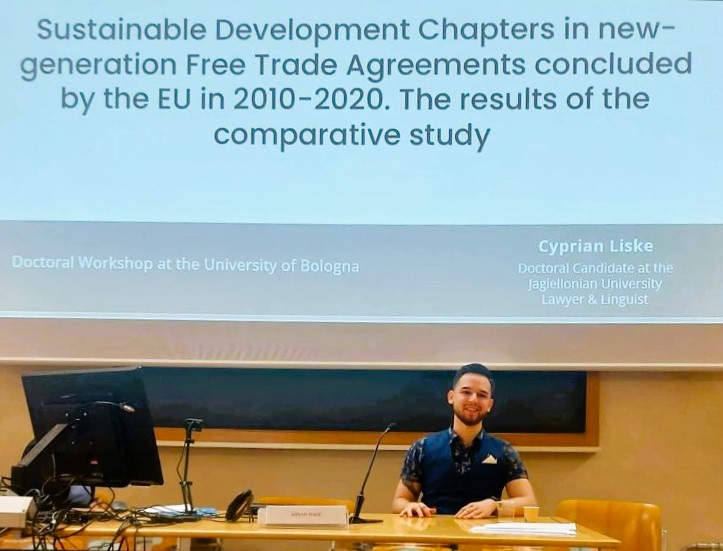
Attorney Cyprian Liske presents at the University of Bologna.
Used with permission.
"Sustainability" is the word of our times, and the European Union has more than a decade's experience building sustainability expectations into trade agreements.

At the University of Bologna in October, for a program of the Guild of European Research-Intensive Universities, doctoral candidate Cyprian Liske, my friend, colleague, and former student, presented his research on sustainable development provisions in EU trade agreements concluded from 2010 to 2020. Here is the abstract:

On 27th November 2019, Ursula von der Leyen, at that time President-elect of the European Commission, delivered a speech in the European Parliament, in which she set a concise programme for the next 5 years of her term of office. "Sustainability" was mentioned in this speech no less than 8 times. "We have to bring the world with us and this is already happening," Ms. President said. "And Phil Hogan [at that time Commissioner for trade] will ensure that our future trade agreements include a chapter on sustainable development."

Indeed, the EU has been including trade and sustainable development (TSD) chapters in new-generation trade agreements since the Free Trade Agreement with South Korea (2010). However, such TSD chapters, devoted to the realisation of the Sustainable Development Goals, including environmental protection, preventing resource depletion, or protecting workers' rights, differ substantially in agreements concluded with particular countries....

The goal of the project was to comparatively analyse TSD chapters in trade agreements concluded by the EU in 2010-2020, pointing out common elements and differences. The analysis will let us critically explore what the reasons for those differences may be (e.g., the course of negotiations, economic dependency, trade partners’ level of development) and whether the EU is consistent in its sustainability requirements set towards its trade partners. It will also allow us to depict the current tendencies in the way how such TSD chapters are shaped by the EU in comparison with the global trends. The comparative analysis of the EU TSD chapters was conducted by the researcher qualitatively and quantitatively with the use of software (MAXQDA 2022).

The research parses the interests advanced by EU agreements..
© Cyprian Liske; used with permission.
The Biden administration lately has redoubled the U.S. commitment to the developing world, announcing at a December summit, for key example, an investment of $55bn in Africa over the next three years.

Development aid is often viewed skeptically by American taxpayers. That's understandable when the homeland is plagued by homelessness and financial insecurity. Isolationism streaks run through both libertarian and conservative ideologies, evidenced lately by Republican skepticism even of aid to Ukraine. But development aid can be justified with reference simultaneously to socioeconomic benevolence and to the donor's national security, thus, appealing to priorities both liberal and conservative.

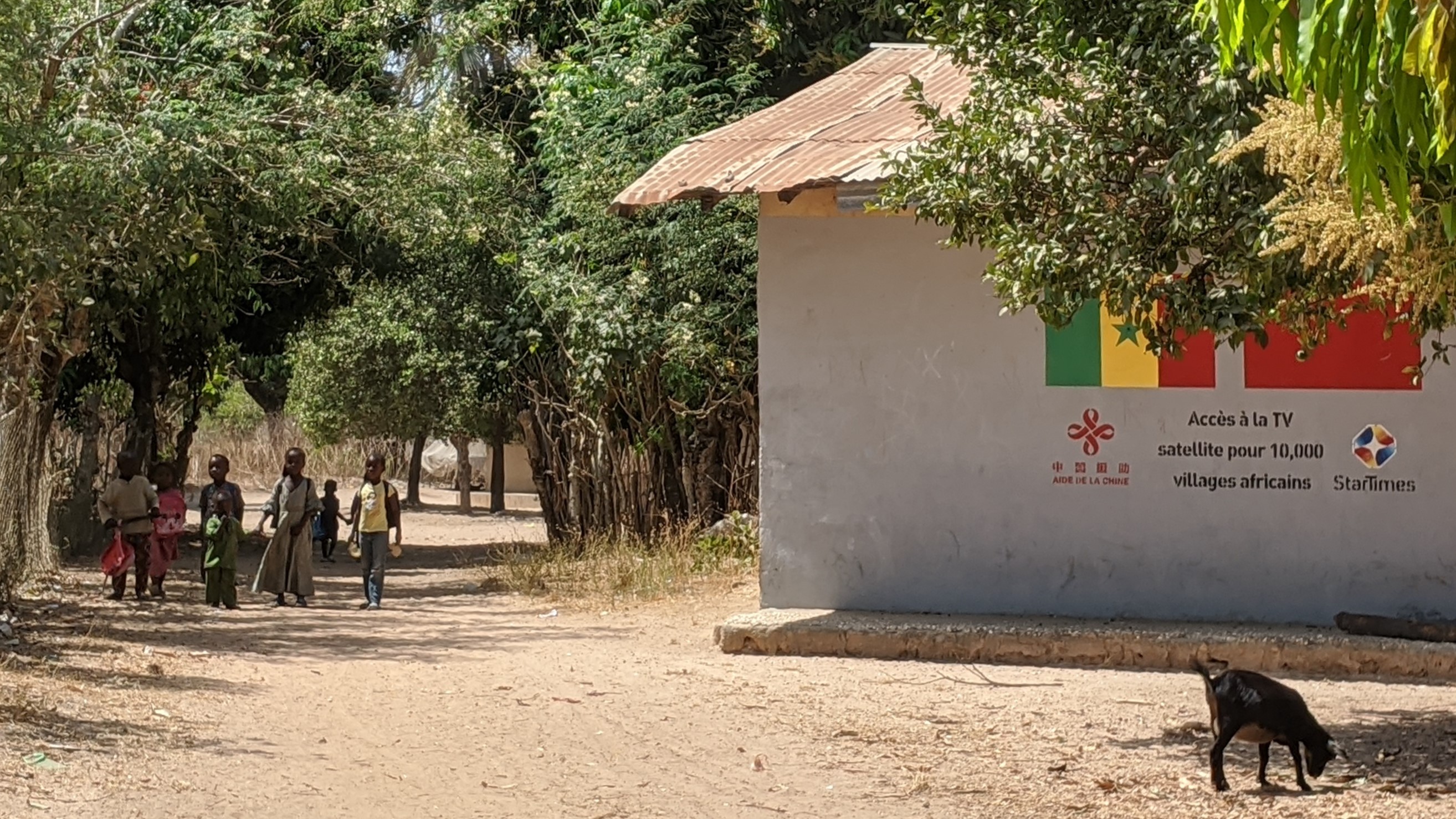
Literal signs of Chinese investment are ubiquitous throughout Africa, as here,
in the rural community
d'Oukout in the Casamance region of Senegal, 2020.
RJ Peltz-Steele CC BY-NC-SA 4.0
The United States has a lot of catching up to do. With hotly debated motive, China has invested heavily in the developing world, near and far from its borders. Chinese presence in Africa is ubiquitous, from massive infrastructure projects such as ports and bridges to telecommunication access in the remotest of villages. Russia, too, has lately gone all-in on Africa: a "charm offensive," researcher Joseph Siegle wrote last year, and "[t]he reasons aren't pretty."

Incorporating sustainable development into trade agreements allows western powers to facilitate development goals at less cost than direct investment, and even with potential gains through free trade. There's still a lower-common-denominator problem when competing against proffered Chinese and Russian agreements that attach browbeating strings only on the back end. But access to Western markets brings some incentive to the table.

A practicing lawyer and legal translator, Liske is pursuing his doctorate on the nexus between sustainable development and international trade law in the context of EU external policy. He graduated in law from Jagiellonian University and in business linguistics from the Tischner European University, both in Kraków, Poland, and both with distinction. He also is an alumnus of the American Law Program of the Columbus School of Law of the Catholic University of America, and of the English Law and Legal Methods International Summer Programme of the University of Cambridge.

Sunday, December 26, 2021

Missionaries kidnapped in Haiti reach freedom, but murky U.S. policy generally fails ransomed abductees

Haitian child in 2012 (photo by Feed My Starving Children CC BY 2.0).
News came last week that the last 12 of 17 Christian missionaries abducted for ransom in Haiti in October either escaped or were released, reports vary, and walked miles to freedom. The circumstances of their liberation raise questions about the ongoing apparent lack of any clear U.S. policy on abductions abroad.

Less well reported than the story of the missionaries, Haitian lawyer and university professor Patrice Dérénoncourt was shot and killed on October 31 by the kidnappers who abducted him in October.  Dérénoncourt taught crimonology and constitutional law in the Economic, Social and Political Sciences Department of the Université Notre-Dame d'Haiti.

Dérénoncourt and the missionaries are typical of the some 800 kidnappings in Haiti just this year. Economic desperation and political turmoil have resulted in flourishing gang violence, and kidnappers seeking ransom have targeted aid workers and the education sector, children included.  Struggling to maintain rule of law, the Haitian government has not been able to get a handle on the problem.  Foreign governments seem either habitually disinterested or similarly impotent.

In the Dérénoncourt case, some of the $900,000 ransom demanded had been paid.  It is unclear whether any ransom was paid for the missionaries.  Representatives of the families and, apparently, the U.S. government through the FBI, were involved in negotiation over kidnappers' outrageous demand for $1 million per person.  Whatever reports are accurate, and whether or not a ransom was paid or the pressure simply became untenable, I find it difficult to believe that the last 12 missionaries surmounted a concerted effort by the kidnappers to keep them.

The Biden Administration was understandably tight-lipped about how it was dealing with the kidnapping crisis while it was going on.  Now that the event is over, it's time for an open conversation about what U.S. policy should be, both with regard to kidnappings and to the social and economic catastrophe unfolding less than 700 miles from Miami.

In the broader picture, U.S. policy on abductions for ransom seems at best inconsistent and at worst incoherent.  In late October, families of Americans still detained abroad, in China, Egypt, Russia, Saudi Arabia, and Venezuela, called on the Biden Administration to do better.  "When we do meet with ... officials," the families wrote, "we feel we are being kept in the dark about what the U.S. government intends to do to free our loved ones."

The murder of an educator such as Dérénoncourt sets back rule of law in Haiti not by just one mind, but by a generation of students he would have taught.  Persistent instability in Haiti meanwhile is contributing to a burgeoning refugee crisis in the Americas and threatens to destabilize democracy in the Caribbean.  Even an isolationist American administration can ignore Haiti for only so long.

Monday, March 9, 2020

Poor development choices may bolster quality-of-life disparity on Tanzania's Msasani Peninsula

 Coco Beach, Msasani Peninsula, Dar es Salaam, Tanzania. All photos RJ Peltz-Steele CC BY-SA 4.0.


The short length of Coco Beach is the touristic gem of Tanzania's largest city, Dar es Salaam, which, for all its rugged charms, is not rich with touristic gems. Coco Beach sits on the eastern, Indian Ocean, coast of the ritzy Msasani Peninsula, just a few kilometers northwest of the CBD.

Msasani says a lot about wealth stratification in Africa. The worsening wealth gap is an issue that vexes me in the United States. But we've got nothing on many an African country. Where subsistence living is the norm, and social safety nets are nearly non-existent, the disparity between haves and have-nots gets closer at each end to all and nothing. And as on Msasani, the extremes are often abruptly juxtaposed. The peninsula is home to subsistence fishermen, and the polluted beaches of the slipway, in the west, and the luxury condominiums of posh Oyster Bay, in the east.

Luxury condo building on the road from Oyster Bay to Sea Cliff Village
I walked the peninsula from west to east and saw, in the span of just a few kilometers, ramshackle wood dwellings on potholed dirt trails without plumbing, in the west and center, and gated condo complexes with marble-esque, statued facades, in the east. While the former teemed with human life, the latter were eerily vacant, deserted of all but the occasional maintenance worker. I assume the condos are mostly second-home getaways and vacation rentals for the well-to-do in high season and on weekends. (I was reminded of the dark-windowed high rises that loom over Central Park West, New York.)

Qatar's is the most modest of the beachfront embassies.
At that, the most striking residences of the eastern Msasani are not luxury homes, but foreign embassies, including those of Qatar, Brazil, Canada, Ireland, the UAE, and Saudi Arabia. (The U.S. embassy and others are in Oyster Bay, but in the interior.) They line the main coastal road that runs between Oyster Bay and Coco Beach, which runs on northward to swank Sea Cliff Village and the Yacht Club.

Present service structures on Coco Beach, astride road construction.
At present, it isn't easy to cross this road, because a massive construction project runs all along the length of Coco Beach. I had hoped that this construction would improve the beach for touristic use that might fuel economic development to benefit the peninsula's have-nots. What passes for services on the beachfront now are wood shacks of dubious hygiene, selling drinks and snacks that might prove hazardous to foreign GI tracts. One municipal toilet building has seen better days and is now inaccessible anyway because of the construction. Alas, no, a local on the beach informed me: The purpose of the construction is to convert the shoulderless, two-lane, asphalt coast road into a four-lane highway, because, he said, the embassies want better and more secure access.

Nearly completed end of beachfront highway entering the CBD.
Many an American city can today tell tales of costly woe for having built transportation and utility infrastructure along prime waterfront property. It's bad enough that embassies, with their high, secure walls, occupy this land on the peninsula to begin with. Their inefficient use of prime real estate, distant from the administrative offices of the CBD, and in the company of Tanzania's "one percent" and cloistered ex-pats, sounds an awakward echo of colonial elitism.  To boot, now, the embassies and luxury homes will soon be served by a four-lane road that will further limit public access from the peninsula to the already underdeveloped beachfront.

Tanzania in 1974 moved its capital de jure to central Dodoma, in an effort to broaden economic opportunity in the country beyond Dar es Salaam. Nevertheless, concentration of development in Dar is still a problem that plagues the country. A businessman in the northeastern town of Arusha told me there's mounting resentment there about rural taxes paying for big-city infrastructure. (Boston says hello, western Massachusetts.) Maybe foreign nations can help Tanzania take a step forward by transferring their embassies from walled beachfront luxury to central locations with better access to government, whether Dar or Dodoma, on condition that appropriate public development of the Msasani Peninsula be left in their wake.  After all, foreign diplomatic posting is supposed to be a hardship, and it's compensated accordingly.

The new highway runs in front of the historic Ocean Road Hospital, where a street sign bears a familiar name.