Showing posts with label war. Show all posts

Monday, September 14, 2026

9/11 widow calling out U.S.-Saudi coziness highlights failure of liability regime to deliver justice

Flag from Ground Zero appears in September 11 commemoration
last week at American History Museum in Washington, D.C.

G. Edward Johnson via Wikimedia Commons CC BY 4.0
"Tell the Saudis to stop lying," a September 11 widow told the 25th annual memorial gathering in New York City on Friday.

Terry Strada is the widow of Thomas S. Strada, a father of three and Cantor Fitzgerald bond broker killed in the terrorist attack on September 11, 2001. She broke the tradition of exclusively apolitical statements at the annual memorial. But she drew applause from the crowd and shamed the assembly of every living former President and the current Vice President, who were there.

Here's more of what Strada had to say, from The Hill:

"For 25 years, administration after administration, including leaders in front of us here today, chose to protect the Saudis instead of standing with the 9/11 families," she said. 

"They withheld evidence," Strada continued. "They vetoed JASTA [Justice Against Sponsors of Terrorism Act]. They broke promises, both public and private. It has been one betrayal after another."

"Tell them that if they want to be friends with the USA, they cannot continue to deny all of this, all of the pain, all of the destruction that we have all been suffering through," Strada said.

The Guardian has further coverage. 

There's no disputing Strada's facts. Twenty-eight pages of the 2002 congressional report on 9/11 were redacted for 14 years and did show possible ties, though nothing definitive, between Saudi officials and 9/11 hijackers. Many 9/11 records, including parts of the 2002 report, remain classified and have dribbled out over the years, including daily presidential briefings released just last week. Tim Burke at the Freedom of the Press Foundation has more on the latest. The City of New York also dumped a document trove into sunlight last week, including revelations of especial interest to first responders showing what officials knew about dangerous air quality.

Both Bush and Obama administrations tried to protect the Kingdom of Saudi Arabia (KSA) from accusations of 9/11 responsibility. The United States is not dependent on Saudi oil. But the White House saw, and still sees, KSA as an essential diplomatic and military partner in Middle East security.

In 2016, President Obama did veto JASTA. Congress overrode the veto five days later. The law waives foreign sovereign immunity in civil claims against foreign governments that aid and abet terrorism, whether with action or with money. 

Legislators were not so noble as it might seem. They knew well that JASTA claims would be next to impossible to prove against KSA, especially while 9/11 intelligence remained classified. So JASTA was really symbolic, something to boast about back home in the district. September 11 families would be pacified for a time while preoccupied with the bureaucracy of civil litigation.

Even if JASTA plaintiffs could obtain evidence, they would have a hard time ever proving a causal chain from the Saudi state to the 9/11 attacks. KSA might have ignored warning signs—so did the United States—but was hardly looking to destabilize geopolitics and send energy demand into free fall.

Indeed, since 2016, no JASTA suit has gained serious traction. A much touted suit against Israel in 2017 has gone nowhere and certainly has not been a deterrent to Israeli warfare. Iran has not even defended against JASTA suits and has suffered default judgments. That just moves plaintiffs into enforcement actions in the United States, in which they've been profoundly unsuccessful. Administrations of both parties have intervened against the plaintiffs, preferring that the government control Iranian assets to use them for diplomatic leverage.

The determination of Strada and other JASTA plaintiffs despite long odds, dim enforcement prospects, and opposition of their own government is a stirring reminder of the manifold purposes of tort law, or civil dispute resolution more generally. The U.S. tort system tends to emphasize, usually to a fault, the aim of compensation. But most 9/11 plaintiffs have received some compensation already from the federal victim compensation find.

Rather, plaintiffs in many types of cases, and especially in wrongful death, are usually after something else entirely. No amount of money can bring back a loved one. But justice is a relentless motivator.

Nevertheless, the law never has favored compensation for plaintiffs in U.S. courts for matters implicating foreign affairs. The preference is partly structural. The Constitution provides roles for both the executive and legislature in foreign policy. Congress often has abdicated, justifiably and not. But foreign policy in any event was always to be policy, by design, a matter of distributive justice for the political branches, not a problem in corrective justice for the courts. 

The preference also is political and is less defensible in that vein. As money became the lingua franca of Washington especially in the post-World War 20th century, policymakers became reluctant to trust courts, much less civil complainants, with regulatory influence over powerful and wealthy actors. In other words, the grubby hands of the unwashed masses must not be allowed to derail the gravy trains of the elite. The distaste for civil complainants against states supporting terrorism is a cousin, and not even a distant one, of the reluctance to create private causes of action in civil rights and consumer protection. 

In an outcome under-reported by mass media amid the usual flurry of Supreme Court opinions late in the last term, in Cisco Systems, Inc. v. Doe, in June, the Court disallowed a lawsuit accusing a U.S. corporation of knowingly developing technology for the Chinese government to facilitate the identification, arrest, and torture of members of the Falun Gong spiritual movement. The Court ruled out both corporate liability under the 1789 Alien Tort Statute (ATS) and aiding-and-abetting liability under the Torture Victim Protection Act (TVPA), appended to the ATS in 1991.

Both conclusions are debatable on the merits; the Court ruled 6-3. But more significant is the problem that remains: whether, or when and how, transnational actors can be held accountable in the United States for their complicity in human rights violations abroad.

As the United States has sought to eschew judicial involvement in foreign matters, other nations and the international legal system have been trying to step up. There is needed and dawning recognition around the world that transnational actors, public and private, have for too long been permitted to operate above the law. From Big Oil in South America, to Big Ag in Africa, to Russia in the former SSRs, the supposed rule of law has failed to stop bad actors from literally getting away with murder.

Which brings us back to KSA. To be fair to the past presidents, the United States always has been in a tough spot with the Saudis.

KSA seems to enjoy impunity in the murder of Jamal Khashoggi, oppression of dissidents at home and abroad, dubious policies on gender and sexual orientation equality, religious freedom, and immigrant labor, and financing war in Syria and Yemen. I'm not saying all such Saudi policies are indefensible, and I'm not letting the United States off the hook for its own issues. I mean only that there seems to be no official inquiry at all; other nations fairly accuse the United States of a double standard. 

The pandering of Bush, Obama, Biden, and Trump to Saudi royals is perennially stomach-churning. Western politicians will smile and abide when KSA hosts the 2034 FIFA World Cup, just as they abided Saudi acquisition of LIV Golf (until this year), Newcastle United, and Electronic Arts. And the United States is moving forward (probably) on an agreement to share nuclear technology with KSA for, one hopes, only civilian applications. 

And no wonder. The United States and KSA continue to rely mutually on strategic alliance for security interests in the Middle East. Meanwhile, Trump and allies, including son-in-law Jared Kushner, are profiting handsomely from Saudi investments.

One might wonder whether a time will come to pay the piper. Late last week, KSA grew frustrated as Iran-backed Houthi rebels seized from Saudi-financed government forces the entire Red Sea coast of Yemen. The Houthis thus gained control—this might sound familiar—of a vital strait and key islands in the transit of oil.

About the same time, KSA suffered a drone attack on its East-West oil pipeline. The massive conduit, stretching 1,200 km (746 miles), vital in the best of times, is a critical overland bypass to the Strait of Hormuz. The attack came from Iraqi territory, but almost certainly was the work of Iran-backed forces, and the timing dovetailed with the Houthi advance. The pipeline is shut down now for damage and risk assessment. I hope you filled your gas tank over the weekend.

In the wake of this one-two punch, reports say that Crown Prince Mohammed bin Salman (MBS) himself—whom you might remember from such hits as the Khashoggi dismemberment and Biden fist bump—asked the White House to intervene militarily against the Houthis. Middle East commentator Professor James M. Dorsey observed analogously seven years ago: "The Saudis do not want an open conflict with Iran. The Saudis would like others to fight that war, and the others are reluctant."

Whether or not Trump personally felt inclined to oblige in Yemen, U.S. military resources happen to be running thin. And Republicans campaigning for midterm election would go into full meltdown if the country were to go to war on a second front.

So the President had to let down his Riyadh chum, but did pledge to send 200 military advisers to beef up intelligence sharing. Why does that also sound familiar (inflation since 128 in 1950)? Well, don't worry, the President said. He had a call with MBS, and "everything's going to work out fine and dandy. It's going to be very good."

A deepening Saudi alliance, a merely symbolic JASTA, and a neutered ATS: Seems to me that the United States is succumbing to sycophancy as its place in the new world oligarchy.

Wednesday, December 4, 2024

Demonstrators in Poland support Ukrainian POWs


The war in Ukraine drags on, but central European resolve against Putin remains firm.

Last week in Kraków, Poland, the main square, Rynek Główny, was packed with Poles and foreign tourists in the days before the Christmas Market's weekend opening. Even amid the festive atmosphere, a small group of demonstrators held flags and spoke through amplifiers about the war in Ukraine and demanded the release of prisoners of war. Passersby were supportive, and some paused to listen (though the speaker spoke Ukrainian rather than Polish when I went by) and to look at the faces of POWs and MIA.

Poles have been unwavering in support of Ukraine. Polish history engenders empathy with victims of Russian oppression. And there's the simple benefit of having at least one friendly neighbor to the east. Poland's Baltic Sea border abuts Russia's Kaliningrad Oblast, and Poland has been besieged by passive-aggressive threats on its eastern border with Belarus.

Unfortunately for Krakovians, especially university students such as mine last week, the influx of Ukrainian refugees drove up the price of housing. Refugee populations have evened out, but, as these things go, housing prices have remained high. That's been a drag on university enrollment: just one more small way that the war burdens the region.

Image by RJ Peltz-Steele CC BY-NC-SA 4.0.

Tuesday, September 24, 2024

Remembering peaceful times in Tyre

I'm saddened by the expansion of the war in the Middle East into Lebanon upon yesterday's attacks by Israel on Hezbollah. To be clear, I'm not (here and now) meaning to make a political statement nor favor a side. Rather, I am remembering time I spent in the south of Lebanon and praying for the safety of civilians I met there. In contrast with the latest images from Tyre (Reuters), I took this photo of kids playing at the Tyre Coast Nature Reserve in May of 2018. I wonder where these boys are now, as thousands flee the south of Lebanon for Beirut and points north. Photo by RJ Peltz-Steele CC BY-NC-SA 4.0.

Tuesday, September 3, 2024

Contemporary sculpturist comments on Ukraine war

Lakenen considers the war in Ukraine in this 2022 sculpture.
A couple of weeks ago, I visited artist Tom Lakenen's Lakenenland, a sculpture park in the Marquette area of Michigan's Upper Peninsula.

I'm a sucker for an outdoor art installation, and Lakenen's work does not disappoint. I only had a couple of hours, but I could have spent the day exploring the inviting woodsy trails.

Composed of "junk," Lakenen's art in its very existence speaks to capitalist materialism and environmental sustainability. About and even besides such themes, Lakenen has a lot to say, and much of it resonates with the ordinary American, especially in terms of economic frustrations. I could not help but notice that vehicles in the parking lot boasted bumper stickers of both "red" and "blue" American political extremes. But insofar as any visitors expressed outrage, it was along with the artist, not at him.

Lakenen is always adding new pieces. I was especially moved by his 2022 work on the war in Ukraine. Above and below, I share some images of that piece. I thank Tom Lakenen for sharing his art with visitors. All photos by RJ Peltz-Steele CC BY-NC-SA 4.0, with no claim to underlying sculptural works, presumed © Tom Lakenen.


Thursday, August 1, 2024

Rule of law seems absent, western powers impassive, as civil war inflicts horrific suffering in Sudan

I know it's hipster hot right now to be up in arms over Gaza and lukewarm over Ukraine. I'd like for a moment to set aside both those conflicts and ask for your consideration of Sudan.

I've written previously about Sudan, from the time of development optimism that was dashed and broken by catastrophic civil war. I was enamored of the country and its people upon visiting there in 2020, and I watched the war unfold with profound sadness.

The war in Sudan rages on, so long since its April 2023 eruption that even I back-burnered it among my conscious anxieties in recent months. It was brought to the front again when I read a Friday story from NPR: Why Sudan Is Being Called a "Humanitarian Desert," by Fatma Tanis.

The story relates a report from Doctors Without Borders: "The report states that bombing and shelling of civilian areas killed thousands of people, including women and children. Civilians were consistently attacked and killed by armed groups in their own homes, at checkpoints, along displacement routes and even in hospitals and clinics."

Horrifyingly, "'a characteristic feature' of the war, the report states ... that women and girls were raped in their homes and along displacement routes. Of 135 survivors of sexual violence who were interviewed by MSF, 40% said they were assaulted by multiple attackers."

Democrats and (too many) Republicans disagree over support of Ukraine. The Republican platform specifically references Israel, and Ukraine's omission is contentiously purposive. The draft Democrat platform for 2024 mentions Israel, Ukraine, and Sudan. American involvement in the latter context looks limited to the present "Special Envoy," charged with making peace, along with a more nebulous commitment to support Africa in solving its own problems. 

I'm reminded of an exercise in university journalism class in which we examined the newspaper column-inches (these were the days of actual newspapers) afforded to global crisis reporting to witness the greater-than-linear, inverse relationship with distance from the United States. Yet, as one might have noted then, too, Khartoum is not that much farther from Washington than Tel Aviv and Kyiv.

Is our commitment to the people of Sudan sufficient? I don't purport to know what the policy of "the most developed nations" should be concerning civil war in Sudan. I do worry that prioritizing international conflicts based on strategic imperatives while paying little more than lip service to our values sends the wrong message to aggressors in a world in which nations, including the United States, are ever more inextricably interdependent.

Monday, February 19, 2024

Kyiv law school strives for normalcy

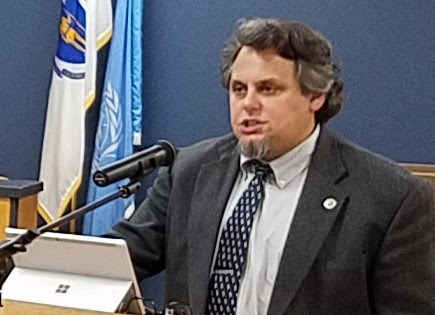
The dean of a Kyiv, Ukraine, law school spoke to American Bar Association (ABA) lawyers Thursday via Zoom about teaching law in a war zone.

I once had a class halted by a (false) fire alarm. That was a hassle.

I've never had a class disrupted by an alarm warning of an incoming hypersonic missile.

Dean Volodymyr Venher
Zoom, Feb. 15, 2024
Volodymyr Venher has. He's dean of the law school at the National University of Kyiv-Mohyla Academy (KMA). Alarms happen once or twice a week, he told the ABA Seasoned Lawyers Interest Network. Russian attacks target civilian infrastructure.

"Sometimes it's really scary," Venher said.

Kyiv has a protective barrier that includes U.S. Patriot missiles, Venher said. But some Russian missiles get through. Two weeks ago, he said, a missile struck 300 meters from his apartment. He lives on the 11th floor, and the building shook, loosening bricks and concrete.

A KMA professor in biology was killed at her home in January.

Kyiv has it a little worse than Lviv, which sees fewer missile attacks, Dean Venher said. But Kyiv is "paradise," Venher said, compared with Kharkiv, where Russia has targeted universities.

This missile attack on a residential complex in 2023 killed five.
State Emergency Service of Ukraine via Wikimedia Commons CC BY 4.0

Faculty and students at KMA Law carry on. Venher said that to endure the constant threat of war, it helps to maintain some semblance of normalcy. His law school ceased operation for only one month, he said, in March 2022. Classes resumed online in April and in hybrid form for the start of a new academic year in September 2022.

Naturally the school was worried about what enrollment would look like. But students wanted normalcy, too. Of an admitted class of 120 in fall 2022, 110 turned up in person to start the year, Venher said. There are occasional setbacks in loss of electricity and internet outages. The internet problem was solved when the school bought two Starlink subscriptions, Venher said.

KMA, 2009
Роман Днепр via Wikimedia Commons CC BY-SA 3.0
Law faculty try to continue both their teaching and research, Venher said. Many focus their work on what it will take to rebuild Ukraine after the war. Some focus on humanitarian needs. Some, including Venher, focus on the law of war and problems of accountability.

There is a mental toll. After missile strikes, one can see people's unhappiness, Venher said. Many people are afflicted with depression and survivor guilt.

"The human brain can adapt to anything," Venher said. "We hope for a better future."

KMA Law is keen to connect with partners abroad. Connecting electronically with the outside world helps to keep spirits up and maintains a status quo ante, a connectedness that would have been ordinary before the war. Venher said that the school welcomes even opportunities for law students to practice speaking English with their counterparts elsewhere. The school is keen too for faculty to find opportunities to present research and expertise.

The school also welcomes resources. A French benefactor recently donated a collection of law books, and the school could use more legal resources in English and French. Under the circumstances, the school cannot afford pricey legal database subscriptions, Venher explained. So students and researchers are more dependent than usual on hardcopy resources.

The school website provides guidance on financial contributions.

This story was updated on Feb. 19 at 9:30 a.m. when I confirmed the death of KMA Prof. Lyudmyla Shevtsova.

Tuesday, January 16, 2024

Western myopia marginalizes war in Sudan, Ecuador

My prayers, especially over the recent holidays, have admittedly felt cliché, if not comical, being dominated by desire for "world peace."

In case Ricky Gervais is right and prayer works like a democratic election (jk; it doesn't), I've focused on the conflicts of the world that my otherwise-trusted David Muir & co., reporting on Israel and Ukraine, seem quick to forget: Sudan and Ecuador.

I've written previously about Sudan (Apr. 2023, Sept. 2023). The New York Times in December reported a death toll in excess of 10,000 and displaced persons rounding 6 million. My friend from Khartoum remains safe abroad, but it looks increasingly like there will be nothing to come home to. I just read in Christianity Today that hospitals have been targeted and destroyed by the warring generals in the unscrupulous scorched-earth struggle.

I'm the last to rush to judgment with the r-word, but is there another explanation for seeming western indifference to this ongoing tragedy?

And then there's Ecuador, which in recent weeks also has entered a chaotic kind of civil war. It's a country dear to me for personal history there, but also of professional interest for fascinating and groundbreaking developments in constitutional law in recent years.

The Daniel Noboa Administration declared war on organized crime after drug lords were broken out of prison, almost certainly with the help of corrupt insiders. As Noboa cracked down, the country was besieged by retaliatory violence, especially in the Guayaquil Canton.

Efforts to remedy the desperate situation are closely related to the social and economic prosperity Ecuador experienced in recent decades. Ecotourism, again especially in Guayaquil, an access point for the Galápagos, had been an engine of economic and social development, precipitating recognition of rights of indigenous people and of nature with which the nation's courts were experimenting.

When I was last in Guayaquil about a dozen years ago, it was safe enough to walk around, for me, at least, by day. Security and the economy were on the upswing. On January 9, 2024, in contrast, the world was horrified to see armed terrorists, some of them teenagers, holding guns to the heads of journalists in a Guayaquil news station broadcasting live. My friend Ugo Stornaiolo Silva, an Ecuadorean lawyer living and working in Poland, reports that his family in Ecuador is safe, but the hatches are battened down. Domestic travel is out of the question.

Elected only in November 2023, Noboa promised to get a grip on drug trafficking and restore the rule of law. In a sense, then, the present violence is a promising sign of a much needed reckoning. Yet it remains to be seen whether the cause is winnable. Observers predict a bloody road ahead, or maybe worse if Noboa wavers in his resolve.

Ecuador's problem is part of the wider narrative of drug trafficking and human migration through Colombia and Central America, driven by the wealth, demand, and relative opportunities of the United States. America's backyard is declining into a mega-narco-state, while neither of our only choices of political party has demonstrated the will or ability to tackle the problem even in its domestic dimension.

Say what you will about China, the PRC recognizes that stability in its neighborhood is essential to the country's own national security. The means to the ends of course are problematic, exemplified by Nauru's recent change of alignment from Taiwan to China. But that matter again demonstrates the ascendancy of Chinese foreign policy over America's apparent appetite for isolationism.

Pray for world peace, as a spiritual matter. Know that it will only happen with American commitment, as a political matter.

*     *     *

As often happens in the course of the school year, my personal blogging in the fall semester had to yield to professional workload. I have been logging matters I'm eager to share and will endeavor to catch up in the coming months.

Monday, September 25, 2023

Armenia, Azerbaijan maintain tentative ceasefire

Yerevan, Armenia: Opera House at center.
RJ Peltz-Steele CC BY-NC-SA 4.0
At the time of this writing, an uneasy but long sought peace is holding in the Armenia-Azerbaijan conflict over the Nagorno-Karabakh region.

Reuters has a good overview of the current situation. The history of the conflict, dating to the Soviet era, defies succinct explication. Suffice to say, hard feelings run deep. It's the kind of conflict that claims the lives of soldiers who were born after it started, the kind of intractable tit for tat that has run so long, no one remembers, as if it would matter, who inflicted the first insult.

Baku, Azerbaijan: me in my happy place.
RJ Peltz-Steele CC BY-NC-SA 4.0
In an offensive last week, Azerbaijan gained control of disputed territory it had possessed on paper but not on the ground. A deal was struck to trade the surrender of separatists for the peaceable integration of ethnic Armenians into Azerbaijan. Still, the peace has been tested by skirmishes and allegations of human rights violations. Armenian and Azerbaijani authorities have traded accusations and threats. Presently, the ceasefire is holding. But ethnic Armenians untrusting of Azerbaijan's pledge or unwilling to be integrated are migrating by the thousands from the disputed region to Armenia.

Armenian flag, near Yerevan
RJ Peltz-Steele CC BY-NC-SA 4.0
I visited both Armenia and Azerbaijan in the spring. I met young veterans on both sides. Some had fared all right with lighter duties. Many had seen hot conflict and bore scars both physical and emotional.

What saddened me most was how much the vets were the same on both sides: good young people whose lives had been upended. They believed in their causes, but could scarcely cite a motivation besides a string of offenses of the other. A few even acknowledged that they saw themselves across the front lines and felt remorse for being thrust into conflict with people their own age, as foreign to the origins of the war as they were. Vets on both sides spoke of their families' fears for their safety and their own fears that if they have children, they will be drafted into the same cycle of war.

Azerbaijani flag, Baku
RJ Peltz-Steele CC BY-NC-SA 4.0
At risk of oversimplifying the conflict with an outsider's lamentation on the futility of it all, how could I not wonder at the opportunity cost in so much energy and so many lives, and at whether or why a political solution cannot be found to end the fear and sacrifice.

I enjoyed my time in both countries immensely. Both countries boast stunning sights, from Armenia's extraordinary Matenadaran, a library of ancient manuscripts in Yerevan (reminding me of my beloved Old Library at Trinity Dublin), and ancient Temple of Garni, to Azerbaijan's Ateshgah Fire Temple and towering Bibi-Heybat Mosque.

RJ Peltz-Steele
CC BY-NC-SA 4.0
In Providence, Rhode Island, this weekend—not meaning to choose sides, but seizing an opportunity—my wife and I went to Armenia Fest RI, where the ex-pat and ethnic Armenian community put on a fabulous celebration of food, music, and culture. The event, on Armenia Street aside the Sts. Vartanantz Armenian Apostolic Church, was well attended despite a pouring rain. Here are some images (RJ Peltz-Steele CC BY-NC-SA 4.0), savory and sweet.


Tuesday, August 29, 2023

Russians travel in Asia despite, or because of, war

An Aeroflot plane awaits departure in Almaty, Kazakhstan,
earlier this month. EU and U.S. sanctions banned the airline in 2022.

RJ Peltz-Steele CC BY-NC-SA 4.0
A joke, belatedly to honor Ukraine Independence Day, August 24.

This summer, traveling in the Caucasus and Central Asia, I crossed a lot of borders. Sometimes back and across again.

I also met a lot of Russians. Most often, we exchanged pleasantries, as if there were nothing going on in the wider world. I didn't want to ask, and they seemed content not to talk about it.

I did meet a number of Russian men who had fled conscription. One fellow, late 20s I estimate, in a craft-beer bar in Bishkek, the capital of Kyrgyzstan, was especially warm company. We never talked directly about Putin's position on Ukraine. But he made clear that he believed Russia's war adventure is socially and economically disastrous for ordinary Russians at home.

Anyway, my friends and I grew accustomed to the questions asked by immigration officials with limited English.

Usually, the border officer asked,

"Occupation?"

"No," a Russian traveler answered.

"Just visiting."

Tuesday, April 25, 2023

Polisci papers track Ukraine war to Arctic, UN, internet

The war in Ukraine occasioned several papers at last weekend's annual meeting of the New England Political Science Association (NEPSA) in Mystic, Connecticut.

The NEPSA meeting offers an outstanding opportunity to preview cutting edge research presented in a low-stakes and supportive setting. Long-time NEPSA Executive Director Steven Lichtman, a professor of political science at Shippensburg University, is the brilliant maestro, setting the right collegial tone while supervising a rigorous selection process that guarantees top-shelf work.

Rotating location in New England states, NEPSA has become one of those regional conferences that is so highly regarded as to draw participation from across the country and from neighboring disciplines including law. The program is open to faculty and graduate students; law students of mine have participated in the past. This year the program opened two panels to undergraduate researchers. An extremely selective submission process yielded undergraduate presenters fully capable of going toe to toe with working scholars.

Prof. Steven Lichtman, 2016
RJ Peltz-Steele CC BY-NC-SA 4.0
There is scarcely a corner of politics and its study not being reshaped by the war in Ukraine. So it's no surprise that the war motivated many of the papers at this year's NEPSA. For all that I learned from myriad presenters, I thought I might share just a taste of takeaways related to the war.

★

A Ph.D. candidate at the University of New Hampshire (UNH), Tim Hoheneder is thinking about the effect of the Ukraine war on Arctic politics. He explained that Russia assumed the rotating chair of the eight-state Arctic Council just before the full-scale invasion of Ukraine. The United States said it would not participate on the council during the term of the Russian chair, which ends this summer, in 2023. The United States did say it would continue to work bilaterally with other states on Arctic issues.

Now what will become of the council is up in the air. Major issues affecting global security, involving nuclear proliferation, militarization, indigenous rights, and climate change, hang in uncertainty. Hoheneder's paper is "Science Diplomacy as a Neofunctionalist Tool in a Post-Ukrainian Invasion Arctic."

★

A master's student at UNH, Sarah DeSimone is considering how the U.N. Security Council might be made functional since the Russian veto has neutralized any meaningful response to the war. She explained both the long history of attempted Security Council reform and the recent history of failed resolutions on Ukraine. 

The only reform to the Security Council to gain traction has been the recent Liechtenstein "Veto Initiative," DeSimone explained. The initiative modestly would require that a council state explain a veto. DeSimone voiced support for an amalgam of proposals that have been floated before: First, the veto should be prohibited in matters of genocide, human rights violations, and serious violations of international law. Second, in conjunction with the prohibition, an oversight mechanism should preclude countries from voting on matters in which they are directly concerned. 

Without Security Council reform, DeSimone warned, lack of credibility will render the United Nations "obsolete." DeSimone's paper is "Reforms to the Security Council: Salvaging the Liberal World Order by Examining the Crisis in Ukraine."

★

A senior at Providence College and editor-in-chief of the student newspaper, The Cowl, Sarah McLaughlin spent 46 unenviable days immersed in a Russian social media image board, Dvach (Двач). Her findings are fascinating. She discovered a world of hyper-masculine Russian nationalists almost as disgusted with Vladimir Putin as they are with Ukraine. The community evinces nostalgia for a perceived past of conservative values and faults Putin for not living up to anti-western and anti-liberal values. The community opposes the war in Ukraine and the mobilization of Russians to support it, even as participants depict the idealized Russian man as strong, hardworking, and dutiful to country. Animals, especially pigs and monkeys, represent Ukrainians, women, and Putin in demeaning memes.

McLaughlin's paper is "Russia the Bear, Putin the Pig: Russian Nationalism and the Imagined Community of Memes."

 ✪

NEPSA's next annual meeting is slated for spring 2024 in Newport, R.I.  Look for a call for papers by September with a December 2023 deadline.

Wednesday, April 19, 2023

Fighting shatters peace, rips at progress in Sudan

"Our tea lady" and me in Khartoum, November 2020.
RJ Peltz-Steele CC BY-NC-SA 4.0
I'm saddened by the outbreak of conflict in Sudan, threatening to set the country back decades in development and economic opportunity.

As I wrote in 2020, Sudan was on a promising trajectory for peace and normalization of relations with the United States. The Trump Administration settled tort litigation over the 1998 East Africa embassy bombings; the attackers were alleged to have planned the operation from Sudan. And in December 2020, after a secular legal reform, Sudan was at last removed from the U.S. list of state sponsors of terrorism. The State Department instructed that U.S. businesses could again trade there, cautioning only that state-owned Sudanese companies ought be regarded warily, as corruption remained a problem.

I was in Sudan in November 2020, and the people bore a palpable optimism. Khartoum was littered with the worn and abandoned husks of American enterprises, such as KFC, and there was expectation that they would come back to life soon. One could imagine that the ruddy cola sold in glass bottles bearing Arabic script might give way to authentic Coca-Cola, for better and worse. From an eager local entrepreneur, I bought ground Sudanese coffee in haute paper packaging printed in anticipation of a new market for exports.

Now military factions are fighting in the streets of Khartoum. Civilian sites, including hospitals and the airport, are under fire. Ordinary people, struggling with food insecurity and climate-change-related dust storms and flooding in the best of times, are caught in the middle.

My associates and I in Khartoum frequented "our tea lady," who ran a thriving street business near a hospital entrance. With unfailing cheer, she brewed tea and fried snacks over hot coals for healthcare workers and passersby. On the sidewalk, she carved out an unexpectedly welcoming space amid the chaos and grime of the city. In a makeshift circle of motley seating on plastic stools and buckets, people from different walks of life and all corners of the world paused, chattered, and laughed.

I hope our tea lady is safe.

Saturday, March 25, 2023

Weapon of Putin's war, anti-gay law jars NHL in US

The NHL Chicago Blackhawks Sunday will host an annual Pride Night, but the team will not be wearing warm-up pride jerseys as intended, for fear of jeopardizing the safety of Russian players and their families.

Yesterday I got to talk about the story with Sasha-Ann Simons of Reset on WBEZ Chicago Public Radio. You can hear the segment online. HT @ ace producer Micah Yason.

WBEZ sports contributor Cheryl-Raye Stout related the facts and layered some nuance on the story. She expressed concern that Blackhawks staff had not consulted their three Russian players. In a Philadelphia Flyers case in January, a player refused to wear a pride jersey, citing his Russian Orthodox religion. It's unclear where the Russian Blackhawks stand.

No one disputes, though, that wearing the jerseys might be problematic for the players as a matter of Russian law and policy. In December 2022, Russia doubled down on the 10-year-old anti-gay law that was a source of controversy during the 2014 Sochi Olympics and the 2018 FIFA men's World Cup.

Under international pressure, Russia was permissive in enforcement of the law during those tournaments. But the failure of the International Olympic Committee and FIFA to reconcile their bold anti-discrimination rhetoric with host-country legal jeopardy for athletes and fans was a bad look and did no favors for human rights. More or less the same drama just played out again with the FIFA World Cup in the fall in Qatar, where homosexual acts are criminalized.

As enacted in 2013, the Russian law imposes civil fines on persons and business, and detention and deportation for foreigners, who engage in "propaganda" promoting same-sex relationships. Propaganda, though, really means any representation of social acceptability, including even the rainbow flag.

The law was enacted as a child protection measure and referred only to expression to children, though that scope encompassed mass media. In 2022, President Putin signed into law an amendment to broaden the law to cover expression to any person, child or adult, and to make plain that trans representations are prohibited, too.

Russian refugees march in New York in 2013.
Bosc d'Anjou via Flickr (CC BY-NC-SA 2.0)
Thus, a Russian athlete photographed wearing a pride jersey in America might face legal repercussions upon returning home. But the risk is really much greater than just civil fines, I explained to Simons on Reset. Informally, the law has signaled indifference by Russian authorities to brutal violence inflicted on LGBTQ persons, or even persons suspected of being LGBTQ, by vigilantes, if not law enforcement. An athlete abroad fairly might fear such reprisal upon returning home, or fear for her or his family meanwhile.

One thing I did not get to say on Reset, that I think is important, is that Putin's expansion of the anti-gay law is complementary of his war in Ukraine, because he perceives both as integral to preserving Russian identity against Western acculturation. Foreign Policy called the issues two sides of the same coin, and Putin has spoken of Western territorial aggression and social policy in the same breath. Doubling down on the anti-gay law in December was calculated as just another salvo in the war. That means, if Brittney Griner were not warning enough, that Putin is prepared to weaponize the law.

Robbie Rogers, 2013
Noah Salzman via Wikimedia Commons CC BY-SA 3.0
Our Reset discussion touched on other related matters, such as the Iranian side's protest at the Qatar World Cup, which I wrote about here in November and spoke about in Poland. I've written previously on the World Cup and sexual equality (with Jose Benavides), the World Cup and human rights, and football and development. 

A paucity of representation in top-flight world sport indicates that laws such as those in Russia and Qatar are hardly the only source of hostility toward LGBTQ athletes. In 2022, in the run-up to the men's World Cup, there was only one openly gay international footballer, and he didn't make the final cut for Australia's squad in Qatar. (There are openly lesbian players in women's world football.)

A good read in this area is Coming Out to Play (2014), an autobiography by Robbie Rogers, co-authored with Eric Marcus. An American and a Christian, Rogers played for Leeds United in the UK and for the U.S. Men's National Team. In 2013, he publicly disclosed that he is gay at the same time he announced his retirement from football, though he returned to the sport to play for four more years with the LA Galaxy in the U.S. MLS.

Monday, February 27, 2023

Program to examine Genocide Convention, Ukraine

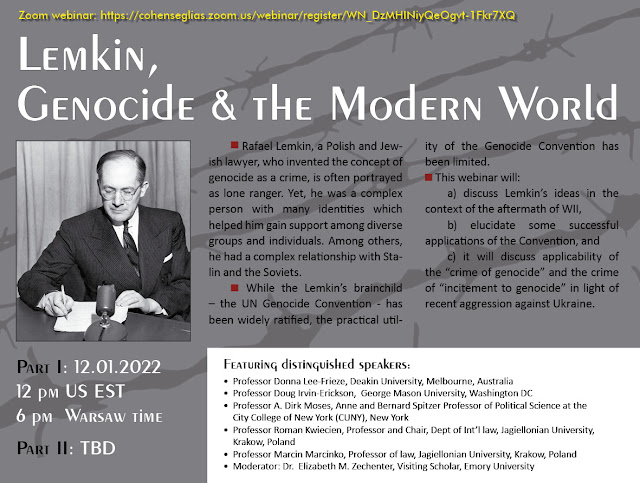
The Jagiellonian Law Society has announced a follow-up seminar, on March 14, 2023, on the subject of Polish-Jewish attorney Rafał Lemkin, his role in creating the UN Genocide Convention, and the relevance of Lemkin and the convention to the war in Ukraine.

In a previous seminar in December, speakers detailed the historical context of Lemkin's life and work. A featured guest in the March program will be the Hon. Stephen J. Rapp, U.S. ambassador-at-large for global criminal justice from 2009 to 2015, and more recently a visiting fellow of practice at the Blavatnik School of Government, University of Oxford.

Here is the program description and information about registration, free but required, CLE credit available, from the Jagiellonian Law Society.

We would like to invite you to another webinar on Raphael Lemkin, Genocide, and the Modern World, keynoted by Ambassador Stephen J. Rapp and featuring distinguished international faculty!

Rafał (or Raphael) Lemkin was a Polish Jewish lawyer best known for coining the term "genocide" and a key person behind the UN Genocide Convention. For that work, he was twice nominated for the Nobel Peace Prize. On the 50th anniversary of the Convention entering into force, Lemkin was honored by the UN Secretary-General as an inspiring example of moral engagement.

The upcoming seminar is the second part of the webinar series discussing the crime of "genocide" and its applicability to the current events in Ukraine and beyond. We will discuss whether Lemkin’s ideas are helpful in the prosecution of mass murders and other crimes aimed at eliminating or erasing entire groups of people. We will also address the likelihood of a successful prosecution of atrocities committed in Ukraine, be it as "war crimes," "crimes against humanity," or a "crime of aggression," via either international or national courts or via special tribunals.

The webinar is presented by the Jagiellonian Law Society with support from the Kosciuszko Foundation and co-sponsored by many organizations, among them ABA, NYSBA, UBA, NJSBA, etc.  It is free and open to the public. Spots are limited. Registration is required.

We are honored and proud to announce that Ambassador Stephen J. Rapp, the United States Ambassador-at-Large for Global Criminal Justice, will be our keynote speaker, and we are honored and delighted to present to you our most distinguished international Faculty:

  • Professor Agnieszka Bieńczyk-Missala, Professor in Political Sciences at the University of Warsaw
  • Prosecutor Thomas Hannis, former lead prosecutor, UN International Criminal Tribunal Yugoslavia
  • Professor A. Dirk Moses, Anne and Bernard Spitzer Professor of Political Science at the City College of New York, CUNY
  • Professor Ana Filipa Vrdoljak, The UNESCO Chair in International Law and Cultural Heritage, Technical University, Sydney, Australia
  • Dr. Mykola Yurlov, International Humanitarian Law and Policy Advisor, member of the Council of the Ukrainian Bar Association in Kyiv
  • Moderator: Dr. Elizabeth M. Zechenter, Visiting Scholar, Emory University

Time: Mar 14, 2023, 12:00 PM in Eastern Time (US and Canada)

To Register 

We offer Continuing Legal Education (CLE) credits. If interested, please contact Jagiellonian Law Society.

Thursday, January 26, 2023

Ukraine Bar Association soldiers on

Lawyers have never stopped work in Ukraine, and the bar has been a catalyst in the development of democracy there, I learned today at a presentation of the Federalist Society.

Gvozdiy via Zoom from Kyiv today.
Via Zoom from Kyiv, Dr. Valentyn Gvozdiy, vice president of the Ukraine Bar Association, joined the Federalist Society International and National Security Practice Group to talk about the evolution of the profession in Ukraine and the role of lawyers in the present war. Dr. George Bogden interviewed Gvozdiy.

The talk came on the heels of news of the firing of a slate of top Ukrainian government officials in a corruption scandal. Gvozdiy addressed that developing story, too, in response to questions.

After the independence of Ukraine from the Soviet Union in 1991, the legislature adopted a "Law on the Bar," in 1992, Gvozdiy recounted. The enactment liberated the bar from "complete state control," but instituted only "quasi self-governance."

Ukraine had long looked to join the European community of nations, and work began promptly after independence to move the country in that direction. A key plank in the platform of European standards, Gvozdiy explained, is the existence of an independent bar. A 1995 resolution in the Council of Europe provided an incentive, recommending the organization of Ukrainian lawyers. The recommendation later became a precondition of the landmark Ukraine-EU association agreement in 2014.

Formal progress was long stalled by the very conflict that animates the present war. The fledgling Ukrainian state was weak, and political leaders were susceptible to corruption by easterly interests. Like popular opinion and the commercial sector, the developing bar leaned westward. By the time Donetsk Oblast-born Viktor Yanukovych claimed the presidency in 2010, to the dismay of the United States, the Russian-leaning leader was walking a tightrope that could not hold. Katya Gorchinskaya explained for Eurasianet:

The catalyst for the Yanukovych administration’s downfall was Ukraine’s stop-and-start efforts to sign an association agreement with the European Union. By late 2013, a majority of the population backed a draft agreement. But the pact to draw Ukraine closer to the EU placed Yanukovych in a tough situation. The treaty would open the way for substantial EU economic assistance and other perks, such as visa-free travel to Europe for Ukrainian citizens. But it would also mandate compliance with transparency and accountability provisions that gave Yanukovych and his associates reason to pause. In addition, Russia, the Ukrainian president’s main foreign patron, was steadfastly against seeing Ukraine take even the tiniest step toward Europe.

Amid the push and pull, Parliament coughed up landmark legislation in 2012 that established the Ukraine Bar Association as fully self-governing. Two years later, the Maidan Revolution deposed Yanukovych, Ukraine and the EU concluded the association agreement, and Russia invaded Crimea.

"'An obstacle is often a stepping stone,'" Gvozdiy said of Yanukovych, invoking a maxim usually attributed to U.S. Revolutionary War Colonel William Prescott. "The former president is not only not popular in Ukraine, he is the worst person we can imagine in our recent political history."

The recent ouster of top Ukrainian officials amid a corruption scandal has unsettled supporters of Ukraine with fear that the Zelensky Administration looks unstable. The news broke at a sensitive time, as the Biden Administration is navigating German reluctance to provide advanced tanks to Ukraine and skepticism over military investment in Ukraine from House Republicans. Meanwhile, Joanna Kakissis explained for NPR, Putin will seize on the news to bolster his characterization of Ukraine as a western puppet and threat to Russian security, incompetent in purported independence without Russian intervention.

In fact, the ouster is a good sign for Ukraine and should bolster western support, Gvozdiy said. Zelensky is signaling to Ukrainians and the world that contemporary Ukraine has "complete intolerance to the corruption."

Formerly, politicians robbed public coffers, and any court order to halt corruption was unenforceable, he said. The ouster now demonstrates Ukraine's remarkable progress in only a few years.

Yet in the present war, the bar is among democratic institutions fighting for survival, Gvozdiy said. The bar "would wither and absolutely disappear under Russian law."

Ukrainian advocates have "never stopped practicing law during the war," Gvozdiy said. Their work has included the defense of prisoners of war, if often to the chagrin of Ukrainians. (Other members of the legal community, such as prosecutors and judges, are busy too, for example, collecting evidence of war crimes. They are law-educated, but, unlike advocates, not members of the bar, as Ukraine follows a bar model in the European civil law tradition.)

Upholding the rule of law is the lawyer's constitutional obligation, Gvozdiy said. "We're not defending their crimes," he said of the POWs. "We defend their human rights."

One program attendee asked what American lawyers can do to help. Relayed by Bogden, the questioner expressed frustration that we don't have on-the-ground skills with obvious application, like other professionals have. 

I often have shared this frustration. We can't charge to the rescue like healthcare workers, nor mission like clergy. Even for pro bono projects at ABA conferences in the United States, I've picked up litter and organized dogs for vaccination, but I've never been asked to use my skills as a lawyer.

Gvozdiy's response was revealing, but not gratifying. Ukrainian lawyers need not just financial support, he said, but mental health support.

"We need professionals who can help us in a professional way to understand better how we need to behave and work and combine war with the practice of law," he explained. "We need training ... which will teach us how to react and how to reflect, how to communicate, how to live in peace with yourself and with all this pressure as a professional."

I'm not sure we're well stocked in the United States with experts in practicing law in a war zone. But when the conflict finally comes to an end in Ukraine, I know where we can find some.

Monday, November 14, 2022

In shadow of Ukraine war, webinar tells story of UN Genocide Convention, Polish-Jewish jurist Lemkin

The Jagiellonian Law Society and its President Elizabeth Zechenter, a visiting scholar at Emory, have put together another superb program prompted by the legal implications of the war in Ukraine.

"Lemkin, Genocide, and the Modern World" will run on Zoom in two parts, the first on December 1, 2022, at 12 noon U.S. EST, 1700 GMT, and the second in January, TBA. Free registration is required.

Here is a summary:

You are invited to a webinar on Raphael Lemkin, the UN Genocide Convention, and the likelihood of prosecution of the crime of genocide. Distinguished academics will discuss Lemkin and the Genocide Convention in light of the recent Russian aggression in Ukraine. Lemkin was Polish and Jewish and survived WWII. He had complex, divided loyalties and life experiences that influenced his work. He is often portrayed as a lone ranger, but he was effective in gaining support for his ideas, especially among women groups, who made the convention possible. Lemkin had a complex relationship with Stalin, which influenced his approach to the convention.

The Holocaust Encyclopedia has more on Raphael Lemkin.

Speakers include:

  • Professor Donna Lee-Frieze, Deakin University, Melbourne, Australia, a genocide studies scholar specializing in memory and aftermath; 
  • Professor Doug Irvin-Erickson, Carter School Director of the Genocide Prevention Program at George Mason University;
  • Professor A. Dirk Moses, Australian historian teaching in political science at the City College of New York, CUNY;
  • Professor Roman Kwiecien, Department of International Law at Jagiellonian University, arbitrator at the Permanent Court of Arbitration in the Hague) and the Court of Conciliation and Arbitration within the OSCE in Geneva;
  • Professor Marcin Marcinko, Jagiellonian University Law School, chair of the National Commission for Dissemination of International Humanitarian Law at the Main Board of the Polish Red Cross, and co-organizer of the Polish School of International Humanitarian Law of Armed Conflict.

The Jagiellonian Law Society hopes also to feature contributions from Ukrainian scholars, arrangements pending.

The program is a result of the collaboration of the Jagiellonian Law Society with support from the International Human Rights and Women Interest Committees of the American Bar Association; the New York State Bar, New York City Bar, and New Jersey Bar; the Department of Russian and East European Studies at the University of Pennsylvania; and the School of Diplomacy and International Relations at Seton Hall University.

Again, registration is free.