Tuesday, July 5, 2022

Sage publishes updated Encyclopedia of Journalism

In March, Sage published the second edition of The Enyclopedia of Journalism (2022).

I was privileged to contribute updated articles on Copyright (previous edition draft) and the Freedom of Information Act (FOIA) (previous edition draft).

A lot has changed since the first edition more than a decade ago. I am grateful for the editorial leadership of Professor Gregory A. Borchard at the University of Nevada, Las Vegas, for his direction and feedback on redrafting the content for the new edition.

Here is the description of the project from Sage.

Journalism permeates our lives and shapes our thoughts in ways that we have long taken for granted. Whether it is National Public Radio in the morning or the lead story on the Today show, the morning newspaper headlines, up-to-the-minute Internet news, grocery store tabloids, Time magazine in our mailbox, or the nightly news on television, journalism pervades our lives. The Encyclopedia of Journalism covers all significant dimensions of journalism, such as print, broadcast, and Internet journalism; U.S. and international perspectives; and history, technology, legal issues and court cases, ownership, and economics. The encyclopedia will consist of approximately 500 signed entries from scholars, experts, and journalists, under the direction of lead editor Gregory Borchard of University of Nevada, Las Vegas.

Here is the first paragraph of Copyright.

Copyright is a legal protection of expressions that are fixed in tangible media. Copyright describes, for example, an author’s right to reproduce a book manuscript, an artist’s right to duplicate his painting, or a musician’s right to perform an original score. Copyright is part of a family of legal interests loosely termed intellectual property, which also includes trademarks, patents, and trade secrets. This entry examines the origins of copyright as well as related theory and criticism. The entry also discusses copyright law, the fair use doctrine, and legal issues connected to copyright law. The entry concludes with a discussion of copyright within the context of journalism.

And here is the first paragraph of the Freedom of Information Act (FOIA).

The Freedom of Information Act (FOIA) is an information disclosure statute that provides the principal means of access to records of the executive branch of the United States federal government. The FOIA, codified at 5 U.S.C. section 552, was enacted in 1966 and has been amended since, significantly by the Electronic FOIA Amendments of 1996 and the OPEN Government Act of 2007. This entry discusses the history of the FOIA, its use today by journalists and others, variations in its interpretation, its influence on other governments, and related laws in the United States.

Kenyan presidential election has Nairobi on edge

UPDATE, Aug. 19: William Ruto won the Kenya presidential election.  Read more at NPR, Aug. 15.

Kenya will vote for a new president next month in a general election laced with ethnic tensions, which has people in Nairobi on edge.

For two five-year terms, incumbent President Uhuru Kenyatta has labored to convince Kenyans that his agenda has generated economic opportunity and quelled corruption. Most of that time he has been effective, at least at the convincing, as evidenced by approval ratings exceeding 70%. But those ratings have occasionally plunged upon allegations that shook the moral high ground.

Perhaps most damning, Kenyatta faced charges in the International Criminal Court alleging complicity in violence, including the burning to death of 28 people inside a church, related to a previous election cycle. In 2014, the court dismissed the indictment for insufficient evidence. Frustrated prosecutors alleged witness tampering and intimidation.

Now Kenyatta is term limited. His exit from power has broader significance because he represents a family dynasty that has maintained control of Kenyan politics since 1963 independence. A rivalry with the Odinga family has lent Kenyatta dominance a gloss of competition, and sometimes a run for its money. But perennial presidential challenger Raila Odinga has never quite made the grade, and the seesawing fortunes of the families come off to more numerous outsiders as oligarchic.

Threads of ethnic tension underlie the contest, too.  The Kenyatta family is part of Kenya's plurality ethnic group, the Kikuyu, a Bantu people constituting about a fifth of the population. Fairly or unfairly, Kenyatta is perceived as having allocated political power to aggrandize Kikuyu hegemony.

But neither of the two leading candidates for the presidency is Kikuyu. One candidate is the familiar Odinga, who hails from the Luo ethnic group, a Nilotic people, like the well known Maasai. Traveling in the Maasai Mara in June, anecdotally, I found people more prone than their Nairobi fellows to view the presidential race through an ethnic prism. Or maybe they were just more willing to say so.

Me with a Maasai mate in June
(C) Alison 2022, licensed exclusively to RJ Peltz-Steele
Though they are longtime rivals, Kenyatta has endorsed Odinga. Further lending support to the feel of oligarchy, the two share a history of occasional accusations of financial improprieties.  Odinga has chosen a Kikuyu running mate with a history similarly suggestive of insider status.

The other contender is the incumbent deputy president, William Ruto. Ruto, who belongs to the Kalenjin ethnic group, also a Nilotic people, was charged in The Hague over election violence, alongside Kenyatta, and saw his charges dismissed likewise in 2016. Ruto also chose a Kikuyu running mate; Martha "Iron Lady" Karua would be the nation's first female deputy president.

That both candidates chose Kikuyu running mates shows the priority of appealing to an ethnic plurality that might fear the loss of long familiar station. Odinga and Ruto have traded the lead in polls, but either way, it is overwhelmingly likely that the highest office in Kenya will, historically, slip out of Kikuyu hands.

With a history of violence following elections—besides the '07-08 turmoil that precipitated ICC investigation, Kenyatta's narrow reelection margin five years ago led to civil unrest and a dramatic court challenge—people in Nairobi are on edge.  I was repeatedly warned to stay away from any assembly that might even morph into a political rally. And I found some city dwellers flatly unwilling to venture out after dark.

All that said, I have to admit, what first caused me to take an interest in the Kenyan presidential election is none of the above. Rather, it was a Ruto billboard that I saw in many places around Nairobi. The billboard boasts the curious tagline, "EVERY HUSTLE MATTERS," or, sometimes, "EVERY HUSTLE COUNTS."

CC BY-NC-SA 4.0 RJ Peltz-Steele

I laughed out loud when I first saw it. I asked a taxi driver what it meant, and he told me matter-of-factly that it meant Ruto promises plenty of jobs, "hustles," for people: important in an economy in which a person might derive income from many and various part-time gigs.

A more trusted Kenyan source later told me, yes, Kenyan English does recognize the negative connotation of the word "hustle." And Ruto did indeed take some heat for his unusual choice of words in an election in which anti-corruption figures prominently.

Maybe in the end, the hustle will work for Ruto. After two terms of Uhuru Kenyatta leadership and a half-century of dynastic family control, Kenya struck me as mired in a state of development ill-befitting its reputation as an East Africa leader and below par relative to neighboring Uganda and Tanzania. Perhaps for voters, it's the economy, stupid.

Monday, July 4, 2022

Judge delays decision again on Mass. right to repair, cites need to study SCOTUS climate change ruling

pix4free
Last week, in West Virginia v. Environmental Protection Agency, the U.S. Supreme Court dealt a major blow to federal regulators on the climate change front, and the case has stalled, again, release of the trial court decision over the right-to-repair law in Massachusetts.

First, a word on West Virginia, in which the Court struck down climate change-combative regulations for being born of a breadth not sufficiently specifically authorized by Congress. Others will comment more ably than I on the constitutional law of it all, but from where I sit, the case was correctly decided. Before you throw your rotten tomatoes at me for composting, at least absorb my two cents on the matter: 

We have too long been under the rule of administrative fiat in the United States, rather than democratic lawmaking, because our dysfunctional Congress long ago abdicated its role as a co-equal branch of government. Early in the 20th century, the Court unwisely allowed the non-delegation doctrine to slip away, and with it went the checks and balances of the constitutional separation of powers itself. So we're overdue for a correction.

You don't want to hear it from me, but the same problem pertains in the Roe/Dobbs debacle, where the administrative fiats on privacy have been coming from the Court rather than the administrative state, but certainly not from Congress: same difference. People, especially people ill schooled in the separation of powers—wherefore the sorry state of K12?—look to monolithic government for answers to their problems. They don't much care which public office provides the answer. So they fail to distinguish a Supreme Court decision—West Virginia or Dobbs—that says not our job from one that says simply not. Protestors picketing the Supreme Court building in recent weeks were on the wrong side of the street.

Abdication is a win-win for lawmakers, who can rake in the dough from corporations for the small price of doing nothing while blaming other branches of government for failing to offer a fix. Lawmakers sat on their hands on privacy and women's rights for decades in the wake of Griswold and Roe, content to let the Court struggle to map fine lines. Now they pantomime outrage and aspersion when Roe goes away and there is no statutory civil rights framework to replace it, nor even a framework to protect interstate travel rights, which is well within congressional authority.

Anyway, the angle on West Virginia that interests me is that on July 1, the U.S. District Judge Douglas P. Woodlock again delayed his decision in automakers' challenge to the Massachusetts right-to-repair initiative, saying that he would have to study the impact, if any, of West Virginia on his rationale. (E.g., Repair Driven News.)

Issuance of the decision in the case has been delayed time and again this calendar year, and the case has spurred occasional fireworks. Chris Villani for Law 360 wrote in February how "[a]n exasperated federal judge said ... he was close to a verdict in a suit challenging Massachusetts' revised 'right to repair' law, yet he pressed attorneys for a group of manufacturers about why they didn't tell him that new Subaru and Kia vehicles complied with rules they claimed are impossible to follow."

It was not clear, later, whether Subaru and Kia had actually complied, or just turned off the offending telematic features in new cars to be sold in Massachusetts. Turning off an otherwise functional mechanism does not, Massachusetts AG Maura Healey opined, and I agree, comply with the consumer data access law.

Though the omission that aggravated the judge was explainable, the incident is demonstrative nonetheless of automakers' obfuscating foot-dragging in their conduct of the case overall. They threw every kitchen-sink theory and procedural roadblock at the Massachusetts law, because every day of noncompliance is money in the bank, never mind the merits, nor the defense cost to taxpayers.

Automakers' problem is less with telematics regulation and more with being regulated state by state, rather than by federal standards. Federal regulation, rather than state regulation, has two powerful advantages for industry. First, federal regulations are universal, rather than 50+ in number, which vastly reduces compliance costs. More efficiency in compliance costs is good for consumers, too. So that's fair.

Second, federal regulations come from a grinding rule-making process that is almost irretrievably contaminated by the mostly lawful if deeply lamentable corruption of the industry-state complex. So manufacturers can lobby their way free of meaningful burdens that would benefit consumers and protect social and economic rights. Less fair.

It is not clear why Judge Woodlock thinks that West Virginia might affect his ruling. I might be able to say if I followed the Massachusetts case more closely. Absent a study, my guess is that the issue has to do with preemption. One of the automakers' kitchen-sink challenges alleged that Massachusetts could not regulate telematics because federal regulation of the auto industry impliedly preempts state right-to-repair regulation. If the judge thought that the vitality of that theory depended on the breadth of the federal regulations, and the permissible breadth of federal regulations, when ambiguous, is necessarily narrowed by West Virginia, then maybe it's less likely that the federal regulations can be said impliedly to preclude state regulation.

I'm now piling supposition upon supposition, but if I'm right, the likelihood is that the trial court was going to rule in favor of industry, and it's possible but unlikely that West Virginia would change that. I put money on industry on this one back in the winter, too, in part because I supposed that the judge's exasperation was evoked by a seeming deception on the part of the soon-to-be-announced prevailing side, and in part because I'm a pessimist. Or, I like to think, a realist.

My will for public policy, though, if not my bet, is on the side of AG Healey. Previously, I've written favorably about right to repair as a bulwark of consumer protection, and I support the Massachusetts initiative.

The Massachusetts case is Alliance for Automotive Innovation v. Healey (D. Mass. filed Nov. 20, 2020).

U.S. footballers celebrate equal pay settlement

Alex Morgan
(Jamie Smed CC BY 2.0 via Wikimedia Commons)
I was elated in April to hear of a proposed $24m settlement in the equal pay dispute brought by U.S. Women's Soccer.

I wrote about the matter in April 2021 and May 2020. There were ups and downs, and, frankly, things were not looking good for the plaintiffs.

However, the case is a lesson in persistence and the value of a public relations campaign running alongside a litigation. U.S. Soccer had the upper hand in the court of law, but was taking it on the chin in court of public opinion.

The case is Morgan v. U.S. Soccer Federation (C.D. Cal. filed Mar. 8, 2019). A June 22 motion seeks court approval of the class action settlement. Named plaintiff Alex Morgan talked to MSNBC about the settlement last week.

UPDATE, July 4, at 1934 EDT: Watch today's CONCACAF match and tell me Alex Morgan should not be US Soccer's highest paid player!

Fourth of July, or day 131 of war in Ukraine


As we celebrate Fourth of July in the United States, let's remember that a war for freedom and autonomy carries on in Ukraine. I photographed this vista of the Dnieper in Kyiv in peaceful times, on June 12, 2013, eight months before the Euro-Maidan Revolution and subsequent invasion of Crimea.  (RJ Peltz-Steele CC BY-NC-SA 4.0.)

Sunday, July 3, 2022

Descendants of slaves imaged in daguerreotypes may sue Harvard for emotional distress, high court rules

Harvard Yard
(Daderot. CC BY-SA 3.0 via Wikimedia Commons)
The Lanier family, whose enslaved ancestors were stripped and forcibly photographed in 1850, may allege reckless infliction of emotional distress against Harvard, the Massachusetts Supreme Judicial Court ruled in June.

I wrote about this case and its heated oral argument in November, with links to sources elucidating the context. The court's decision to allow an emotional distress claim is momentous, even while the court dismissed claims in property law and tortious conversion.

Read more about the latest disposition at The Harvard Crimson and CBS News.

The case is Lanier v. President and Fellows of Harvard College, No. SJC-13138 (Mass. June 23, 2022). Justice Scott Kafker wrote the opinion of the court.

Chief Justice Kimberly S. Budd wrote separately in concurrence "to emphasize that the alleged conduct of the defendants (collectively, Harvard) here clearly transgressed moral standards broadly adopted by archival institutions."

Justice Elspeth B. Cypher wrote an intriguing additional concurrence in which she proposed that the plaintiffs should be afforded a novel common law cause of action, besides infliction of emotional distress, upon the unprecedented facts of the instant case.

Miami Beach looks like a police state; Ocean Avenue shootings happened anyway

In March, I visited Miami Beach and found it to have the feel of a police state.

Uvalde and the shortly subsequent widely reported shootings happened while I was away from the United States, which was something of a mercy. I didn't have to live through the immediate trauma of it all happening again. But thinking about what happened and what could or should be done, including John Oliver's apt skepticism of the perennial calls to harden school security, caused me to remember my experience in March.

I've always liked Miami Beach. The art deco aesthetic combines with Latin-flavored food, drink, and entertainment and incomparable people watching to provide a unique and memorable experience every time. I had not been there, though, in many years, and I was anxious to see how it emerged from the pandemic.

I had a good time revisiting old haunts, but I found the nighttime police presence downright oppressive. Countless cop cars sat with their blue and red lights illuminated all along Ocean Drive and in Lummus Park. Bright spotlights made artificial daylight in the park and on the beach inside the dunes; paths to the ocean were closed. Surveillance cameras were everywhere, perched upon lamppost after lamppost. It was a police state on steroids. (All photos RJ Peltz-Steele CC BY-NC-SA 4.0.)


I could not imagine what had happened that precipitated such security, and I was inclined to be critical. Then, shortly after I returned home and despite what I'd witnessed, news broke of five separate shootings during the main week of spring break. Authorities declared a state of emergency and imposed a midnight curfew to quell further violence, NPR reported.

I have no great insights as to what is going on at Miami Beach. I can only say that one of my favorite places, a vacation destination in the United States, looks more like a police state than actual police states I've visited abroad. And that didn't avert five shootings.

I don't have the answers, but making more places look like what Miami Beach has become doesn't seem to be one.

UMass Law Federalist Society talks speech, SCOTUS

Regular blog readers will soon recognize that I am playing catch-up, sharing items that I stockpiled for the better part of the spring semester.

Indeed, I was overwhelmed this spring by a number of great opportunities to speak, teach, learn, and share, all unplanned when the calendar turned to 2022. The blog had to take a back seat.

This overdue thanks harkens back to winter, circa Valentine's Day.  A very fun thing I did was speak to my own law school's student chapter of the Federalist Society about cases with free speech implications—and some related stuff that interests me—in the 2021-2022 term of the U.S. Supreme Court. These are the cases I chose on which to focus our attention (with links here to SCOTUSblog).

  • Access: Project Veritas Action Fund v. Rollinscert. denied. (U.S. Nov. 22, 2021) (1st Cir. having struck Mass. wiretap statute as applied).
  • Voir dire: U.S. v. Tsarnaev (U.S. Mar. 4, 2022) (reversing vacatur of death sentence in re pretrial publicity).
  • Speech/retaliation: Houston Cmty. Coll. Sys. v. Wilson (U.S. Mar. 24, 2022) (allowing First Amendment claim for verbal censure of public board member by board).
  • Forum/gov't speech & establishment: Shurtleff v. City of Boston (U.S. May 2, 2022) (faulting city for refusal to fly ecumenical flag).
  • Campaign finance: FEC v. Ted Cruz for Senate (U.S. May 16, 2022) (striking limit on candidate's ability to repay himself for loan to campaign).
  • Bivens: Egbert v. Boule (U.S. June 8, 2022) (refusing to recognize implied constitutional causes of action for Fourth Amendment excessive force and First Amendment retaliation in context of immigration enforcement at border).
  • Religious exercise and establishment: Kennedy v. Bremerton Sch. Dist. (U.S. June 27, 2022) (siding with high school football coach who prayed on field).

We furthermore talked and speculated about "the actual malice question" raised by Palin v. New York Times (e.g., NPR), a pet favorite topic of mine at the intersection of tort law and free speech.

The students offered insightful questions and commentary. I am grateful to them for lending me a soapbox.

Good riddance, covid immigration testing

I took this photo in Swansea, Mass., back in January 2022 (CC BY-NC-SA 4.0 RJ Peltz-Steele).

The sign well summed up how I was feeling about the chaotic guidance coming from the federal government at the time.

I never posted the photo, but figured I'd pull it out now to celebrate the dropping of the test requirement for immigration.

Of course, I now have about $300 worth of unused tele-medicine test kits I no longer need. Incidentally, apparently, my pharmacy insurer is not obligated to reimburse me for those, despite the President's promises. Promises, promises, Joe. But that's another story.

Saturday, July 2, 2022

Museveni still holds reins in Uganda after 35 years, rebuffs allegations of human rights abuses

At age 77, Yoweri Museveni maintains his grip on power in Uganda and yesterday rebuffed criticism by Human Rights Watch.

In 2016, I presented a work-in-progress research paper on history and human rights in Uganda at a regional law-and-society conference at the University of Cape Town, South Africa. I never published the paper; it's a project that I back-burnered and have yearned to return to. At that time, I was nervous about the presentation, because I had never actually been to Uganda; only read about it. There were academics from Uganda in the audience. I was relieved afterward when they said I got it right; I hoped they weren't just being nice.

The impression left on me by my research was that Uganda was, sadly, kind of a backward place. Museveni had, and has, held the presidency since 1986, not long after the Idi Amin regime collapsed. (If you haven't seen The Last King of Scotland (2006), watch it now.)  Museveni is one of those leaders who wins reelection by just too large a margin, and laws have to be changed to allow him to run again. One can't help but lament that Uganda's story is no more than a series of authoritarian regimes exploiting people and resources since the British brought the political entity into existence in the 19th century.

Selfie at a roadside fruit-and-veg stand in Fort Portal, Uganda
CC BY-NC-SA 4.0 RJ Peltz-Steele
So winging into Entebbe in June, I expected to find in Uganda a bleak economic picture: a dilapidated infrastructure built on empty promises and crushed by poverty—maybe like the development-run-out-of-gas picture I found, literally, in Harare in 2020, just before the pandemic savaged what sanctions had not.

I was surprised, then, not to find that at all. To the contrary, there was ample evidence of economic prosperity in the tile-roofed residential and commercial buildings that filled the terraced hills between Entebbe and Kampala. I found a reasonably well outfitted capital in Kampala. The streets were no worse than the dirt-guttered throughways I had navigated in Nairobi. There were decent restaurants; I found a good gym. Subsequently, traveling in the countryside, sure, I saw plenty of poverty and subsistence living. But the picture was no more bleak than supposedly-more-faithfully democratic Kenya with its nearly triple the GDP.

Museveni overlooks street traffic in Kabale, in the Western Region of Uganda.
CC BY-NC-SA 4.0 RJ Peltz-Steele

Museveni-for-President posters are plastered everywhere, from the city to the villages. It's good to be king. But the gentle face that looks out from the posters harbors grim secrets.

What attracted me to research on Uganda in the first place was having learned of the terrifying plight of the LGBTQ population there. In the 2010s, Massachusetts pastor and one-time gubernatorial candidate Scott Lively traveled to Uganda to warn lawmakers of a homosexual menace—practically the same cabal that waged World War II against the world through the secretly homosexual leadership of the Nazi Party, as Lively had recounted in his 1995 book, The Pink Swastika

What influence Lively had on the Ugandan Parliament is as unknown as why he had any at all, but the Parliament subsequently enacted the infamous 2014 Anti-Homosexuality Act, which criminalized same-sex relations on pain of life imprisonment, thanks to late amendment, rather than the death penalty, as legislators had first proposed.

The law in Uganda was enjoined by the courts, but it was never the law that was really the problem. The mentality that the law represented justified a regime of brutal abuse and oppression of the gay community, including murder, whether at the hands of public authorities or while authorities stood idle. As a Christian, a Massachusetts scholar, and an Africaphile in comparative law, I was aghast at what Lively seemed to have wrought—though it must be said, for his part, that Lively never countenanced violence.

You can learn more about the matter from many sources, including what is probably my all-time number-one-favorite documentary film, Call Me Kuchu (2012); human rights activist Pepe Julian Onziema's part 1 and part 2 appearances on Last Week Tonight with John Oliver (2014); and documents in the unsuccessful U.S. federal lawsuit, Sexual Minorities Uganda (SMUG) v. Lively (1st Cir. 2018) (at the Center for Constitutional Rights, though don't misread CCR's rosy spin to misunderstand: Lively prevailed, just not as much as he wanted to).

This particular background certainly did nothing to raise my expectations for Uganda. Happily, though, I found in Uganda nothing like the senselessness I had read about. For the most part, I met happy, hard-working people. I found observance of faith, Catholic, Protestant, and Muslim, no different from other parts of East Africa. I saw nothing like a dogmatic mob stirred to feverish rage, like I had seen in a video of a Lively public appearance.

The fault is mine. I gave into stereotypes, because it was easy to generalize "backward" from Uganda's democratic deficit. But that deficit is the aftermath of colonialism, corruption, and the related ills that afflict so much of Africa, not an ailment of ordinary people. I failed to consider that generalizing from the crowd of believers in Lively's audience is about as fair to Uganda as assuming that the January 6 rioters, pictured relentlessly on TV, are representative of all Americans.

Museveni's and other political posters adorn a chai shop in a rural village of the Kabale District.
CC BY-NC-SA 4.0 RJ Peltz-Steele
Yesterday, according to the Uganda Monitor, at a Makerere University law school program on human rights accountability, Human Rights Watch CEO Kenneth Roth confronted Museveni with a report (this one, I assume) detailing unlawful detention and horrific physical abuses of civilians by Ugandan security forces. Roth described the president's dismissive response: "The President said Africa has lived through colonialism, it has lived through slavery, and it has lived through various exploitations by Europeans. He overthrew Idi Amin. Don't talk to him about human rights."

The HRW report doesn't even mention the LGBTQ community. It seems that official disregard for human rights is not so narrow a problem. Anyone who doesn't toe the line with the regime is at risk. 

I loved Uganda. It disappointed only my foolish suspicion that it might be a place beyond redemption. No place is. Certainly no people are.

Ugandans deserve better.

Monday, June 27, 2022

Rwanda preens in Commonwealth spotlight, while genocide trauma, Congo conflict smolder just offstage

June 22, KIGALI—The usually biennial Commonwealth Heads of Government Meeting, "CHOGM 2022," postponed from 2020, is under way in Kigali, Rwanda, marking both a sign of pandemic recovery and a possible Commonwealth pivot to reemphasize development.

The Commonwealth of Nations is an association of 54 states, ranging from island nations such as Dominica and Nauru to larger nations such as Australia, Canada, India, and South Africa. Constitutional origins in the British Empire, and, thus, shared history, language, and legal systems tie together almost all of the Commonwealth member states.

Notionally, the Commonwealth dates to the late 19th century; it was formalized in the early 20th century. The Commonwealth really took off functionally to fill the governance gaps left by decolonization and World War II in the mid-20th century. With the Crown as titular head, the Commonwealth mission today emphasizes rule of law, democratic governance, and human rights. Historical ambitions in the vein of common defense were largely displaced by Cold War realignments and the rise in power of the United States and NATO.

To sport fans, the Commonwealth might be best known for the quadrennial Commonwealth Games, to be hosted this summer by Birmingham, England. In contrast with the Olympics, the Games highlight sports that the United States has weakly or not embraced, such as cricket, netball, and rugby.

Commonwealth participation is not quite a multilateral treaty obligation, because membership is voluntary and terminable at will. Members can be suspended, but not expelled. In Africa, members such as Nigeria and Zimbabwe have had off and on-again relationships with the Commonwealth with waning and waxing commitments to human rights. Members such as Gambia and Maldives have left and rejoined the Commonwealth.

All photos by RJ Peltz-Steele CC BY-NC-SA 4.0
Rwanda's membership in the Commonwealth is an unusual case, adding to the significance of CHOGM 2022 taking place here. The precarious Kingdom of Rwanda was forcibly superseded by German colonization in 1884, then passed into Belgian hands from World War I until 1959. Revolution led to 1962 independence and cycles of tumult. The infamous 1994 Rwandan genocide, in which up to one million ethnic Tutsi were brutally slaughtered in about 100 days, was not a singular horror, rather a climactic installment in decades of violence, as power shifted among competing factions.

Rwanda's 2009 accession to the Commonwealth, the culmination of a six-year campaign, was therefore controversial. Varied factors motivated Rwanda to apply, despite its lack of constitutional ties to the British Empire. The Francophone country stood to gain global prestige and to strengthen foreign economic ties, both intercontinentally and with Anglophone neighbors in East Africa, as well as social development opportunities in youth, education, and sport. 

Rwanda also had a sour relationship with France over French support for the Hutu government responsible for the genocide. France played an active role in Rwanda after independence, politically and militarily, effectively treating the country as its own former colony, for better or worse. Rwandan membership in the Commonwealth therefore represented a deliberate rejection of Francophone heritage. In 2021, French President Emmanuel Macron apologized for France's role in precipitating and failing to stop the genocide, as well as subsequent resistance to investigation. Rwandan President Paul Kagame accepted the apology.

Both intergovernmental and nongovernmental human rights groups, including the Commonwealth's own investigators, found Rwanda wanting in the 20-aughts, its record on human rights still not up to snuff. They warned that Rwandan membership would degrade Commonwealth standards. Commonwealth purists objected to Rwandan membership for the country's lack of British colonial history. Rwanda looked to the example of Mozambique, a former Portuguese colony and Lusophone nation that had been admitted in 1995. In the 1990s and 20-aughts, Commonwealth members disagreed internally over whether to retain the requirement of "historic ties" to Britain. Mozambique had made a strong case upon its valuable support for Commonwealth opposition to South African apartheid. Expansionists prevailed again in 2009, and Rwanda won its membership.

In Africa, CHOGM, which has met since 1971 in Singapore, has been hosted by Zambia (1979), Zimbabwe (1991), South Africa (1999), Nigeria (2003), and Uganda (2007). Queen Elizabeth attended in Uganda, her first visit there since 1954, when Queen Elizabeth National Park took her name. The Prince of Wales is in Kigali now. So bringing CHOGM 2020/2022 to ostensibly Francophone Rwanda is a noteworthy achievement for the Kagame government.

But human rights groups have never abated in their discontent. Especially the recent abduction and imprisonment in Rwanda of "Hotel Rwanda" hero and human rights activist Paul Rusesabagina casts a shadow over CHOGM 2022 that the government would like delegates to ignore. I have written previously about the Rusesabagina matter and a related pending lawsuit in the United States by the Rusesabagina family.

My family and I arrived in Kigali last weekend to find a rush-hour traffic jam aggravated by road closures for CHOGM 2022. The formal CHOGM meeting of dignitaries happens Friday and Saturday, but delegates are here all week to do the real diplomatic work. The black, brown, and white faces of the Commonwealth circulate in the CBD, and plastic-encased CHOGM credentials dangle from lanyards. Heavily armed police and private security monitor every corner; the last thing Rwanda needs is a black-eye security breach. The CBD is plastered with posters in the vein of "Visit Rwanda" and "Invest in Rwanda," bearing images of the country's legendarily hills, green terrain, and exquisite fauna.

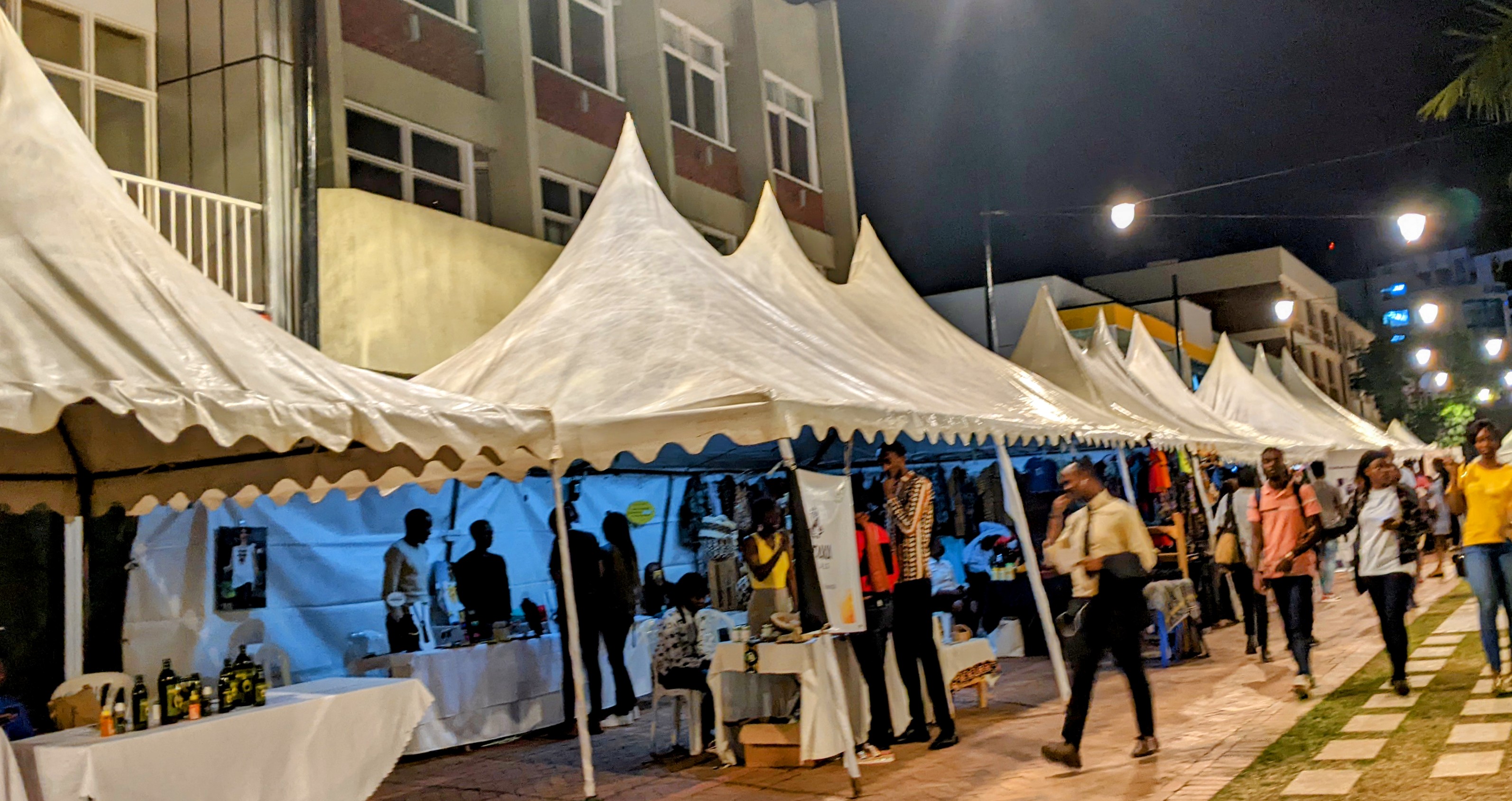
Last night I walked through a night-market showcase of life and culture in Rwanda (and in smaller sections, Uganda and Mozambique), from agricultural supplies and textiles to food and dance. Smiling representatives eagerly promoted their wares.  I succumbed to the hype and bought some green—literally and figuratively—cosmetic products for my wife, as well as some Rwandan coffee. (I'd already bought Rwanda and Musanze FC kits for myself.) I took a selfie in front of gigantic letters spelling "KIGALI."


Food stalls offered delights from East Africa, including Rwanda-based restauranteurs in foreign cuisines, such as Indian and Ivorian. An aside: The highlight of the showcase for me was Kigali-based "Now Now Rolex," which makes gourmet ethnic variations of the classic Ugandan street food. A rolex is an egg omelette rolled in chapati, usually with other ingredients, such as diced tomatoes and onions, added to the taste of the buyer. Typically for no more than a dollar or two, the wrap is cooked quickly in a hot skillet, crepe style, at a roadside cart or stall. The name "rolex" derives from "rolled eggs," but for its quick preparation also plays cheekily with the name of the watch brand. Now Now's gourmet options incorporate ingredients for variations such as French, Italian, and Mexican, still just $2 a pop; I had "the Rwandan," featuring minced beef. Oh, and a delectable vodka mule to wash it down.

Notwithstanding the festive atmosphere, the genocide is never far from mind in Rwanda. CHOGM 2022 takes place against the backdrop of Kwibuka 28, a three-month remembrance of the genocide sponsored by Rwanda and the African Union. With the theme "Remember-Unite-Renew," Kwibuka is recognized with its own gigantic letters at the Kigali Genocide Memorial. Newscasters on Rwandan TV (English-language for me) and videos at the cultural showcase readily recognize the genocide, but reiterate a forward-looking "never again" message. They refrain from revisiting gruesome atrocities and scarcely acknowledge the ongoing public health problem of post-traumatic stress.

Personally I've been skeptical of Rwanda's reconciliation with the genocide and purported triumph over ethnic conflict. The mantra one hears throughout Rwanda today is that "we are all Rwandan now," meaning ethnic differentiation is a thing of the past. But how does a people turn that page so quickly, even in the span of one generation? Nothing I learned about the genocide at the Kigali Memorial gave me solace. The way that nationalistic leaders and opportunistic, wanna-be warlords manipulated information and exploited mass media—sound familiar?—to turn ordinary people into torturers and murderers of their friends and neighbors; decades of violence and 100 days of carnage to rival the Holocaust; and then it all just evaporated, never to happen again? I noted that the impressive and truth-rendering Kigali Genocide Memorial, which houses the remains of a quarter million people and where Prince Charles laid a wreath today, was constructed in the 20-aughts by a UK NGO, not by the Rwandan government.

To President Kagame's credit, Rwanda looks and feels peaceful. I found only warm and welcoming people traveling in the country's lush northwest. I walked around Kigali day and night with a comfort level I've had in no other African capital (though I am not recommending being carefree here; I take precautions). Kagame brokered Commonwealth membership and landed CHOGM.

Kigali

At the same time, Kagame has been president since 2000. He was a leader of the domestic military force that ultimately quelled the genocide, and many say he has been running the country de facto since then. For perspective, that's since Bill Clinton was President of the United States.

In a recent book, journalist Michela Wrong unflinchingly painted Kagame as a wolf in sheep's clothing.  (I've read about the book, but not read the book.) She charged him with political assassination of a rival and dictatorial repression of dissent. According to descriptions of Wrong's portrayal, a "sinister" and "chilling" head of state lurks behind the rendering of peace and promise that the West is so eager to embrace.

"Hotel Rwanda" today: the Hotel des Mille Collines

Wrong's take squares with details alleged in the abduction of Rusesabagina. Assiduously avoiding return to Rwanda, Rusesabagina persistently criticized the Kagame regime and alleged failure to reconcile meaningfully with the genocide. The Rusesabagina family lawsuit alleged that a covert Rwandan intelligence officer lured Rusesabagina away from his Texas residence for a purported speaking engagement in Burundi, then orchestrated his abduction to Kigali from a Dubai layover. Rusesabagina's subsequent criminal prosecution in Rwanda on terrorism charges had every hallmark of a show trial. The Kagame administration denies involvement in the abduction and any impropriety in the prosecution.

I wonder whether Rwanda's enthusiastic embrace of Kwibuka, the annual genocide commemoration, represents genuine engagement with reconciliation or mere lip service to human rights platitudes that gratify western leaders and smooth the pathways of foreign investment. I haven't seen a single mention in Rwandan media of demands by human rights groups that Rusesabagina be released. Such as I've seen, discussion of human rights in Rwanda, besides recognition of the genocide as a historical event and cause for unified patriotism going forward, has been limited to the promotion of innovations in public health and sustainable agriculture.

Meanwhile, violence and unrest in the neighboring Democratic Republic of the Congo casts another unwanted shadow over CHOGM 2022. Like Rwanda, the DRC (formerly Zaire) has convulsed with violence since its Belgian decolonization in the 1960s. Millions have died just since the 1990s. Since 2015, the eastern border region, which shares Lake Kivu and the Virunga mountain range with Rwanda, has been the site of a bloody confrontation, costing thousands of civilian lives. Supported by UN peacekeepers, the Congolese army has been locked in conflict with "M23" revolutionaries. Making matters worse, Kinshasa accuses Kigali of funding M23 in a bid to expand Rwandan territory. Rwanda denies involvement.

I know next to nothing about the political situation in the DRC, so my perceptions are informed only by experience on the Rwandan side of the border.  The establishment of a Tutsi government after the genocide propelled Congolese Tutsi into Rwanda, and nearly 2 million Hutu left Rwanda for the DRC. More than once in the Lake Kivu region, I met Congo-born 20-somethings—the average age in Rwanda is a remarkable 19—whose Rwandan families relocated there after the genocide, only to return later to Rwanda as refugees of war in the DRC. Though born to Rwandan families, the persons I met identified as Congolese and lamented that they could not go home.

I came close to the DRC border twice. The first time, in the Virungas, I had an escort of four soldiers with automatic weapons. Armed escorts are common in East African parks to protect tourists from wild animals (ideally to scare them with gunfire, not to shoot them). But this was more than animal deterrence. The soldiers acknowledged that Rwandan officials are worried about incursion from the DRC, especially while CHOGM is ongoing in Kigali.  I was encouraged not to linger at the summit of Mount Bisoke, whose crater lake straddles the border.  (I was not allowed to photograph soldiers or border posts.)

The Virunga volcanic range sits at the junction of the DRC, Rwanda, and Uganda.

I came close to the border as well in the lakeside town of Gisenyi. A Rwandan official invited me closer to the line than I cared to be. I could see where queues, asphalt road, and orderly buildings on the Rwandan side gave way to dirt road, a shantytown, and a colorful, chaotic, and predominantly pedestrian marketplace on the Congolese side.

As of this writing, CHOGM 2022 is progressing without incident, and Rwanda is availing of the opportunity to put its best foot forward in the world. Surely for the sake of everyone I've met here, I hope that Rwandan participation in the community of nations affords, for every Rwandan who wants it, opportunity for more than subsistence living.

However, for that to happen, Commonwealth delegates will have to see past colorful souvenirs, product pitches, and reconciliation rhetoric. Rwanda needs a plan for infrastructure, educational opportunity, and an improved standard of living for all its people. Rwanda does not need recolonization through the finance sector.

For an indulgent exploration of the contemporary aftermath of the Rwandan genocide and the precarious relationship with the DRC, I highly recommend the television series Black Earth Rising (2018), a co-production of Netflix and BBC Two, written and directed by Hugo Blick and starring Michaela Coel and John Goodman.  The story is fictional, but the riveting expression of social and political tensions is spot on. HT @ Jason Peura.

For a moving documentary on the plight of the gorillas in the Virunga mountains amid the chaos of war in the DRC, see the Oscar-nominated Virunga (2014), also available on Netflix.

Monday, May 23, 2022

Putin's war strains ties to Belgrade

In Belgrade, Serbia, on Sunday, I was surprised to see a couple of pro-Russian T-shirts for sale on the main shopping strip. One had an image of Putin; another, to the lower right in my photo below (CC BY-NC-SA 4.0), bore the iconic Russian "Z."


These shirts were exceptional, to be clear. They were the only ones of their kind that I saw, and neither was displayed prominently. Also, the "Z" shirt was for sale from a cart that was heavy on Serb patriotism and sold some of the faux-old Soviet hats and pins that can be found throughout the former SSRs.

Still, I was struck that someone had gone to the trouble to manufacture these items recently. And nothing pro-Ukraine was to be seen.

I might ought not have been surprised. My local guide told me that the 1999 NATO bombings of Yugoslavia in the Kosovo affair still sit heavily here—notwithstanding recognition of the misguided nature of leadership by once-President Slobodan MiloÅ¡ević, who died in prison in The Hague in 2006.

A bombed-out portion of the Serbian Ministry of Defense building stands unrepaired today in Belgrade as a deliberate reminder of the attack (below, public domain image in 2005 by Not Home).


In the historic old-fort area of Belgrade, a display of military hardware proudly includes the surface-to-air missile launcher said to have shot down a U.S. Air Force F-117 stealth aircraft in the 1999 engagement (my photo below, CC BY-NC-SA 4.0). The U.S. pilot ejected and was rescued.


In the Cold War, Belgrade was the de facto capital of the non-aligned movement, positioning Yugoslavia as a buffer between East and West. Serbia's inclinations have thus always vacillated. Evidence of waxing and waning relations with the West appears in the strong presence of western cultural institutions in the city and an eclectic mix of architectural styles in post-World War II reconstruction (including bigamous brutalism).

While there surely do remain a hard edge of NATO skepticism and persistent thread of nationalism in Serbian politics, the mood on the street, at least in progressive Belgrade, is not so disdainful. My guide said that most people in Belgrade, if asked today, would go ahead and give Kosovo its formal independence. And Al Jazeera reported 11 days ago that even "pro-government tabloids [in Serbia] have turned on Putin."

With a Serbian eye on EU membership, the country might not be able to resist the pull westward. The wounds and memories of 1999 might have to make peace at last with a new global order.

Thursday, April 28, 2022

'Now NATO might join Ukraine,' experts opine

In Washington, D.C., the International Law Section of the American Bar Association receives a message from Ukraine. Attorney Michael Burke is at the lectern; Ambassador William B. Taylor is at the table. Photo by RJ Peltz-Steele CC BY-NC-SA 4.0 with no claim to depicted video.
The war in Ukraine is not only about Ukraine, and Ukraine will prevail if the West expands military support.

Those were the top takeaways from experts at a panel of the American Bar Association International Law Section (ABA ILS) in Washington, D.C., today, April 28.

The panel at the Capital Hilton comprised William B. Taylor, U.S. ambassador to Ukraine from 2006 to 2009 and now vice president for Russia and Europe at the NGO U.S. Institute of Peace; Vladyslav Rashkovan, a board member of the International Monetary Fund and former governor of the Ukraine Central Bank; attorney Michael E. Burke of Arnall Golden Gregory, moderator; and, by pre-recorded message, an attorney in the Kyiv area.  The panelists spoke in their personal capacities, not as representatives of their organizations.

'This war is not new'

I withhold the name of the Kyiv attorney for security; he is a member of the ABA ILS.  As a man under age 60, he cannot leave Ukraine and sent his regrets with the message, recorded on Orthodox Easter, April 24.

Clad in a hoodie and standing before a nondescript wooded background, the Kyiv attorney described persistent air-raid sirens, especially at night, with rockets anticipated to strike "civil" targets all over Ukraine. He described the mentality of the resistance with knowledge that Ukrainian civilians have been killed, tortured, and raped by Russian soldiers.

"This war is not new for us," the attorney said. "It has been around for hundreds of years," hostilities boiling over only most recently in 2014 and 2022.

I was reminded of speaking to a Krakovian friend, a lawyer and long-ago student of mine, in March, earlier in the invasion. Like many Poles, he was planning to host Ukrainian refugees in Warsaw, where he lives now.  

"It's the Russians again," he said matter-of-factly.

The Kyiv attorney emphasized a recurring theme we hear from Ukrainian officials and commentators, that the war is not only about Ukraine. Rather, "Ukraine is just the first obstacle in the way of Russia," he said. If Russia is not stopped in Ukraine, "European kids and families will keep dying in their homes."

The attorney urged lawyers from around the world to reach out to their political leaders to emphasize the importance of supporting Ukraine, especially militarily.

"Please do your best to support Ukrainians," he concluded. "And keep praying for Ukraine and the brave Ukrainian army."

Ukraine will win, if ...

If western military aid to Ukraine persists and expands, Ambassador Taylor predicted, Ukraine will win the war.  Presently, he explained, Russia is "probing" eastern Ukraine for weakness and softening defenses with air and long-range artillery strikes, while "preparing for a big offensive."

Rashkovan echoed the characterization of conflict with Russia as enduring for "centuries." The February 24, 2022, invasion was "a shock, but not a surprise," he said.

Russia has coveted Ukraine since the 20-aughts, Rashkovan said. To Russia's frustration, every attempt to draw Ukraine closer had the effect of pushing it away.

According to Rashkovan, surprises did follow the invasion of Ukraine, but they were for Russian President Vladimir Putin and for the West.

Putin "believ[ed] his own propaganda," Rashkovan said, citing a recent piece in The Economist by Ian Bremmer. Putin thought "Ukrainians would be waiting with flowers."

Another surprise to Putin was that Ukrainian resistance proved to be sustainable, Rashkovan said.  In contrast, the Russian army proved "not so modern," "not prepared for 21st-century war," "not ready to fight in the streets, against drones and [civic] groups.  They are fighting [with] a strategy of the [19]80s."

Putin also miscalculated by giving a speech in February declaring interest only in the Ukrainian coast, immediately before Russia bombed targets nationwide, Rashkovan said.  The duplicity created "outrageous anger" and "unity" in Ukrainians and in the world, rather than the fear that Putin intended.

Surprises resulted for the West, as well, Rashkovan said. The West "finally understood" that conflict in eastern Ukraine, simmering since the 2014 invasion of Crimea, was about more than the Donbas region and more than just Ukraine.

"I don't want to say for Europe," because Europeans remained reluctant to give up business with Russia, Rashkovan said.  But now it has become clear that Putin stands against the western liberalism of the last half century and norms that it has generated: "globalization, humanism, ... multiculturalism, tolerance, and democracy."

"Ukraine is now on the front line of this fight," Rashkovan said. "Let's be frank.  Until recently, the West was not ready to fight for Ukraine. And Putin showed that he is ready to fight."

The defense of Ukraine should be instructive to the West, Taylor and Rashkovan both said, resulting in the joke, "Now NATO might join Ukraine."

But the joke is "not crazy," Taylor said.  Ukrainians "are showing how to fight, how to win this war."  Upon a Ukrainian victory, he opined, the West should guarantee Ukrainian security against future invasion, whether through NATO or another agreement binding in international law.

Stop saying 'off ramp'

I was pleased to hear a harder line from Ambassador Taylor than I hear from the U.S. leaders that Taylor no longer represents.  Evidently, I am not the only person tired of hearing commentators chatter about the need for an "off ramp" for Putin, a compromise, or my word, "appeasement."

"I am not interested in an off ramp," Taylor said. "Putin caused this problem" by invading a peaceful neighbor that posed no threat and made no provocation.

An "off ramp suggests that we should find something to help him save face," Taylor explained. "No, no.  He needs to find a way out."  When Putin realizes he is losing the so-called "second phase" of the war, if Western military aid does expand, Putin "will look for an off ramp, something to convince the Russian people that it was worth all this.  Good luck with that."

Taylor said he is not worried about Russian aggression against other countries, such as Moldova, as long as Ukraine prevails. Without control of the Ukrainian coast, Taylor opined, Putin "doesn't have the manpower ... to go all the way across the south."

And Russia will not use the nuclear option, Taylor said. "I don't think Putin is suicidal," nor "crazy." "[W]e have to be ready," he said, but "Washington sees no indication of an operational step toward that."

However, if western military aid is not expanded, and Russia does gain control of Ukraine, "then that would be a threat," Taylor said. Besides Moldova, Russian aggression would threaten Georgia, the Balkans, and, ultimately, NATO allies.

"This is not the last war in Europe" if Russia prevails, Rashkovan agreed. "Who knows about Sweden and Finland," countries that recently signaled their intentions to join NATO, "now under critic[ism] from Russia. Who knows about Poland."

Zelensky stars

Both Taylor and Rashkovan praised the leadership of President Volodymyr Zelensky as key in the defense of Ukraine.

Taylor was in Kyiv just three weeks before the invasion, he said, and he met with political opposition leaders, who were characteristically critical of Zelensky.  Upon the invasion of February 24, "that changed....  Zelensky has motivated and inspired leaders, parliaments, nations around the world."  Now, in the context of the war, opposition leaders line up "nearly 100%" in support of the president, Taylor said.

Famously an actor and comedian before entering politics, Zelensky was a sort of Stephen Colbert of Ukrainian "late night" fame.  (Colbert has "run" for the U.S. Presidency more than once, since 2008, in mixed satirical and activist capacities.)  A pledge to eradicate corruption saw Zelensky to a stunning 73% electoral victory in 2019.  When war broke out, Taylor said, it was Zelensky himself who gathered and energized the Ukrainian leadership.

"He understands the Ukrainian people because of his entertainment background," Taylor said. His audience is the electorate.  "It's that connection with the leader and the people that gives him the strength, the moral strength."

China watches and learns

Taylor commented also on the perspective of China.  Just before the invasion, at the Olympics, Beijing broadcast its allyship with Moscow. China has been conspicuously non-committal since.  It has not joined western efforts to arm Ukraine, but has refrained from speaking favorably of the invasion and has not moved to undermine western sanctions. In fact, Taylor said, many Chinese firms are respecting the sanctions.

China's strategy is pragmatic.  Before the invasion, China was the biggest foreign investor in Ukraine, Taylor explained. And Chinese economic planners have their eyes on the European market, "which dwarfs the size of the economy in Russia."

Moreover, the Chinese are studying Russia's exploits relative to the matter of Taiwan.  "President Xi is watching very carefully the response of the United States and NATO, putting sanctions on a central bank," Taylor said. "That probably opened some eyes in China: 'Can they do it to us?'"

And China is watching the military engagement on the ground, too, Taylor said. China might be wondering whether, like Russia, its army is not as strong as Beijing has calculated, and whether Taiwanese resistance to a takeover might be stronger than anticipated.

Lawyers and sanctions help

Both Taylor and Rashkovan told the ABA ILS audience that lawyers are important in the Ukraine conflict, now and in the future.  Lawyers play a role now in documenting and calculating infrastructure losses in Ukraine, Rashkovan said. Data are being fed to the World Bank in anticipation of a reparations bill that might someday issue to Russia.

Meanwhile, Rashkovan said, lawyers should be helping Ukrainian people and businesses to design "legal class action[s]" against Russian defendants.  "I don't know the practicalities," he said, "but we should deliberate this further."

Taylor said that American lawyers can support the investigation of war crimes notwithstanding U.S. non-ratification of the Rome Statute that created the International Criminal Court.  Lawyers can help, too, to strengthen sanctions, which must be made "more targeted and smarter," Rashkovan said.

To evade sanctions, "Russia will start looking for the back doors," Rashkovan said. Russia still imports western food through eastern European and central Asian allies; Rashkovan joked about "Belarusian parmesan," before Belarus, too, came under sanctions.

According to the Crimean play book, he said, Russians will take over businesses from fast food, such as McDonald's, to car manufacture and aerospace, "knowing the techniques" to keep them running. But Rashkovan predicted that "the capacity of Russia to produce something serious, high tech, will diminish substantially."

Acknowledging that not everyone sees sanctions against Russia as necessarily enduring as long as Putin's presidency, Taylor suggested that sanctions will outlast the war, "[b]ecause when they [Russia] lose, they will be back.

"They will not give up," Taylor said, at least not as long as Putin remains on his "almost mystical mission, his commitment to dominate Ukraine."
Thursday, March 24, 2022

Let's laugh at them, not with them: Klobuchar cites serious stats, but occasions levity in Jackson hearing

On day 2 of the Judge Ketanji Brown Jackson hearings, Senator Amy Klobuchar (D-Minn.) borrowed a joke from The Daily Show's Trevor Noah.

Klobuchar remarked on the significance of a woman taking a seat on the U.S. Supreme Court to attain a 5-4 gender balance for the first time.  Of 115 confirmed justices in American history, Klobuchar counted, 110 have been men.  Klobuchar said that she had "reminded" Trevor Noah on The Daily Show of similar statistics relative to service in the U.S. Senate: "Of the nearly 2,000 people who have served, only 58 have been women.  And he responded that if a night club had numbers that bad, they'd shut it down."  Here's the 38-second clip:


It was Noah who actually quoted the Senate statistic from a book, Nevertheless, We Persisted (2018), an anthology for which Klobuchar wrote a foreword and which she touted at the time. Noah followed up, "I've been to gay clubs that have better ratios of men to women."  Klobuchar took the occasion in 2018 to speak against the Brett Kavanaugh nomination, pending at the time.  She put the appearance on Facebook.


Klobuchar appeared on The Daily Show also in 2017 and in 2019, the latter while running for President.  But none of those appearances marks the funniest intersection of Klobuchar and Noah in popular culture.  That honor goes to a 2019 tweet by Noah in which he lampooned Klobuchar for overusing a joke on the campaign trail.

Senators' interrogations of Jackson on Tuesday and Wednesday this week were at times cringeworthy, to use my wife's word.  In particular, the questioning by Senators Ted Cruz (R-Tex.) and Josh Hawley (R-Mo.) were difficult to endure; even National Review Senior Fellow Andrew C. McCarthy, who opposes Jackson's appointment on other grounds, described Hawley's attack as "meritless."  The affair rubs in for me David Brooks's recent lament in The Atlantic on the divide between today's rabid right and the meritorious social value of genuine conservatism.

Both Stephen Colbert and Trevor Noah are off this week, so between the stresses of a contentious Senate hearing and the ongoing war in Ukraine, I am sorely missing my daily doses of escapist levity. Fortunately, The Daily Show's Desi Lydic deposited a dose of satire on the web for us; don't miss it.