Showing posts with label soccer. Show all posts

Monday, September 7, 2026

UEFA-FIFA football war spills into U.S. courts as European lawyers wield discovery 'superpower'

A powerful American legal tool is a weapon of choice in a brewing legal battle between two of the world's most powerful transnational sporting organizations.

Soccer might not be on the minds of Americans on a daily basis, but that won't stop the global corporate landscape from shifting under our feet as two behemoths of football governance wage world war on one another. Battles in that war erupted in three U.S. federal courts at the end of August.

RJ Peltz-Steele with Google Gemini CC0 1.0
UEFA, the governing body of football in Europe, filed ex parte applications in U.S. courts on August 27 with expansive discovery demands in anticipated litigation against world-governing FIFA. FIFA fought back last week with counter-filings as a would-be intervenor. Dirty laundry is close to spilling out, and the mechanism making it possible is a section of the U.S. code that bestows on foreign lawyers a "little-known superpower."

First, some context. Americans might remember from the waning days of the World Cup news cycle—and thus the waning days of Americans caring about soccer, despite the summer hype, and owing significantly to the self-inflicted wound of allowing profit-thirsty NBC to fragment Premier League matches across disparate network bundles, but that's another story—that FIFA chief Gianni Infantino, apparently intoxicated by the refined air inside his mega-millionaire bubble, proposed selling shares in the people's game to private investors. 

The proposal was akin to a company going public, except not at all public and, being above the laws of nations, hardly regulated. After schmoozing States-style, Infantino wanted to do his part to firm up the global wealth gap and to locate himself at its rich-ward extreme. No joke: Infantino's vision looks like it was modeled on President Trump's Board of Peace, with which Infantino's FIFA in fact formally partnered. Infantino would have set himself up as the head of a World Cup company, sidestepping the inconveniently quasi-democratic and term-limiting features of the FIFA presidency, and shaken down private investors and member associations for minority stakes.

There apparently is some limit to what even the supra-national, mega-rich can do, as Infantino's plan drew worldwide rebuke. Of course there was objection from watchdogs, such as Reboot FIFA, a campaign I signed on to that holds out hope for socially responsible sporting governance and issued a July statement condemning the Infantino plan. But tellingly, FIFA's member associations led the chorus of boos; UEFA pledged a boycott of FIFA. The limit might be when rich people step on the toes of other rich people, because UEFA is no stranger to the profit-engine-masquerading-as-for-the-commoner MO of professional football governance.

Longer memories will recall when Swiss police raided FIFA headquarters in 2015 at the behest of U.S. investigators, and the U.S. Department of Justice filed a 47-count federal indictment in Brooklyn targeting top FIFA brass. Mighty FIFA President Sepp Blatter fell from grace, and it looked for a moment like democracy might be bigger than corporatocracy.

Infantino shows Trump the World Cup trophy in the Oval Office, 2025.
U.S. Government (public domain) photo from the White House
The moment didn't last. It only proved the old adage, cut the head off the hydra, and two more take its place. Infantino inaugurated a new era of next-level corruption. Of course, the U.S. prosecution had been motivated in part by the FIFA hijinks that saw the U.S. bid for the '22 World Cup founder in the face of Qatar's, let's say, "procurement." The '26 World Cup was our payoff. Washington meanwhile changed lanes to go all in on pay-to-play, and FIFA awarded President Trump his personally tailored Peace Prize. Plutocratic order was restored.

Infantino backed off of the private-investment plan. Yet hell hath no fury like a sporting cartel scorned. UEFA persists, demanding that FIFA oust Infantino and threatening legal action. 

Meanwhile, because there's a grain of truth to the offensive assumption that all rich people know each other, there's a U.S. connection to the FIFA scandal that runs even deeper than Trump and Infantino's mutual social grooming. New York-based Thrive Capital, a venture capital firm, was set to pour $4.2 billion into Infantino, Inc. And the co-founder and soul of Thrive Capital is Joshua Kushner.

You think I mistyped Jared Kushner, the President's son-in-law who solved the Middle East. No. Josh is the other Bennet sister, an entirely different offspring of tax fraud, etc., convict Charles Kushner. Not that I'm judging a book by its author; a billionaire deserves a chance to write his own story.

Since the Infantino deal went up in glorious flames, Josh Kushner has tried to distance Thrive and himself from it. He says he never would have gotten involved had he known, and that he thought the deal would funnel more capital to promote socioeconomic development. Shoulda coulda woulda.

Well, UEFA wants to know more about that. Which is why its breathtaking range of documents filed in the U.S. District Court for the Southern District of New York includes, very much inter alia, a proposed subpoena for the deposition of one Joshua Kushner.

RJ Peltz-Steele with Google Gemini CC0 1.0
The legal tool at the heart of the UEFA filings is 28 U.S.C. § 1782. The law opens up the discovery process of U.S. civil procedure for litigants in other countries to access records and to depose persons in the United States. Though section 1782 is implicated here, as it usually is, in connection with business disputes, it can be used just as well in ordinary tort litigation, from fraud to personal injury. 

This is important, because U.S. discovery is famously more expansive than production in other legal systems. Fittingly, U.S. civil procedure takes a sort of free-market approach to discovery, upon a truth-will-out philosophy. The system, articulated in the relevance-and-proportionality standard of Rule 26(b) of the Federal Rules of Civil Procedure, does not grant carte blanche for fishing expeditions, especially since 2015 amendment tried to rein it in a bit. But it goes a lot farther than the they-didn't-ask-so-don't-tell approach that is the norm in Europe.

Section 1782 on its face requires that (1) the domestic respondent can be found in the U.S. district in which discovery is sought, (2) the discovery is for use in a foreign or international tribunal, and (3) the section 1782 requester has an interest in the foreign proceeding. The statute won some notoriety in 2022 when the U.S. Supreme Court resolved a circuit split by deciding that arbitral panels are not eligible tribunals under the second element.

Section 1782 compliance by U.S. district courts is discretionary, not required, by the statute. So the U.S. Supreme Court in 2004 set out factors to guide court discretion: (1) whether the domestic respondent is subject to the foreign proceeding, so discovery might rather be sought against the respondent there; (2) whether the foreign tribunal is receptive to U.S. court assistance; (3) whether the requester is trying to circumvent an intended limitation on discovery in the foreign system; and (4) whether the request is especially intrusive or burdensome. The third factor especially tends to be a contested point, and it is sometimes difficult for U.S. courts to find the line between a foreign limitation on discovery by design and the mere happenstance that the foreign discovery system is more conservative than the U.S. system.

In a 2020 empirical study, Penn Carey Law Professor Yanbai Andrea Wang concluded that section 1782 is an "increasingly pervasive practice that is transforming civil litigation worldwide." With 90% of ex parte 1782 requests granted, Wang found that the law raises due process concerns. Potential adversaries in the home litigation are not always given proper notice of their right to intervene in the United States and object to the discovery. In the instant matter at least, the 1782 petition is part of UEFA's public relations strategy. And FIFA had no trouble intervening in New York and mounting a public relations offensive of its own, accusing UEFA of a "smear campaign." 

Properly employed, section 1782 does open the door for a foreign actor to poke around in the business of an adversary or potential adversary, to bolster a legal theory back home, in a way that it could not without the U.S. hook. Sometimes what the requester can discover with the aid of U.S. law is valuable enough to shift public opinion or a case on its merits so significantly as to obviate or dispose of the matter back home. It's not a stretch to figure that UEFA hopes to find Infantino-Kushner correspondence so damning or embarrassing as to compel Infantino's ouster.

Watching the battles unfold in UEFA vs. FIFA, and In Re Union Des Associations Europeennes de Football (S.D.N.Y. filed Aug. 27, 2026) in particular, is a bit like being on a rowboat between battleships. But the stab at arrogant corporate impunity, even if thrust by a fellow titan, is nonetheless prone to induce a satisfying schadenfreude, especially if UEFA can bring Infantino down.

RIP, football transparencist Andrew Jennings. Your mouth would be watering.

Saturday, August 22, 2026

Conservancy loss illustrates ongoing impotence of environmental protection right in state constitution

Franklin Park postcard, c. 1930-1945
Boston Public Library, public domain
In the Massachusetts Supreme Judicial Court Wednesday, environmentalists lost their bid to block renovation of a stadium in a Boston park.

I wrote about the case in the lower court at some length in 2024. The Emerald Necklace Conservancy and local residents wanted to stop the road construction and structural overhaul to bring White Stadium in Boston's Franklin Park into service as stadium host of Boston Legacy, a football club in the U.S. National Women's Soccer League. The "Emerald Necklace" is an urban greenway that landscape architect Franklin Law Olmsted planned to encircle Boston and was widely disrupted in the city's 20th century growth.

The court affirmed on various grounds, and two are of interest to me relative to environmental litigation. First, the court held that The Emerald Necklace Conservancy lacked standing to challenge the project as a violation of terms of the trust that supports the existing stadium and park.

This result is not unusual; environmentalist standing has been a challenging plaintiff problem since I studied environmental law decades ago. (Hat tip to Profs. James Boyle & Jonathan Weiner.) But the outcome shows that that's still so. The doctrine of locus standi in the European Union and elsewhere looks like standing in U.S. constitutional law, but is not as prohibitive, and in many jurisdictions—such as Malawi, where I traveled this summer—legislators have enacted workarounds to allow conservation organizations to respond to industry abuses that endanger human welfare.

Second, the court held that the Massachusetts legislature removed the stadium property from park status no later than 1950, thus depriving the plaintiffs of a claim to which they might otherwise be entitled under Amendments Article 97 (Article XCVII) of the Massachusetts Constitution, a conservation measure that voters approved overwhelmingly in 1972.

Article 97 interests me because of its potential breadth. Its first paragraph articulates a powerful affirmative right: "The people shall have the right to clean air and water, freedom from excessive and unnecessary noise, and the natural, scenic, historic, and esthetic qualities of their environment; and the protection of the people in their right to the conservation, development and utilization of the agricultural, mineral, forest, water, air and other natural resources is hereby declared to be a public purpose."

This language dates to the same year, 1972, as the Clean Water Act in federal law, and the likes of article IX of the Montana Constitution, which sustained the youth climate claim in Held v. Montana in 2024. The language weirdly resonates with later constitutional expressions of environmental rights elsewhere in the world, such as South Africa's (article 24). 

Thus far, however, the Massachusetts Supreme Judicial Court has interpreted Article 97 narrowly, only in connection with designated park land and only as implemented by the legislature—so hardly a constitutional right at all.

The case is Emerald Necklace Conservancy, Inc. v. City of Boston (Mass. Aug. 19, 2026). Justice Gabrielle R. Wolohojian wrote the unanimous opinion of the court.

Wednesday, February 25, 2026

Lichtman lecture unpacks politics of World Cup

Prof. Steven Lichtman spoke at UMass Law Thursday on "Soccer and American Exceptionalism: A Political Science Preview of World Cup 2026."

With the FIFA men's World Cup of soccer coming soon to the co-host United States, Prof. Lichtman took a peek behind the curtain at the once embattled yet seemingly unshameable enterprise of the world's biggest sporting event.

The American indictments and dramatic Zurich raid of the 2015 FIFA corruption scandal seem hardly to have slowed soccer's voracious appetite for cash. And sport is inseparable from politics. After all, FIFA President Gianni Infantino recently turned up at the inaugural meeting of U.S. President Donald Trump's Board of Peace. That struck me as an aptly symbolic testament to the corporatocratic nature of the Trumpian new world order. 

Prof. Lichtman spoke to the long history of World Cup politics, for example examining how reaction to the 1986 "Hand of God" goal manifested the angst and identities of both post-colonial Argentina and post-imperial England.

RJ Peltz-Steele CC BY-NC-SA 4.0
A self-described "recovering lawyer," Prof. Lichtman is co-editor of Judging Free Speech: First Amendment Jurisprudence of U.S. Supreme Court Justices (2015). His other work has appeared in the Maryland Law Review, the Penn State Law Review, Vingtième Siècle Revue d'Histoire, the Pennsylvania Lawyer, and the newsletter of the Law and Courts section of the American Political Science Association. He earned his bachelor's and Ph.D. at Brandeis University, where he was a founder of the Boris' Kitchen Sketch Comedy troupe, and his J.D. from New York University.

Prof. Lichtman is a professor of political science at Shippensburg University. He serves also as executive director of the New England Political Science Association, and he is the incoming president of the Northeast Association of Pre-Law Advisers. His visit to UMass Law was co-sponsored by the International Law Students Association, the Law & Political Economy student organization, and the Office of the Dean.

Friday, December 5, 2025

Author of 'Surviving Your Friend's Cancer,' law alumna Kayleigh Ellison made world better, brighter

Kayleigh's relentless smile,
from the UMass Dartmouth
soccer roster
I'm sad to hear and to share news of the death of Kayleigh Dawn Marie Ellison on November 27.

Originally from Troy, Mo., and a graduate in diplomacy and international relations from Seton Hall University, Kayleigh was an alumna of my first-year torts class at UMass Law.

Kayleigh was an extraordinary and inspiring person. Because full-time law school could not keep her busy enough, she played soccer for the campus Corsairs at UMass Dartmouth.

Her remarkable obituary offers ample illustration of life well lived. She met every challenge with unflinching determination, and every setback with joyful resilience, from cancer to law school to defenders on the pitch, and she exuded infectious vibrancy all the while.

Surviving Your Friend's Cancer
by Kayleigh Ellison,
available at Lulu 

Among the countless ways in which Kayleigh made the world a better and brighter place, she authored a book, Surviving Your Friend's Cancer (2015). She told me that as hard as it was to fight cancer, it was just as hard to help friends overcome their anxiety over what to say and how to be present for her. She figured she could help other sufferers and their friends and families by giving some simple guidance. Her characteristic gentle humor outshined painful context.

I appreciated the book when I read it in the abstract. I have treasured it since, when I have needed its advice. I highly recommend it.

And I highly recommend taking inspiration, a recommitment to live every day to its fullest, from Kayleigh's life story. I know she would much prefer that to anyone's overindulgence of grief.

The UMass Dartmouth Torch wrote about Kayleigh and her book in 2016. The same year, Kayleigh appeared in a short UMass Law promo video. A related public relations piece features two fantastic photos from the soccer pitch by award-winning (New Bedford, Mass.) Standard-Times photographer Mike Valeri. Notice Kayleigh's smile in the latter. (If anyone can reach The Standard-Times or Valeri, please ask whether they might contribute the photos to Kayleigh's obituary page. I tried, but The Standard-Times staff directory is 403.)

Surviving Your Friend's Cancer remains available from Lulu at the time of this writing.

Sunday, September 14, 2025

'Liberal Playmaker' goes Substack; Boston awaits FIFA

"The Liberal Playmaker," a.k.a. Jose Benavides, is now on Substack.

Benavides, a Texas attorney, past co-author, and excellent former student, has been producing informative and compelling content about soccer (football) and politics since launching a year ago (featured at The Savory Tort in March 2025).

Benavides has a passion for the beautiful game, and it is contagious through his writing. His narrative pieces recall great players and great games and also comment on the current business and art of the sport. 

Here are recent titles:

The Liberal Playmaker will be a content maker to watch as we near World Cup 2026. Boston has deployed a massive publicity campaign to gin up interest, e.g., Boston's South Station, below, in July (RJ Peltz-Steele CC BY-NC-SA 4.0), though the relevant venue is Gillette Stadium in Foxborough, Massachusetts, home to the MLS New England Revolution and NFL Patriots.


Wednesday, March 12, 2025

Apple Music drops Lady Gaga, Leo Messi interviews; L.A. producer Steele was behind the scenes

Morgan Steele, my daughter, based in Los Angeles, has worked lately on some star-studded and classified projects, two now public.

This (below) is Lady Gaga's Mayhem interview with Zane Lowe for Apple Music in New York City, dropped March 5.

The interview took place at the lower-east-side "dive bar" that was a formative place in becoming "Gaga," as she described her early creative growth. She recalled writing lyrics at the bar and joked that that was "where all the cool kids hung out." Morgan confirmed that this place is the real deal, in no way a set, like entering a time warp into a corner bar that, in a comforting way, never changes as the decades elapse outside.

This (below) is Lionel Messi's interview with Zane Lowe in Miami, dropped February 28. That's right, a Messi interview with Apple Music!

Messi, probably the greatest of all time playing the beautiful game now, plays presently for Inter Miami in the MLS and is a star to watch in the upcoming 2025 FIFA Club World Cup. The Argentine player spoke Spanish in his responses; the interview is subtitled. (Incidentally, my mate Dylan is a Messi doppelganger, which, amusingly, has caused us more than once in Africa to be mobbed by children who refuse to accept his denial. If you're ever unsure, the tell is that Dylan speaks French and not Spanish.)

The Messi interview is a cross-platform promotion for Apple Music and the MLS. Messi is not (yet?) embarking on a music career. But Lowe is a football (soccer) fan, besides a music guru, and he aptly described Messi as a kind of artist. The two talked about Messi's relationship with music, a vital part of true-blue Argentine culture. Messi talked also about his decision to come with his family to Miami and the style of play in the MLS, relative to his longtime former club, FC Barcelona.

For those keeping track, I'm now two degrees of separation from Gaga and Messi. If you know me, you're at no more than three!

Don't forget to look for my friend Jose Benavides's football coverage on The Liberal Playmaker at Apple Podcasts.

Thursday, March 6, 2025

Texas attorney launches football (soccer) podcast

A Texas attorney, co-author, and former student, Jose Benavides officially has launched his football (soccer)-and-politics podcast, The Liberal Playmaker. 

The podcast on the beautiful game is available at Apple, Spotify, and on video at YouTube.

Sixteen 2025 episodes are online already, for most recent example, "Copita del Rey," Feb. 27, below. Coverage includes but definitely is not limited to the Premier League. 

Monday, February 26, 2024

Parks group challenges soccer stadium under state constitutional right to environmental conservation

A Boston lawsuit pits parks against soccer, tying in knots fans of both such as me.

The Emerald Necklace Conservancy on February 20 sued the City of Boston and Boston Unity Soccer Partners to stop the redevelopment of White Stadium to host a women's professional soccer team. 

(UPDATE, Mar. 25: The Superior Court on March 22 denied injunction of the redevelopment project. E.g., WBUR. UPDATE, August 19, 2026: The Supreme Judicial Court affirmed for the defense. E.g., WBUR. Saliently, the court held that the land was removed from park status prior to the adoption of the Article 97 conservation measure.)

What's compelling about the case as a matter of urban redevelopment arises from the fact that a stadium is already there. The conservancy is not trying to get rid of it. Though there is tentative objection to the footprint of the redevelopment project in Franklin Park, the complaint focuses on the repurposing of the stadium for the benefit of private investors, to the exclusion of public use.

Everyone agrees that White Stadium is in sore need of refurbishment. The 1945 construction has a storied history going back to Black Panther rallies in the 1960s. Its present state of deterioration for age is evident. Naturally, local government is keen to link arms with private investment. Boston Unity makes a heckuva pitch (pun intended) in a town willing and able to support an entrant in the expanding National Women's Soccer League.

Site plan in complaint exhibit.

However, the project, which Boston Unity characterizes as "a first-of-its-kind public/private partnership," will exclude the public from the redeveloped area on game days. That includes the expulsion of local high school times for their 10 to 12 games per year, according to the Dorchester Reporter. At the same time, city officials say other stadium uses, such as a track, might see more public use. 

The conservancy and residents say that the project has been moving too fast for them to study and comment, and that the headlong rush violates article 97 of the Massachusetts Constitution.

That's another eyebrow-raising point in the story. Article 97 of the Massachusetts Constitution is worth a read:

The people shall have the right to clean air and water, freedom from excessive and unnecessary noise, and the natural, scenic, historic, and esthetic qualities of their environment; and the protection of the people in their right to the conservation, development and utilization of the agricultural, mineral, forest, water, air and other natural resources is hereby declared to be a public purpose.

The general court shall have the power to enact legislation necessary or expedient to protect such rights.

In the furtherance of the foregoing powers, the general court shall have the power to provide for the taking, upon payment of just compensation therefor, or for the acquisition by purchase or otherwise, of lands and easements or such other interests therein as may be deemed necessary to accomplish these purposes.

Lands and easements taken or acquired for such purposes shall not be used for other purposes or otherwise disposed of except by laws enacted by a two thirds vote, taken by yeas and nays, of each branch of the general court.

Voters approved Article 97 in 1972. That's the same year as the federal Clean Water Act, and about halfway in between the Clean Air Act and Love Canal.

The "right to a clean environment" is a hallmark of contemporary human rights discussion, sometimes grouped in with "third generation" human rights. In this sense, notionally, Massachusetts was ahead of its time.

But like statutory expressions of environmentalism, Article 97 was not understood to ground an affirmative right, rather a negative right to prevent government from repurposing conserved land without legislative approval. The Supreme Judicial Court (SJC) entertained the constraint of Article 97 in cases in 2005 and 2013, but didn't find that the local governments in those cases had dedicated land to public purposes. The SJC did constrain local government in a 2017 case. 

The 2013 and 2017 cases might prove instructive in the White Stadium matter if the case progresses. In Mahajan v. Department of Environmental Protection (Mass. 2013), the court distinguished land taken for "conservation, development and utilization of the agricultural, mineral, forest, water, air and other natural resources," which triggers Article 97, from land taken urban renewal, that is, "for the purpose of eliminating decadent, substandard or blighted open conditions." In that case, the Boston Redevelopment Authority was able to commit a part of Long Wharf in Boston Harbor to a private redevelopment project without legislative approval under Article 97.

In Smith v. Westfield (Mass. 2016), the court decided that the City of Westfield had dedicated a parcel of land, 5.3 acres comprising a playground and two little-league baseball fields, to serve as a park, so was constrained by Article 97 before the city could build a school there.

In Smith, the court opined that Article 97 would attach only "there is a clear and unequivocal intent to dedicate the land permanently as a public park and where the public accepts such use by actually using the land as a public park." The court also acknowledged that the analysis fact intensive.

On the face of it, Smith looks like the better fit with Emerald Necklace. The land is clearly dedicated to park use and has been used as a park. The baseball fields and playground in Smith show that a recreational use can include a structure, such as the stadium.

At the same time, there's a viable counterargument in the re- of the White Stadium redevelopment. The city will argue, I expect, that it's not changing the purpose of the land, i.e., its dedication to recreation. A stadium is and will remain. The city is just improving the land to do recreation better.

The problem then boils down to that "first-of-its-kind public/private partnership": whether the private end of the partnership means that the land is being "otherwise disposed of" within the meaning of Article 97.

I've written about transparency and accountability in foreign development specifically amid the challenges of privatization and quasi-privatization. So it's fascinating, if it shouldn't be surprising, to see this problem arise in my own backyard. I wonder as well whether there ever might be a future for Article 97's purported "right to clean air and water" that amounts to more than a procedural hurdle in property development.

See more about Boston's remarkable 1,100-acre Emerald Necklace park system, designed by architect Frederick Law Olmsted, with Will Lange on PBS in 2014.

The case is Emerald Necklace Conservancy, Inc. v. City of Boston, No. 2484CV00477 (filed as 24-0477) (Mass. Super. Ct. filed Feb. 20, 2024). Emerald Necklace asked for a temporary injunction. Hat tip @ Madeline Lyskawa, Law360 (subscription).

Thursday, September 14, 2023

U.S. Soccer, FIFA lose antitrust appeal; defense shows short-sighted strategy to develop soccer in America

Cristiano Ronaldo plays for Real Madrid against Barcelona in 2011.
Jan S0L0 via Flickr CC BY-SA 2.0
U.S. Soccer and the Fédération Internationale de Football Association (FIFA) will have to defend an antitrust action in federal court for refusing to permit a Spanish La Liga match on U.S. soil, the Second Circuit ruled in March. 

In 2017, world famous football (soccer) clubs Real Madrid and Barcelona faced off in an exhibition game in Miami. The match was fabulously lucrative for the commercial interests behind it, including organizer Relevant Sports, LLC, based in New York.

World sport likes the United States, because our infrastructure practically prints money. Americans, especially the top echelons of the wealthy, have been habitualized by our unregulated and often subsidized sport-and-entertainment monopolists to pay more than people elsewhere in the world to see live events, both directly for seats and indirectly in media rights.

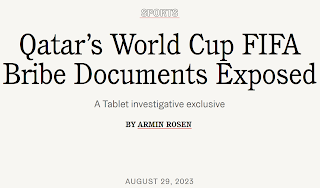
Incidentally, that's the principal reason that bringing the FIFA (men's) World Cup back to North America in 2026 was not really a hard sell, notwithstanding modest public enthusiasm and the theater of the global bidding process. The 2026 co-hosts, the United States, Canada, and Mexico, likely did not even have to pay the half-billion dollars that Qatar apparently spent, mostly to FIFA executive committee members, in, uh, let's say, "incentives," in siting the 2022 World Cup (about my World-Cup-2022-contemporaneous lecture; Qatar on this blog): check out the investigative exclusive by Armin Rosen for Tablet (link from inset), published late last month, using U.S. court records in collateral matters.

Understandably, then, Relevant Sports wanted to maintain the momentum of the 2017 exhibition match. The company proposed that the Spanish La Liga subsequently might site a regular-season, full-stakes match in the United States. 

However, FIFA rules say that a match cannot be held in a country foreign to both sides without the approval of the football federation in the host country. U.S. Soccer said no.

Relevant sued, alleging that the rule improperly protects domestic football from being overshadowed, and therefore diminished in interest and income, by high-profile competitors. U.S. Soccer and FIFA defend the system on the merits under antitrust law, and, saliently in this intermediate disposition, argued that the FIFA "rule" is not really a rule, because FIFA doesn't make the decision for U.S. Soccer or La Liga. They're free to make their own decisions, notwithstanding potential adverse consequences, such as exclusion from international competition for players, teams, or federations that don't play ball.

The instant Second Circuit decision is limited. The court remanded the antitrust claim to proceed, recognizing that FIFA's rule is rule enough to represent the kind of concerted action in violation of antitrust law that Relevant alleges.

Earlier this week, I wrote about Cory Doctorow's enthusiasm, which I share, for the federal government's antitrust agenda—including the Justice Department investigation of Google. (I canceled my Google Nest Aware subscription upon the 25% rate hike. Google's not the only game in town. Yet.) U.S. Soccer's loss in the Second Circuit represents a judicial step in the same right direction.

I'm not an antitrust expert. But to my relatively lay eyes, the fact that the federal district court dismissed the case in 2021 on the faint theory that U.S. Soccer was not formally bound by FIFA's command demonstrates how appallingly far U.S. antitrust law has strayed from basic fair-market principles. Or maybe the court just didn't understand the governance system in world sport and its facility for subverting the laws of nations.

USWNT celebrates in times happier than this year's World Cup.
rachael.c.king via Flickr CC BY 2.0
The U.S. Soccer position in the litigation to me demonstrates furthermore a fundamental misunderstanding of what it will take to make football successful in America. American soccer advocates often wonder aloud why the sport seems to stall again and again, even after the men's World Cup in the United States in 1994 and the astonishing run of the U.S. Women's team in an unprecedented four World Cup titles.

To be sure, there are many, many reasons for the frustrating cycle of revving and stalling. But equally surely, one of those many reasons is the short-term greed of commercial actors that works a detriment to long-term development. 

I've written previously about this problem in the context of media rights. When NBC acquired the rights to English Premier League football, the broadcaster divvied up matches among its many media properties based on the popular appeal of each. NBC's strategy was to leverage interest in the league to sell separate subscriptions to multiple services: NBC, NBC Sports, (at one time, "NBC Gold,") Peacock, USA, Telemundo, Universo.

The network either didn't consider or doesn't care what that model looks like from the customer's perspective. Football in a place such as its home U.K. (at least before U.K. media companies such as Sky started merging with U.S. media giants and took sport away from the publicly minded BBC; that's another story) maintains a multi-generational foothold because supporters follow their teams.  

Divvying up the matches makes it impossible in the United States for a viewer to follow a team. Each week, one gets whatever match a selected service happens to carry, based on its level of market appeal.  If you subscribe to a middle-tier service and your team starts to lose, you might get more matches. If your team starts winning, and you start becoming more engaged, you find yourself suddenly deprived of matches.

That market behavior doesn't build a fan base. For American football or basketball, maybe there are enough viewers who will watch any game because they love the sport. But Americans don't yet love soccer that much. Sport-market development requires fostering two interrelated conditions at the same time: public enthusiasm for the sport, and public enthusiasm for a team. Neither can thrive without the other.

U.S. Soccer's refusal to permit La Liga to play a match on U.S. soil also is self-defeating, if for the converse strategic blindness. Both media rights usurpers and U.S. Soccer, focused on short-term profits, are dampening American enthusiasm by impeding U.S. viewers' access to the highest level of play in the world, in the Premier League and La Liga. While NBC's strategy deprives Americans of the opportunity to root for a team, the U.S. Soccer strategy deprives Americans of the opportunity to root for the sport.

Again, neither can thrive without the other.  U.S. Soccer is trying to protect Major League Soccer and the federation's underage and lower divisions. The federation reasons coldly that someone who buys a $500 La Liga ticket will skip five or ten $48 Tampa Bay Mutiny matches.

They're wrong. One of my U.S.-based family is a card-carrying member of the Toon Army, a dedicated supporter of Newcastle (U.K.) United FC. He traveled domestically to see Newcastle play an exhibition match in the United States this summer. Being a Newcastle supporter has made him a more, not less, enthusiastic supporter of his nearby D.C. United and the U.S. men's and women's national teams. With access to the matches of each, live and on TV, he's more likely to spend money on all of them.

Antitrust law is not a device to make commercial actors prioritize long-term interests over short. To the contrary, if NBC and U.S. Soccer put themselves out of business, that's a healthy outcome for the free market. But if antitrust inadvertently compels U.S. Soccer to up its game and compete for eyeballs by actually developing the sport, rather than constraining consumer choice, then that's an outcome I can get behind.

The case is Relevant Sports, LLC v. U.S. Soccer Federation, Inc. (2d Cir. Mar. 7, 2023). U.S. Circuit Judge Raymond J. Lohier, Jr.., wrote the opinion of the unanimous panel that also comprised Chief Judge Livingston and Judge Lynch. In 2017's "El Clásico Miami," Barcelona bettered Real Madrid 3-2.

Monday, August 28, 2023

Can Arsenal supporter be impartial in football inquiry?

A curious story of lawyering ethics and football allegiance broke in mid-May, just after I went off contract with UMass Law and left the States for a chunk of the summer.

Manchester City Football Club (City, or MCFC), my team, won a historic "treble" over the summer, topping the Premier League, FA Cup, and UEFA Champions League.

Thomas Jefferson, me, and a City kit
at Hofstra University, 2016

Morgan Steele CC BY-NC-SA 4.0

While City was on its spring tear, a modest shadow was cast by allegations of violations of "fair play" financial regulations in the Premier League for transactions dating to 2009 to 2018. From as much as is publicly known, the allegations focus on financial transparency requirements. Any ultimate finding of violation can have consequences going forward, ranging from fines to relegation from top-tier play.

City denies any misfeasance. In 2020, the Court of Arbitration for Sport (CAS) reversed a UEFA suspension of City for alleged violation of the financial regulations related to transactions from 2012 to 2016. The CAS decision was based principally on the exclusion of dated evidence, so the matter was not resolved on the merits. City then also denied any wrongdoing.

The present allegations, which themselves are reported to arise from a four-year investigation, have been referred to an independent commission. Its behind-closed-doors work will take a while. And City can be expected to litigate any adverse result.

The piece of the story that caused me to scratch my chin in May was the report that City had filed objection to the appointment of an Arsenal FC supporter, Murray Rosen KC, as chair of the independent commission.

Under rules of professional conduct in American law practice, being a fan of a sport team would not preclude a lawyer from representing a competitor. American Bar Association (ABA) Model Rule 1.7 focuses on conflicts in legal representation, not matters of social affiliation. Of course, the question comes down to the lawyer's ability to do the job "competent[ly]" and "diligent[ly]," so it's always possible for a lawyer to be compromised by sporting fervor. The best course is disclosure and client consent.

For a judge, ABA Model Code of Judicial Conduct Rule 2.11 similarly, probably, would not demand a sport-fan judge's recusal from a matter involving a competitor. The requisite "personal bias or prejudice" is usually indicated by concrete evidence such as financial interest, familial affiliation, or former representation, not social preference.

More than lawyer ethics, the judicial canons give weight to public perception, testing expressly for objective perception of impartiality. But being a sport fan, absent economic investment, doesn't move that needle.

For example, in a fraud lawsuit settled confidentially five years ago, plaintiffs accused the New York Giants and players, including quarterback Eli Manning, of American football, of passing off memorabilia falsely as game worn. The plaintiffs asked New Jersey Superior Court Judge James J. DeLuca to recuse, because he was a Giants fan and, with his son, owned professional seat licenses—that's something, economically—to attend Giants games. DeLuca declined to recuse and pledged on the record his ability to remain impartial. All good, legal commentators opined. (E.g., NJ.com.)

JAMS guidelines for arbitrators are at least as permissive. Like the judicial canons, the guidelines look to both actual conflict and objective appearance of conflict. JAMS guidelines expressly condone "social or professional relationships with lawyers and members of other professions" as long as they do not "impair impartiality."

I don't know what ethics constraints pertain to Rosen, but I'm doubtful they are any more demanding. I also don't know, though, how deeply Rosen bleeds Arsenal red and white. City's filing is secret, so it's possible there's evidence of conflict that the public can't see.

Nothing in Rosen's public record raises a red flag. Based in London, he's a CAS-certified arbitrator and mediator. Any European professional, especially a Brit, and especially someone working in sport law, can be expected to favor a club or two in association football. Rosen was called to the bar in 1976. He's practiced media, sport, and art law and has served in a wide range of offices, even once chairman of the board of appeal of English Table Tennis.

A biography of Rosen at 4 Square Chambers, pre-dating the City matter, reported:

He is a strong believer in fairness and in the power and benefits of sport and has a keen appreciation of its social, political and financial aspects. He has participated in sport all his life, is a member of the MCC [I presume, Marylebone Cricket Club] and Arsenal FC, and still regularly plays real tennis and ping pong.

A 2019 biography at Herbert Smith Freehills mentioned in parentheses that Rosen "is an Arsenal season ticket holder." Arsenal of course was a contender for trophies City won in the end in its treble. But, at least upon what is publicly known, Arsenal has no direct interest in the financial regulatory matters, any more than another competing club.

The objection to Rosen might be part of a kitchen-sink litigation strategy, or, more likely, a public relations strategy. It's frustrating not being able to know the substance of the objection (or nearly anything about sport governance matters that wind up before CAS). On the public record, at least, the objection on ethics grounds doesn't seem to hold water.

In any event, the allegations against City do nothing to dampen my celebration of the treble! I wore my Erling Haaland kit to law school orientation just last week.

Tuesday, May 23, 2023

Nike, Puma stop making shoes with kangaroo leather

Nike and Puma both announced this year that they will stop using kangaroo leather to make shoes.

I didn't know that kangaroo leather was used to make shoes. Or anything. I didn't know "kangaroo leather" was a thing. So this news was simultaneously stomach-turning and a relief to me.

Kangaroo leather is a thing, apparently prized for its strength and durability. According to People for the Ethical Treatment of Animals (PETA), somewhere between 1.5 and 5 million kangaroos are killed annually for "k-leather" clothing and accessories. (NPR reported 1.3m in Australia in 2021, per a government count there.) PETA described violent killing of adults and joeys by hunters; I'll refrain from sharing the horrifying details. 

PETA named Nike, Puma, Adidas, Diadora, Versace, and Prada as companies that used kangaroo leather, though all except Adidas have now announced that they'll stop. Footy Headlines reported in March that Adidas will offer 2024 kangaroo football (soccer) boots.

Nike was under pressure from more than NGOs. Nike World Headquarters is in Beavorton, Oregon, and a bill introduced in the Oregon legislature would have banned kangaroo leather products, NPR (and Oregon Public Broadcasting) reported in January. California has since the 1970s. The Oregon bill died in March, but not without having left a mark in public consciousness.

A California representative proposed a federal ban on kangaroo leather in the U.S. House of Representatives in 2021. ESPN gave some press to the Kangaroo Protection Act during the FIFA World Cup in Qatar in December, but the bill never made it out of committee.

Photos: Kangaroos at the Australia Zoo in 2005, RJ Peltz-Steele CC BY-NC-SA 4.0.

Tuesday, November 29, 2022

Politics complicates football: Sympathy for ... Iran

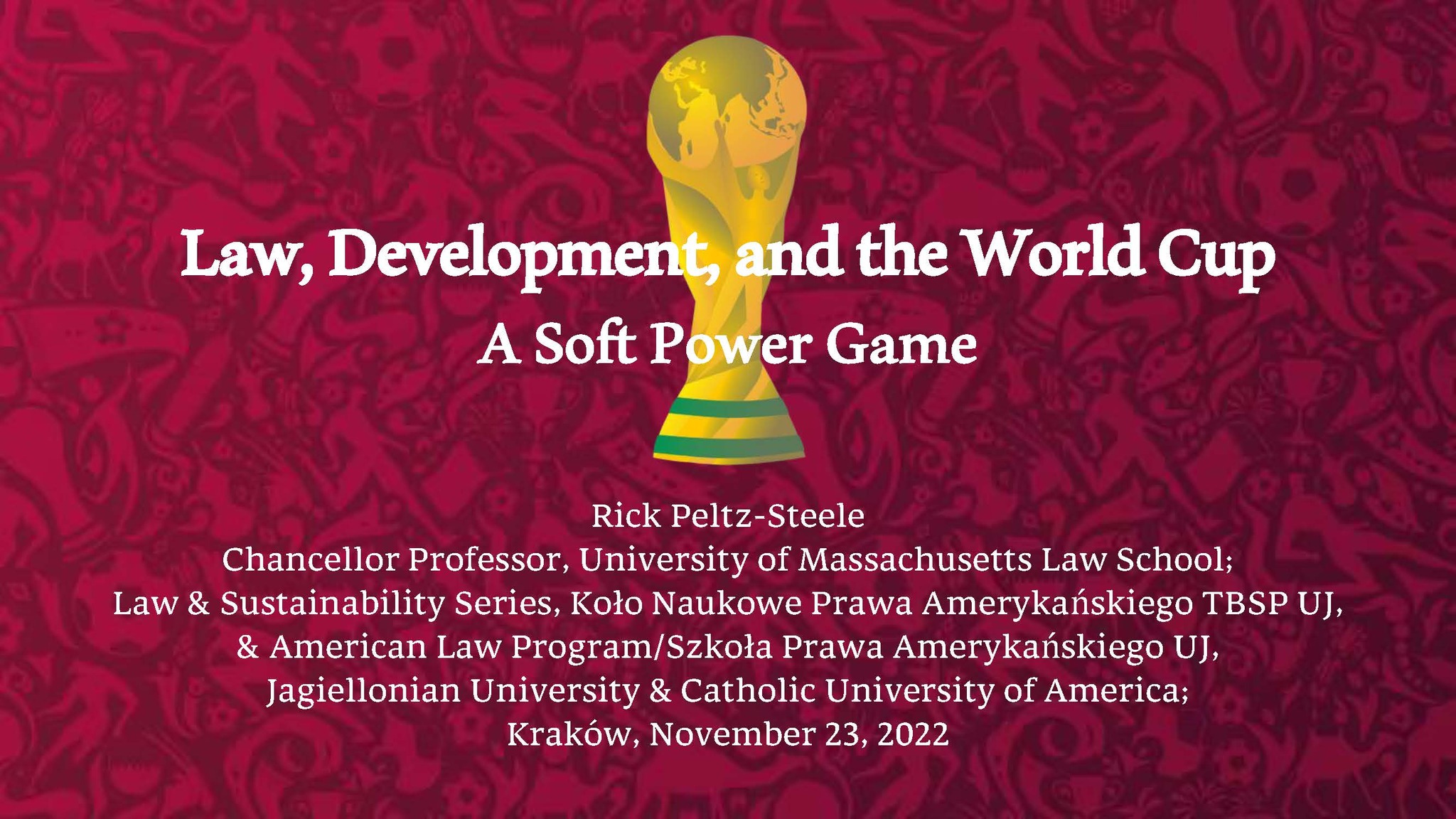
As advertised, last week in Kraków, Poland, I had the great privilege to talk law, development, and the FIFA World Cup, with the group stage under way in Qatar.

Students and faculty of the American Law Scientific Circle (KNPA) and American Law Program at Jagiellonian University (KoÅ‚o Naukowe Prawa AmerykaÅ„skiego TBSP UJ and SzkoÅ‚a Prawa AmerykaÅ„skiego UJ), in collaboration with the Columbus Law School at the Catholic University of America, generously hosted me.  The talk kicked off a KNPA lecture series on "Law and Sustainability." My especial thanks to KNPA President Zuzanna Maszniew and her leadership team.

Photo © Zuzanna Maszniew, used with permission.
I was no John Oliver, to be sure, but I hope I stimulated thinking about the Gordian Knot of sport and politics and its implications for the Middle East and North Africa's place at the table.

Today, November 29, the United States will round out its play in the group stage in Qatar with a match against Iran, simultaneously with a high stakes stand-off between England and Wales. It's a big day, football fans.

Meanwhile, coming home to the States this week, I've been disappointed that Americans are not more in tune with the fascinating stories of geopolitics that are unfolding under the sporting tents of the Qatar World Cup. I admit, what's happening now in China dangles meritorious distraction. But with the USMNT facing Iran today, I want to mention one of the stories from Qatar that has gripped me.

In Iran's opening match with England last week, Iranian footballers refused to sing their own national anthem (BBC).  Stony faced, the players apparently chose to stand in silent solidarity with rights protestors against the government at home (N.Y. Times). Subsequently, Iranian authorities arrested a former national-team footballer known for occasional anti-regime sentiments (Guardian). At Iran's second match, the lads toed the line.

The anthem stunt was extraordinarily courageous. The players had to have known the disgrace they brought on the regime would have consequences when they go home, if not sooner.

Iranian footballers in 2018.
Mahdi Zare/Fars News Agency via Wikimedia Commons CC BY 4.0
More, though, I was struck by the reminder that people and their governments are not the same thing.

I'm a reasonably bright person, as people go, and I've seen a lot of the world. I come from an immigrant family myself. I grew up with a dear Iranian friend. Her stepmother taught me how to make tahchin, and her dad eagerly gave me his own well worn copy of All the Shah's Men. I shouldn't need to be reminded that people are just people, much the same around the world, just trying to make the best of things and find some joy where we can; and that it's wrong to ascribe the Machiavellian motives of states, whether others or our own, to their citizens. The protests now in China say the same.

Yet, I admit, I had followed the USMNT into the World Cup with something of a Cold War mentality, maybe because of the era when I grew up. Yellow ribbons, burning effigies, and "Death to America" chants all bounce around my long-term memory. I was determined that we and our Group B compatriots from England and Wales should beat Iran to make some kind of political point. A Miracle on Ice or Rocky IV situation.

The Iranian men's demonstration unsettled my unconscious prejudice. As a result, a part of me has been pulling for Iran in their last matches, even while, still, I had to favor the England squad, which features some of my beloved Manchester City stars, and Wales, which invokes Lasso-esque Wrexham affections. And even while, of course, I support my home USMNT today, there will be a part of me that wants to see the Iranian side make a pride-worthy showing.

Wednesday, November 23, 2022

With FIFA World Cup under way in Qatar, law students study sport and soft power, law and development

I'll be talking law, development, and the World Cup today in Kraków, Poland.

Thanks to the American Law Scientific Circle (KNPA) and American Law Program at Jagiellonian University (Koło Naukowe Prawa Amerykańskiego TBSP UJ and Szkoła Prawa Amerykańskiego UJ), in collaboration with the Columbus Law School at the Catholic University of America, for hosting me. This talk kicks off a KNPA lecture series on "Law and Sustainability" and begins at 3 p.m. CET at Pałac Larischa 203, Bracka 12.

I'll share some of the subject matter later.  Too much football to watch!

Wednesday, November 16, 2022

Qatar World Cup opens Sunday; meanwhile, Netflix series stokes embers of FIFA corruption scandal

I visited CONMEBOL HQ in Asunción, Paraguay, in October.
The South American angle on the FIFA corruption scandal
was engagingly fictionalized in El Presidente in 2020.

(Photo by RJ Peltz-Steele CC BY-NC-SA 4.0.)

The sport world is abuzz over the Netflix documentary series, FIFA Uncovered, dropped November 9, just weeks before the FIFA World Cup opener in Qatar.

Many in Qatar are crying foul by filmmaker Miles Coleman for dredging up the ugliness of the FIFA corruption scandal, the focus of this docuseries, right now. But in an interview with renowned MENA scholar James Dorsey, Coleman, who created This Is Football for Amazon Prime in 2019, said he had no motive other than historical documentation. The timing of the release, Coleman said, is to bring football fans up to speed on the facts, so they can have informed conversations around the Qatar World Cup.

FIFA was rocked by scandal in 2015 when investigators led by the U.S. Department of Justice (DOJ) arrested top officials in Zurich and issued an avalanche of indictments. It was revealed then that corruption practically poisoned every part of world football governance, especially the bidding process for the world's top sporting event and its 2010 award to Russia for 2018 and Qatar for 2022.

Qatar narrowly edged out a bid from the United States in 2010, and disgraced FIFA President Sepp Blatter and his allies accused the United States of spite. Purportedly relieved of corrupt process, FIFA in 2018 awarded the 2026 World Cup to the joint bid of the United States, Canada, and Mexico.

When issues remain controverted, the docuseries presents all voices, Coleman told Dorsey. Indeed, the interviews are what makes the series worthwhile. Most of the story has been told already and well; I read and reviewed a number of books on the subject in the first pandemic summer. The docuseries, though, includes interviews with just about every key player, including Blatter himself, as well as Qatar bid chief H.E. Hassan Al Thawadi; "Qatar whistleblower" Phaedra Al-Majid, featured recently on Norwegian television; and Mary Lynn Blanks, romantic partner of corrupted American football official Chuck Blazer, who died in 2017.

Among the revelations, or at least confirmed suspicions, arising from the docuseries interviews is the fact, borne out by evidence besides his own testimony, that Blatter favored the United States rather than Qatar to host the 2022 World Cup. For all Blatter's failings, he was outmaneuvered by the colossal corruption machine that he helped to create. African Football Confederation President Issa Hayatou, a rival of Blatter's within FIFA, was key to securing the Qatari win. Hayatou was joined in his efforts by Jack Warner, president of the North, Central America and Caribbean Association, whose defection infuriated Blazer.

On Wednesday next week, November 23, at Jagiellonian University in Kraków, Poland, I will lead a discussion, "Law, Development, and the World Cup."  The program, in English, begins at 3 p.m. local time at PaÅ‚ac Larischa 203, Bracka 12.

The World Cup opens Sunday night in Doha, Nov. 20, at 1100 US EST/1600 GMT, when Qatar hosts Ecuador in Group A. The United States MNT plays its Group B opener against Wales on Monday, Nov. 21, at 1400 US EST/1900 GMT. Poland plays its Group C opener against Mexico on Tuesday, Nov. 22, at 1100 US EST/1600 GMT/1700 CET.

Hat tip to Alessandro Balbo Forero, an alum of my Comparative Law class who wrote his final paper on football and Brexit, for alerting me to the drop of FIFA Uncovered. He's an Arsenal supporter, but nobody's perfect.

Here is the trailer for FIFA Uncovered:

And here is the Dorsey interview of Coleman:

Tuesday, September 20, 2022

UK orders commission to study women's football; rising TV prices warn of commercial monopolization

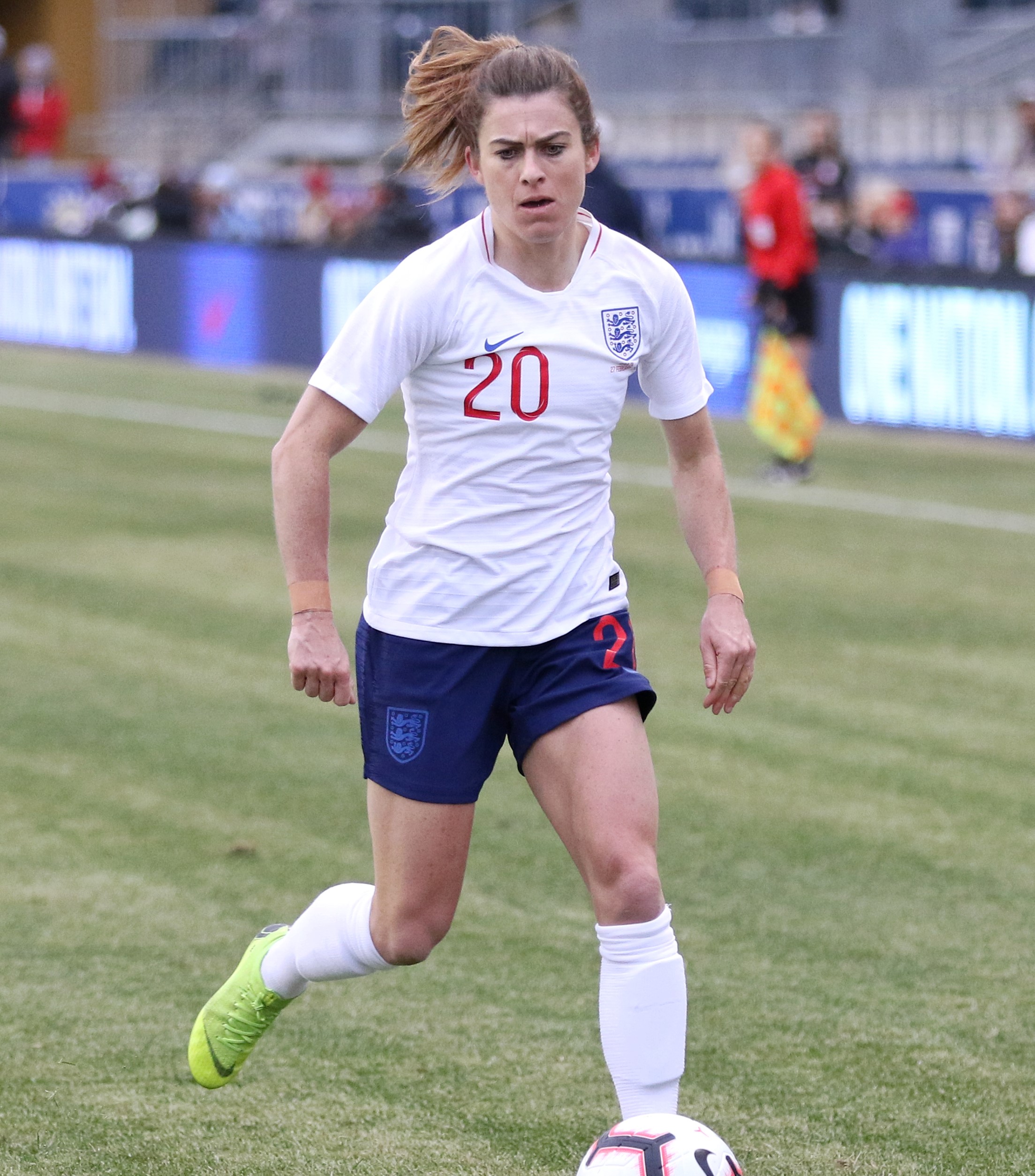
Karen Carney in 2019
(James Smed CC BY 2.0 via Wikimedia Commons)
The UK has announced "an in-depth review into the future of domestic women’s football" and appointed the decorated footballer and today commentator Karen Carney MBE to chair.

In the United States, this year marked the historic equal pay settlement for the blockbuster Women's National Team (USWNT). And in the UK, England hosted and won the 13th UEFA Women's Euro 2022, delayed two years by the pandemic, in a nail-biter over Germany.

Though to say women's football is coming into its own is an assertion decades late, just as it is decades early to say that women's football has at last been afforded parity with men's in social and commercial recognition.

The UK announced three points of focus for the review:

[1] Assessing the potential audience reach and growth of the game—by considering the value and visibility of women’s and girls’ football in England, including the potential to grow the fanbase for women’s football and whether current growth still supports home-grown talent and can be achieved without overstretching infrastructure.

[2] Examining the financial health of the game and its financial sustainability for the long term. This will include exploring opportunities and ways to support the commercialisation of the women’s game, broadcast revenue opportunities and the sponsorship of women’s football.

[3] Examining the structures within women’s football. This includes the affiliation with men’s teams, prize money, the need for women’s football to adhere to the administrative requirements of the men’s game; and assessing the adequacy, quality, accessibility and prevalence of the facilities available for women’s and girls’ football for the growth and sustainability of the game.

The UK does have already a system for youth development in women's football that looks sophisticated from the U.S. vantage point. Carney is a case in point. Even in the 1990s, Carney came up through the ranks of Birmingham City since age 11. She became one of England's top capped players, scoring 32 goals for the national side from 2005 to 2019.

After three years at Arsenal, in 2009, Carney moved to the United States to play for the Chicago Red Stars, a team then affiliated with the Women's Professional Soccer league (WPS). The WPS was a short-lived installment in the fits and starts of women's pro soccer in the United States. The league collapsed after scarcely a year. Carney returned to England in 2011 to play for five years again for Birmingham City, then three years for Chelsea.

Today, Carney comments on both men's and women's football for Sky Sports and Amazon Prime. The Chicago Red Stars play today as part of the National Women's Soccer League.

Sky, like NBC in the United States, is a division of Comcast. The anti-competitive bundlings of these interrelated companies is making it unaffordable for viewers in the UK and in the United States to follow a team. I'm not sure how long UK viewers and regulators will tolerate the exploitation. Some Latin American governments have been increasingly ruffled about commercial efforts to make access to football a privilege of the elite. I've speculated that in the United States, NBC is effectively killing the goose that laid the golden egg. U.S. viewers will never commit to world-class Premier League football if they're given access only to different teams and lower priority matches week to unpredictable week.

Unfortunately, commercial development of the women's game presents the same conundrum. Commercialization in the priorities of the Carney review is presented as an undisputed good. To be sure, that's where the money is, and it will take money to bring the women's game to gender parity.

At the same time, there is evidence already in the United States that commercial success, ironically, invites audience exclusivity and, thus, narrows public appeal. USWNT television rights presently lie with ESPN and Fox Sports, both divisions of Disney. But Disney+ viewers won't find the USWNT there, nor in the Disney+/ESPN+ bundle, as "+" seems to be a number less than (ESPN)2 and (ESPN)3.

In March, US Soccer awarded USWNT and men's team rights together in an eight-year deal to HBO Max and Turner properties, all divisions of AT&T by way of WarnerMedia. An HBO subscription doesn't come cheap, and different Turner channels require subscription to different bundles.

With media empires now controlling access to football on both sides of the Atlantic, fans' budgets will be stretched thin, and appetite for allegiances to new endeavors, such as expanded women's football, might prove difficult to stir. If the women's game is to be kept from becoming a victim of its own success, the goal of commercialization should be viewed with a discerning eye, wary of monopolization.

A call for evidence in support of the Carney review is expected from the UK Football Association in the coming weeks. HT @ lawyer Paul Maalo, writing for the Wiggin digital commerce team in London.