Showing posts with label FIFA. Show all posts

Monday, September 7, 2026

UEFA-FIFA football war spills into U.S. courts as European lawyers wield discovery 'superpower'

A powerful American legal tool is a weapon of choice in a brewing legal battle between two of the world's most powerful transnational sporting organizations.

Soccer might not be on the minds of Americans on a daily basis, but that won't stop the global corporate landscape from shifting under our feet as two behemoths of football governance wage world war on one another. Battles in that war erupted in three U.S. federal courts at the end of August.

RJ Peltz-Steele with Google Gemini CC0 1.0
UEFA, the governing body of football in Europe, filed ex parte applications in U.S. courts on August 27 with expansive discovery demands in anticipated litigation against world-governing FIFA. FIFA fought back last week with counter-filings as a would-be intervenor. Dirty laundry is close to spilling out, and the mechanism making it possible is a section of the U.S. code that bestows on foreign lawyers a "little-known superpower."

First, some context. Americans might remember from the waning days of the World Cup news cycle—and thus the waning days of Americans caring about soccer, despite the summer hype, and owing significantly to the self-inflicted wound of allowing profit-thirsty NBC to fragment Premier League matches across disparate network bundles, but that's another story—that FIFA chief Gianni Infantino, apparently intoxicated by the refined air inside his mega-millionaire bubble, proposed selling shares in the people's game to private investors. 

The proposal was akin to a company going public, except not at all public and, being above the laws of nations, hardly regulated. After schmoozing States-style, Infantino wanted to do his part to firm up the global wealth gap and to locate himself at its rich-ward extreme. No joke: Infantino's vision looks like it was modeled on President Trump's Board of Peace, with which Infantino's FIFA in fact formally partnered. Infantino would have set himself up as the head of a World Cup company, sidestepping the inconveniently quasi-democratic and term-limiting features of the FIFA presidency, and shaken down private investors and member associations for minority stakes.

There apparently is some limit to what even the supra-national, mega-rich can do, as Infantino's plan drew worldwide rebuke. Of course there was objection from watchdogs, such as Reboot FIFA, a campaign I signed on to that holds out hope for socially responsible sporting governance and issued a July statement condemning the Infantino plan. But tellingly, FIFA's member associations led the chorus of boos; UEFA pledged a boycott of FIFA. The limit might be when rich people step on the toes of other rich people, because UEFA is no stranger to the profit-engine-masquerading-as-for-the-commoner MO of professional football governance.

Longer memories will recall when Swiss police raided FIFA headquarters in 2015 at the behest of U.S. investigators, and the U.S. Department of Justice filed a 47-count federal indictment in Brooklyn targeting top FIFA brass. Mighty FIFA President Sepp Blatter fell from grace, and it looked for a moment like democracy might be bigger than corporatocracy.

Infantino shows Trump the World Cup trophy in the Oval Office, 2025.
U.S. Government (public domain) photo from the White House
The moment didn't last. It only proved the old adage, cut the head off the hydra, and two more take its place. Infantino inaugurated a new era of next-level corruption. Of course, the U.S. prosecution had been motivated in part by the FIFA hijinks that saw the U.S. bid for the '22 World Cup founder in the face of Qatar's, let's say, "procurement." The '26 World Cup was our payoff. Washington meanwhile changed lanes to go all in on pay-to-play, and FIFA awarded President Trump his personally tailored Peace Prize. Plutocratic order was restored.

Infantino backed off of the private-investment plan. Yet hell hath no fury like a sporting cartel scorned. UEFA persists, demanding that FIFA oust Infantino and threatening legal action. 

Meanwhile, because there's a grain of truth to the offensive assumption that all rich people know each other, there's a U.S. connection to the FIFA scandal that runs even deeper than Trump and Infantino's mutual social grooming. New York-based Thrive Capital, a venture capital firm, was set to pour $4.2 billion into Infantino, Inc. And the co-founder and soul of Thrive Capital is Joshua Kushner.

You think I mistyped Jared Kushner, the President's son-in-law who solved the Middle East. No. Josh is the other Bennet sister, an entirely different offspring of tax fraud, etc., convict Charles Kushner. Not that I'm judging a book by its author; a billionaire deserves a chance to write his own story.

Since the Infantino deal went up in glorious flames, Josh Kushner has tried to distance Thrive and himself from it. He says he never would have gotten involved had he known, and that he thought the deal would funnel more capital to promote socioeconomic development. Shoulda coulda woulda.

Well, UEFA wants to know more about that. Which is why its breathtaking range of documents filed in the U.S. District Court for the Southern District of New York includes, very much inter alia, a proposed subpoena for the deposition of one Joshua Kushner.

RJ Peltz-Steele with Google Gemini CC0 1.0
The legal tool at the heart of the UEFA filings is 28 U.S.C. § 1782. The law opens up the discovery process of U.S. civil procedure for litigants in other countries to access records and to depose persons in the United States. Though section 1782 is implicated here, as it usually is, in connection with business disputes, it can be used just as well in ordinary tort litigation, from fraud to personal injury. 

This is important, because U.S. discovery is famously more expansive than production in other legal systems. Fittingly, U.S. civil procedure takes a sort of free-market approach to discovery, upon a truth-will-out philosophy. The system, articulated in the relevance-and-proportionality standard of Rule 26(b) of the Federal Rules of Civil Procedure, does not grant carte blanche for fishing expeditions, especially since 2015 amendment tried to rein it in a bit. But it goes a lot farther than the they-didn't-ask-so-don't-tell approach that is the norm in Europe.

Section 1782 on its face requires that (1) the domestic respondent can be found in the U.S. district in which discovery is sought, (2) the discovery is for use in a foreign or international tribunal, and (3) the section 1782 requester has an interest in the foreign proceeding. The statute won some notoriety in 2022 when the U.S. Supreme Court resolved a circuit split by deciding that arbitral panels are not eligible tribunals under the second element.

Section 1782 compliance by U.S. district courts is discretionary, not required, by the statute. So the U.S. Supreme Court in 2004 set out factors to guide court discretion: (1) whether the domestic respondent is subject to the foreign proceeding, so discovery might rather be sought against the respondent there; (2) whether the foreign tribunal is receptive to U.S. court assistance; (3) whether the requester is trying to circumvent an intended limitation on discovery in the foreign system; and (4) whether the request is especially intrusive or burdensome. The third factor especially tends to be a contested point, and it is sometimes difficult for U.S. courts to find the line between a foreign limitation on discovery by design and the mere happenstance that the foreign discovery system is more conservative than the U.S. system.

In a 2020 empirical study, Penn Carey Law Professor Yanbai Andrea Wang concluded that section 1782 is an "increasingly pervasive practice that is transforming civil litigation worldwide." With 90% of ex parte 1782 requests granted, Wang found that the law raises due process concerns. Potential adversaries in the home litigation are not always given proper notice of their right to intervene in the United States and object to the discovery. In the instant matter at least, the 1782 petition is part of UEFA's public relations strategy. And FIFA had no trouble intervening in New York and mounting a public relations offensive of its own, accusing UEFA of a "smear campaign." 

Properly employed, section 1782 does open the door for a foreign actor to poke around in the business of an adversary or potential adversary, to bolster a legal theory back home, in a way that it could not without the U.S. hook. Sometimes what the requester can discover with the aid of U.S. law is valuable enough to shift public opinion or a case on its merits so significantly as to obviate or dispose of the matter back home. It's not a stretch to figure that UEFA hopes to find Infantino-Kushner correspondence so damning or embarrassing as to compel Infantino's ouster.

Watching the battles unfold in UEFA vs. FIFA, and In Re Union Des Associations Europeennes de Football (S.D.N.Y. filed Aug. 27, 2026) in particular, is a bit like being on a rowboat between battleships. But the stab at arrogant corporate impunity, even if thrust by a fellow titan, is nonetheless prone to induce a satisfying schadenfreude, especially if UEFA can bring Infantino down.

RIP, football transparencist Andrew Jennings. Your mouth would be watering.

Wednesday, February 25, 2026

Lichtman lecture unpacks politics of World Cup

Prof. Steven Lichtman spoke at UMass Law Thursday on "Soccer and American Exceptionalism: A Political Science Preview of World Cup 2026."

With the FIFA men's World Cup of soccer coming soon to the co-host United States, Prof. Lichtman took a peek behind the curtain at the once embattled yet seemingly unshameable enterprise of the world's biggest sporting event.

The American indictments and dramatic Zurich raid of the 2015 FIFA corruption scandal seem hardly to have slowed soccer's voracious appetite for cash. And sport is inseparable from politics. After all, FIFA President Gianni Infantino recently turned up at the inaugural meeting of U.S. President Donald Trump's Board of Peace. That struck me as an aptly symbolic testament to the corporatocratic nature of the Trumpian new world order. 

Prof. Lichtman spoke to the long history of World Cup politics, for example examining how reaction to the 1986 "Hand of God" goal manifested the angst and identities of both post-colonial Argentina and post-imperial England.

RJ Peltz-Steele CC BY-NC-SA 4.0
A self-described "recovering lawyer," Prof. Lichtman is co-editor of Judging Free Speech: First Amendment Jurisprudence of U.S. Supreme Court Justices (2015). His other work has appeared in the Maryland Law Review, the Penn State Law Review, Vingtième Siècle Revue d'Histoire, the Pennsylvania Lawyer, and the newsletter of the Law and Courts section of the American Political Science Association. He earned his bachelor's and Ph.D. at Brandeis University, where he was a founder of the Boris' Kitchen Sketch Comedy troupe, and his J.D. from New York University.

Prof. Lichtman is a professor of political science at Shippensburg University. He serves also as executive director of the New England Political Science Association, and he is the incoming president of the Northeast Association of Pre-Law Advisers. His visit to UMass Law was co-sponsored by the International Law Students Association, the Law & Political Economy student organization, and the Office of the Dean.

Sunday, September 14, 2025

'Liberal Playmaker' goes Substack; Boston awaits FIFA

"The Liberal Playmaker," a.k.a. Jose Benavides, is now on Substack.

Benavides, a Texas attorney, past co-author, and excellent former student, has been producing informative and compelling content about soccer (football) and politics since launching a year ago (featured at The Savory Tort in March 2025).

Benavides has a passion for the beautiful game, and it is contagious through his writing. His narrative pieces recall great players and great games and also comment on the current business and art of the sport. 

Here are recent titles:

The Liberal Playmaker will be a content maker to watch as we near World Cup 2026. Boston has deployed a massive publicity campaign to gin up interest, e.g., Boston's South Station, below, in July (RJ Peltz-Steele CC BY-NC-SA 4.0), though the relevant venue is Gillette Stadium in Foxborough, Massachusetts, home to the MLS New England Revolution and NFL Patriots.


Friday, May 9, 2025

Poli sci research dazzles with deep dive on judicial bias, asylum woes, AI to police corruption

The New England Political Science Association (NEPSA) met at Bretton Woods, N.H., late last month.

I always look forward to the NEPSA meeting, as political scientists are just about the warmest crowd of academics I know. No other kind of social scientist so eagerly shares knowledge as the political scientist, who similarly embraces interdisciplinary feedback, even from a non-PhD such as me.

True, political scientists can and do argue about anything. They put law professors to shame in that regard. You make a mistake of parliamentary procedure at the political science business meeting at your peril. 

But only the political scientist compromises her or his confident disputation with a wink of the eye that acknowledges the house of cards we've built around ourselves. You won't find that kind of concession in the grim gaze of an economist.

I saw a great many fabulous papers as always at NEPSA, and I had the privilege of chairing and discussing the papers on a compelling panel on law and public policy on April 26. The panel comprised Dr. Ihsan Alkhatib, Murray State University; the Hon. Sarada Prasad Nayak, UMass Amherst; and attorney Nicole Norval, Eastern Connecticut State University.

All of the panelists, like me, are recovering lawyers. Dr. Alkhatib practiced family law and immigration law for a decade in the Detroit area, representing mostly Arab- and Muslim-American clients. Nayak was a judge in various capacities, including family court, in Odisha State, south of Kolkata, in India for 30 years, before moving to the United States for a new pursuit in academics. Norval was a real estate attorney in South Africa before she left to trot the globe as a tech exec, reg counsel, and business law professor.

In the projects presented, Dr. Alkhatib is studying U.S. immigration law, and in particular the awful consequences of failing to recognize violence against women expressly as a basis for asylum. Judge Nayak, with co-author Dr. Paul Collins Jr. at UMass Amherst, is poring over an extraordinary database of cases in India to understand religious and gender biases in judicial decision-making, with transnational implications. And attorney Norval, with co-author Sameer Somal, CEO of Blue Ocean Global Technology, is looking at the potential for AI to detect and police corruption in business and finance, testing real tech on models such as FIFA and FTX, with promising results.

These authors' paper abstracts are copied below. The full 2025 NEPSA conference program with abstracts is available for a limited time here.

The NEPSA conference was stewarded as usual by the incomparable Dr. Steven Lichtman, Shippensburg University, a friend who never fails to inspire me with his teaching and in his clear-eyed commitment to supporting colleagues and developing academic talent.

Here on The Savory Tort this coming Monday, May 12, 2025, I will write about Bretton Woods as the location of the founding of the International Monetary Fund, and how that history has come up lately in our politically tumultuous times. Stay tuned.


Ihsan Alkhatib, Murray State University
Gender in Immigration Court: Orientalism on Trial
There are five grounds for asylum. Gender is not one of them. Gender however comes up under the grounds of Particular Social Group. Two approaches to gender claims from the Arab world are presented and compared. I argue that one approach is grounded in Orientalism and perpetuates Islamophobia. The second approach is is grounded in a global view of gender and is more accurate representation of gender reality. Immigration lawyers are bound by Rules of Ethics. Advocacy grounded in the second approach is more consistent with the ethical obligations of lawyers.

Sarada Prasad Nayak, University of Massachusetts - Amherst
Case Backlogs and Bias in Timely Justice Delivery in the Indian Judiciary
Understanding bias in the judicial decision-making process is crucial for ensuring fairness and justice in the legal system. To date, scholarship on judicial bias focuses overwhelmingly on the American legal system, focusing on case outcomes or judges’ voting behavior. In this paper, we shift the focus outside of the U.S. and beyond case outcomes. To do this, we examine judicial delays in India, where prolonged legal processes often serve as a form of punishment. We theorize that bias may infiltrate the amount of time it takes to dispose of cases based on the gender and religion of the judge who is assigned the case, as well as those of the defendants. To subject these expectations to empirical scrutiny, we analyze hundreds of thousands of criminal cases decided in India’s lower courts. Our results indicate that Muslim defendants experience shorter delays when their cases are heard by Muslim judges, providing evidence of in-group bias. However, there do not appear to be differences in the timing of case outcomes based on the defendant or judge gender. This study contributes to the literature by highlighting how judicial delays in less developed countries may reflect subtle forms of bias, mainly along religious lines. 

Nicole Norval, Eastern Connecticut State University
Can AI Reduce Business Corruption - and Prevent Another FIFA … Another FTX?
Regulators consider artificial intelligence (‘AI’) an inevitable tool for compliance with regulations such as anti-corruption laws. How should we regulate AI to improve regulatory compliance without sacrificing the right to privacy? Can we regulate AI to prevent corrupt business practices and improve human rights outcomes? Unifying existing and forthcoming AI regulation in multiple jurisdictions (primarily the United States and the European Union) in a matrix of business corruption reforms, results in a useful legal model. This paper concludes by applying the model to the decades-long Fédération Internationale de Football Association (FIFA) corruption scandal and the recent FTX cryptocurrency exchange bankruptcy to understand the benefits and limitations of this legal framework. We examine why AI is an inevitable tool for regulatory compliance, comparing, AI regulation, guidelines, and recommended practices in the United States, the European Union, and other jurisdictions, in order to extract common objectives of AI regulation such as protecting privacy rights and improving human rights outcomes. We discuss business corruption reforms in general, focusing on the financial services sector as a business sector crucial for such reform initiatives. Integrating these financial services sector reforms with common AI regulation objectives, we construct a legal model for application to business corruption events. We apply this legal model to two business corruption events with significant negative financial impact in order to establish whether the use of AI to identify business corruption signifiers would have reduced these negative financial impacts, protected privacy rights, and improved human rights outcomes. We conclude by identifying limitations and benefits of our legal model for future improvement, examining the moral imperative and impact of this research, and identifying further areas of research.

Thursday, September 14, 2023

U.S. Soccer, FIFA lose antitrust appeal; defense shows short-sighted strategy to develop soccer in America

Cristiano Ronaldo plays for Real Madrid against Barcelona in 2011.
Jan S0L0 via Flickr CC BY-SA 2.0
U.S. Soccer and the Fédération Internationale de Football Association (FIFA) will have to defend an antitrust action in federal court for refusing to permit a Spanish La Liga match on U.S. soil, the Second Circuit ruled in March. 

In 2017, world famous football (soccer) clubs Real Madrid and Barcelona faced off in an exhibition game in Miami. The match was fabulously lucrative for the commercial interests behind it, including organizer Relevant Sports, LLC, based in New York.

World sport likes the United States, because our infrastructure practically prints money. Americans, especially the top echelons of the wealthy, have been habitualized by our unregulated and often subsidized sport-and-entertainment monopolists to pay more than people elsewhere in the world to see live events, both directly for seats and indirectly in media rights.

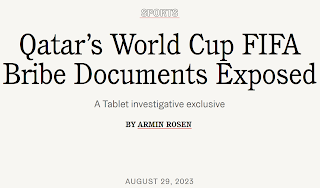
Incidentally, that's the principal reason that bringing the FIFA (men's) World Cup back to North America in 2026 was not really a hard sell, notwithstanding modest public enthusiasm and the theater of the global bidding process. The 2026 co-hosts, the United States, Canada, and Mexico, likely did not even have to pay the half-billion dollars that Qatar apparently spent, mostly to FIFA executive committee members, in, uh, let's say, "incentives," in siting the 2022 World Cup (about my World-Cup-2022-contemporaneous lecture; Qatar on this blog): check out the investigative exclusive by Armin Rosen for Tablet (link from inset), published late last month, using U.S. court records in collateral matters.

Understandably, then, Relevant Sports wanted to maintain the momentum of the 2017 exhibition match. The company proposed that the Spanish La Liga subsequently might site a regular-season, full-stakes match in the United States. 

However, FIFA rules say that a match cannot be held in a country foreign to both sides without the approval of the football federation in the host country. U.S. Soccer said no.

Relevant sued, alleging that the rule improperly protects domestic football from being overshadowed, and therefore diminished in interest and income, by high-profile competitors. U.S. Soccer and FIFA defend the system on the merits under antitrust law, and, saliently in this intermediate disposition, argued that the FIFA "rule" is not really a rule, because FIFA doesn't make the decision for U.S. Soccer or La Liga. They're free to make their own decisions, notwithstanding potential adverse consequences, such as exclusion from international competition for players, teams, or federations that don't play ball.

The instant Second Circuit decision is limited. The court remanded the antitrust claim to proceed, recognizing that FIFA's rule is rule enough to represent the kind of concerted action in violation of antitrust law that Relevant alleges.

Earlier this week, I wrote about Cory Doctorow's enthusiasm, which I share, for the federal government's antitrust agenda—including the Justice Department investigation of Google. (I canceled my Google Nest Aware subscription upon the 25% rate hike. Google's not the only game in town. Yet.) U.S. Soccer's loss in the Second Circuit represents a judicial step in the same right direction.

I'm not an antitrust expert. But to my relatively lay eyes, the fact that the federal district court dismissed the case in 2021 on the faint theory that U.S. Soccer was not formally bound by FIFA's command demonstrates how appallingly far U.S. antitrust law has strayed from basic fair-market principles. Or maybe the court just didn't understand the governance system in world sport and its facility for subverting the laws of nations.

USWNT celebrates in times happier than this year's World Cup.
rachael.c.king via Flickr CC BY 2.0
The U.S. Soccer position in the litigation to me demonstrates furthermore a fundamental misunderstanding of what it will take to make football successful in America. American soccer advocates often wonder aloud why the sport seems to stall again and again, even after the men's World Cup in the United States in 1994 and the astonishing run of the U.S. Women's team in an unprecedented four World Cup titles.

To be sure, there are many, many reasons for the frustrating cycle of revving and stalling. But equally surely, one of those many reasons is the short-term greed of commercial actors that works a detriment to long-term development. 

I've written previously about this problem in the context of media rights. When NBC acquired the rights to English Premier League football, the broadcaster divvied up matches among its many media properties based on the popular appeal of each. NBC's strategy was to leverage interest in the league to sell separate subscriptions to multiple services: NBC, NBC Sports, (at one time, "NBC Gold,") Peacock, USA, Telemundo, Universo.

The network either didn't consider or doesn't care what that model looks like from the customer's perspective. Football in a place such as its home U.K. (at least before U.K. media companies such as Sky started merging with U.S. media giants and took sport away from the publicly minded BBC; that's another story) maintains a multi-generational foothold because supporters follow their teams.  

Divvying up the matches makes it impossible in the United States for a viewer to follow a team. Each week, one gets whatever match a selected service happens to carry, based on its level of market appeal.  If you subscribe to a middle-tier service and your team starts to lose, you might get more matches. If your team starts winning, and you start becoming more engaged, you find yourself suddenly deprived of matches.

That market behavior doesn't build a fan base. For American football or basketball, maybe there are enough viewers who will watch any game because they love the sport. But Americans don't yet love soccer that much. Sport-market development requires fostering two interrelated conditions at the same time: public enthusiasm for the sport, and public enthusiasm for a team. Neither can thrive without the other.

U.S. Soccer's refusal to permit La Liga to play a match on U.S. soil also is self-defeating, if for the converse strategic blindness. Both media rights usurpers and U.S. Soccer, focused on short-term profits, are dampening American enthusiasm by impeding U.S. viewers' access to the highest level of play in the world, in the Premier League and La Liga. While NBC's strategy deprives Americans of the opportunity to root for a team, the U.S. Soccer strategy deprives Americans of the opportunity to root for the sport.

Again, neither can thrive without the other.  U.S. Soccer is trying to protect Major League Soccer and the federation's underage and lower divisions. The federation reasons coldly that someone who buys a $500 La Liga ticket will skip five or ten $48 Tampa Bay Mutiny matches.

They're wrong. One of my U.S.-based family is a card-carrying member of the Toon Army, a dedicated supporter of Newcastle (U.K.) United FC. He traveled domestically to see Newcastle play an exhibition match in the United States this summer. Being a Newcastle supporter has made him a more, not less, enthusiastic supporter of his nearby D.C. United and the U.S. men's and women's national teams. With access to the matches of each, live and on TV, he's more likely to spend money on all of them.

Antitrust law is not a device to make commercial actors prioritize long-term interests over short. To the contrary, if NBC and U.S. Soccer put themselves out of business, that's a healthy outcome for the free market. But if antitrust inadvertently compels U.S. Soccer to up its game and compete for eyeballs by actually developing the sport, rather than constraining consumer choice, then that's an outcome I can get behind.

The case is Relevant Sports, LLC v. U.S. Soccer Federation, Inc. (2d Cir. Mar. 7, 2023). U.S. Circuit Judge Raymond J. Lohier, Jr.., wrote the opinion of the unanimous panel that also comprised Chief Judge Livingston and Judge Lynch. In 2017's "El Clásico Miami," Barcelona bettered Real Madrid 3-2.

Tuesday, November 29, 2022

Politics complicates football: Sympathy for ... Iran

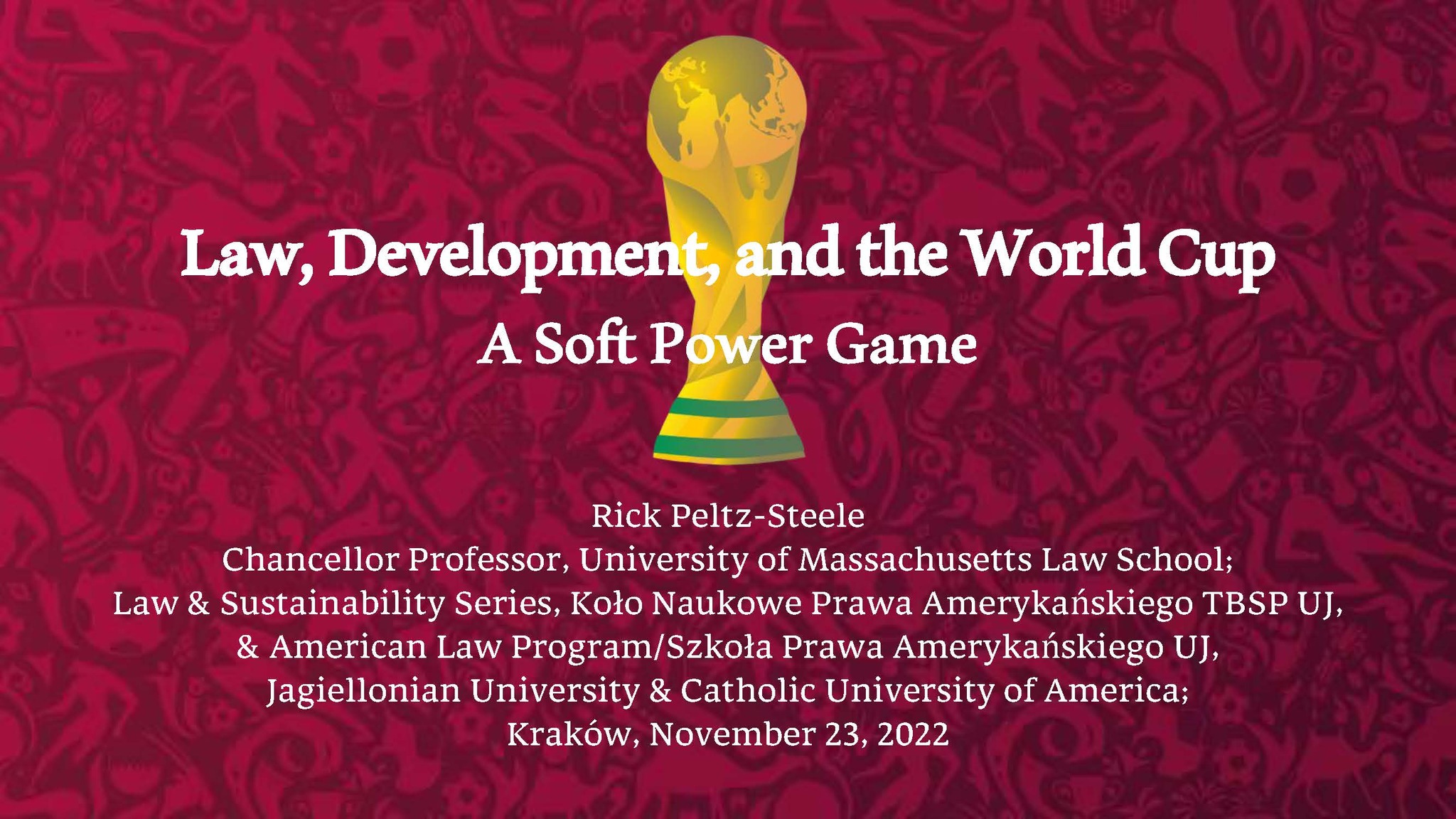
As advertised, last week in Kraków, Poland, I had the great privilege to talk law, development, and the FIFA World Cup, with the group stage under way in Qatar.

Students and faculty of the American Law Scientific Circle (KNPA) and American Law Program at Jagiellonian University (Koło Naukowe Prawa Amerykańskiego TBSP UJ and Szkoła Prawa Amerykańskiego UJ), in collaboration with the Columbus Law School at the Catholic University of America, generously hosted me.  The talk kicked off a KNPA lecture series on "Law and Sustainability." My especial thanks to KNPA President Zuzanna Maszniew and her leadership team.

Photo © Zuzanna Maszniew, used with permission.
I was no John Oliver, to be sure, but I hope I stimulated thinking about the Gordian Knot of sport and politics and its implications for the Middle East and North Africa's place at the table.

Today, November 29, the United States will round out its play in the group stage in Qatar with a match against Iran, simultaneously with a high stakes stand-off between England and Wales. It's a big day, football fans.

Meanwhile, coming home to the States this week, I've been disappointed that Americans are not more in tune with the fascinating stories of geopolitics that are unfolding under the sporting tents of the Qatar World Cup. I admit, what's happening now in China dangles meritorious distraction. But with the USMNT facing Iran today, I want to mention one of the stories from Qatar that has gripped me.

In Iran's opening match with England last week, Iranian footballers refused to sing their own national anthem (BBC).  Stony faced, the players apparently chose to stand in silent solidarity with rights protestors against the government at home (N.Y. Times). Subsequently, Iranian authorities arrested a former national-team footballer known for occasional anti-regime sentiments (Guardian). At Iran's second match, the lads toed the line.

The anthem stunt was extraordinarily courageous. The players had to have known the disgrace they brought on the regime would have consequences when they go home, if not sooner.

Iranian footballers in 2018.
Mahdi Zare/Fars News Agency via Wikimedia Commons CC BY 4.0
More, though, I was struck by the reminder that people and their governments are not the same thing.

I'm a reasonably bright person, as people go, and I've seen a lot of the world. I come from an immigrant family myself. I grew up with a dear Iranian friend. Her stepmother taught me how to make tahchin, and her dad eagerly gave me his own well worn copy of All the Shah's Men. I shouldn't need to be reminded that people are just people, much the same around the world, just trying to make the best of things and find some joy where we can; and that it's wrong to ascribe the Machiavellian motives of states, whether others or our own, to their citizens. The protests now in China say the same.

Yet, I admit, I had followed the USMNT into the World Cup with something of a Cold War mentality, maybe because of the era when I grew up. Yellow ribbons, burning effigies, and "Death to America" chants all bounce around my long-term memory. I was determined that we and our Group B compatriots from England and Wales should beat Iran to make some kind of political point. A Miracle on Ice or Rocky IV situation.

The Iranian men's demonstration unsettled my unconscious prejudice. As a result, a part of me has been pulling for Iran in their last matches, even while, still, I had to favor the England squad, which features some of my beloved Manchester City stars, and Wales, which invokes Lasso-esque Wrexham affections. And even while, of course, I support my home USMNT today, there will be a part of me that wants to see the Iranian side make a pride-worthy showing.

Wednesday, November 23, 2022

With FIFA World Cup under way in Qatar, law students study sport and soft power, law and development

I'll be talking law, development, and the World Cup today in Kraków, Poland.

Thanks to the American Law Scientific Circle (KNPA) and American Law Program at Jagiellonian University (Koło Naukowe Prawa Amerykańskiego TBSP UJ and Szkoła Prawa Amerykańskiego UJ), in collaboration with the Columbus Law School at the Catholic University of America, for hosting me. This talk kicks off a KNPA lecture series on "Law and Sustainability" and begins at 3 p.m. CET at Pałac Larischa 203, Bracka 12.

I'll share some of the subject matter later.  Too much football to watch!

Wednesday, November 16, 2022

Qatar World Cup opens Sunday; meanwhile, Netflix series stokes embers of FIFA corruption scandal

I visited CONMEBOL HQ in Asunción, Paraguay, in October.
The South American angle on the FIFA corruption scandal
was engagingly fictionalized in El Presidente in 2020.

(Photo by RJ Peltz-Steele CC BY-NC-SA 4.0.)

The sport world is abuzz over the Netflix documentary series, FIFA Uncovered, dropped November 9, just weeks before the FIFA World Cup opener in Qatar.

Many in Qatar are crying foul by filmmaker Miles Coleman for dredging up the ugliness of the FIFA corruption scandal, the focus of this docuseries, right now. But in an interview with renowned MENA scholar James Dorsey, Coleman, who created This Is Football for Amazon Prime in 2019, said he had no motive other than historical documentation. The timing of the release, Coleman said, is to bring football fans up to speed on the facts, so they can have informed conversations around the Qatar World Cup.

FIFA was rocked by scandal in 2015 when investigators led by the U.S. Department of Justice (DOJ) arrested top officials in Zurich and issued an avalanche of indictments. It was revealed then that corruption practically poisoned every part of world football governance, especially the bidding process for the world's top sporting event and its 2010 award to Russia for 2018 and Qatar for 2022.

Qatar narrowly edged out a bid from the United States in 2010, and disgraced FIFA President Sepp Blatter and his allies accused the United States of spite. Purportedly relieved of corrupt process, FIFA in 2018 awarded the 2026 World Cup to the joint bid of the United States, Canada, and Mexico.

When issues remain controverted, the docuseries presents all voices, Coleman told Dorsey. Indeed, the interviews are what makes the series worthwhile. Most of the story has been told already and well; I read and reviewed a number of books on the subject in the first pandemic summer. The docuseries, though, includes interviews with just about every key player, including Blatter himself, as well as Qatar bid chief H.E. Hassan Al Thawadi; "Qatar whistleblower" Phaedra Al-Majid, featured recently on Norwegian television; and Mary Lynn Blanks, romantic partner of corrupted American football official Chuck Blazer, who died in 2017.

Among the revelations, or at least confirmed suspicions, arising from the docuseries interviews is the fact, borne out by evidence besides his own testimony, that Blatter favored the United States rather than Qatar to host the 2022 World Cup. For all Blatter's failings, he was outmaneuvered by the colossal corruption machine that he helped to create. African Football Confederation President Issa Hayatou, a rival of Blatter's within FIFA, was key to securing the Qatari win. Hayatou was joined in his efforts by Jack Warner, president of the North, Central America and Caribbean Association, whose defection infuriated Blazer.

On Wednesday next week, November 23, at Jagiellonian University in Kraków, Poland, I will lead a discussion, "Law, Development, and the World Cup."  The program, in English, begins at 3 p.m. local time at Pałac Larischa 203, Bracka 12.

The World Cup opens Sunday night in Doha, Nov. 20, at 1100 US EST/1600 GMT, when Qatar hosts Ecuador in Group A. The United States MNT plays its Group B opener against Wales on Monday, Nov. 21, at 1400 US EST/1900 GMT. Poland plays its Group C opener against Mexico on Tuesday, Nov. 22, at 1100 US EST/1600 GMT/1700 CET.

Hat tip to Alessandro Balbo Forero, an alum of my Comparative Law class who wrote his final paper on football and Brexit, for alerting me to the drop of FIFA Uncovered. He's an Arsenal supporter, but nobody's perfect.

Here is the trailer for FIFA Uncovered:

And here is the Dorsey interview of Coleman:

Tuesday, March 1, 2022

Crisis worsens in Lviv; FIFA at last suspends Russia

Stand with Ukraine rally at the Lincoln Memorial, Washington, D.C. (image by Victoria Pickering CC BY-NC-ND 2.0)
ABC News has published a list of aid organizations supporting Ukraine, including the U.N. High Commissioner for Refugees itself.  The number of persons fleeing the war has now exceeded a half million.  Matt Gutman's latest report from Lviv, not yet freely available, is heartbreaking, including a train interview with a little boy and images of a sobbing girl, both contemplating fathers left behind.  A TikTok video gives a flavor.

@abcnews Matt Gutman reports from the train station in #Lviv, #Ukraine, where hundreds of people are waiting to board to leave the country. #news #russia ♬ original sound - ABC News

Recent days have seen moving recognition of the war in professional football (soccer).  My own Manchester City's Oleksandr Zinchenko, who hails from Ukraine, met Everton countryman Vitaliy Mykolenko on the pitch for an embrace before the Saturday match-up, as the stadium overflowed with azure and gold.

Born in Radomyshl in Ukraine, about 70 miles west of Kyiv, Zinchenko perfected his skills with the youth squad of FC Shakhtar Donetsk, where he became captain.  Then, with his family at age 17, he was forced to flee the conflict in the Donbas region, according to the BBC.

The support at the Etihad on Saturday brought Zinchenko to tears. Subsequently, he had harsh words for Vladimir Putin and joined a statement demanding Russia's expulsion from international football. After some earlier ambiguous statements, FIFA, the world governing body of football, yesterday at last settled on suspending Russia from all competitions, including ongoing qualifiers for the World Cup in Qatar late this year.

Manchester City chief Pep Guardiola said Saturday that Zinchenko wanted to play, despite the circumstances. He is set to start today in Man C's FA Cup match against Peterborough, 1915 GMT, on ESPN+ in the United States.

Friday, January 14, 2022

RIP Andrew Jennings, legendary investigative sport reporter who exposed corruption in FIFA, IOC

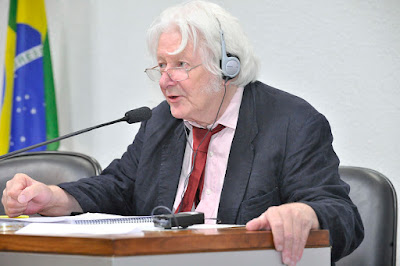
Andrew Jennings testifies in a Brazilian legislative probe  of the national football
federation (photo by Waldemir Barreto/Agência Senado CC BY 2.0).
A pause today to take stock of the work of investigative reporter and anti-corruption advocate Andrew Jennings, publisher of Transparency in Sport, who died on January 8.

Jennings was a tireless and cantankerous thorn in the side of Big Sport.  It would be difficult to overstate the role he played in precipitating the sea-changing revelations of corruption in the administration of the Olympics and international football.  He broke new ground with his books, The Lord of the Rings (1992) and Foul! The Secret World of FIFA (2006).  The "fall of the house of FIFA" and boss Sepp Blatter in the 2015 corruption scandal probably would not have happened had Jennings not sewed the seeds a decade earlier.

Jennings was a prolific writer across media, his many books besides.  Notwithstanding a more-than-fair share of earned global acclaim and enmity, Jennings also was a tirelessly supportive colleague in his crusade.  Email to his blog's contact address went directly to him; he personally and kindly answered a query of mine when I was researching on sport accountability.  He penned a foreword and praise for Whatever It Takes: The Inside Story of the FIFA Way, the book (reviewed) by Australian whistleblower (and friend of The Savory Tort) Bonita Mersiades.

Andrew Jennings has been widely memorialized, e.g., Sports Illustrated. His death leaves a gaping hole in the agencies of accountability for the quasi-corporate behemoths of transnational sport.  But his work has shown the world irrevocably that corruption thrives in the dark soil of secrecy.

Sunday, May 17, 2020

Report from a Social Distance Week 8: Speaking of Football, Magic, and Beer ...

Del's is a Rhode Island tradition.  (Photo by Lady Ducayne CC BY-NC 2.0.)
This will be my last weekly report for a while.  I've tried to make it extra savory.  My law school cut summer compensation, so my lemonade from lemons will be much less screen time in the next three months.  These eight "Reports from Quarantine" / "Reports from a Social Distance" have been a lot of fun to write, and I'm grateful for the positive feedback you've sent, dear reader.  Nevertheless, it feels like work anytime a laptop is staring back at you.

Though still experiencing a record-cold spring, the temperature here is at last topping 60°F (15.5°C) as many days as not.  My sprained ankle seems healed, thanks to my Instagram medical team, so I'm looking forward to more time out of the house.  We're reopening in Rhode Island, but there's not yet any timeline for phase 2, much less phase 3.  As I wrote yesterday, people's patience is wearing thin even here in staid New England.  Here's hoping that falling infection numbers bear out our anxious economic plan.

This has been my week 8 since coming home from Africa, and week 8 at home.  Literally, at home.

What I'm Reading

Mary Sidhwani, How to Find the True Self Within: Secrets of Relieving Stress and Anxiety (2019).  I'm not the self-help sort.  But my aunt wrote this book.  I can't imagine a more fitting title to kick off my time away from work.  I'm only as far as the introduction, and I'm keeping an open mind.  Audio chapters are available also.  Dr. Sidhwani is the compassionate soul behind the Women's Therapeutic Health Center, based in Ellicott City, Maryland.

John Maynard, The Aboriginal Soccer Tribe (2019).  This unusual nonfiction selection was a gift—name drop ahead 🤭—from Bonita Mersiades, whom I met last year at Play the Game, and of whom I became an instant admirer.  Mersiades is known in world sport circles as "the Australian whistleblower" for exposing FIFA corruption in soliciting nations' World Cup bids years before the 2015 indictments made whistleblowing fashionable.  She suffered enormously for the perceived betrayal, persecuted both professionally and personally.  Watch her talk about it at Play the Game, or read my account of the session.  A powerful personality already schooled in fighting the establishment as an executive in women's sport, Mersiades was not so easily deterred.  She wrote her own book, aptly titled Whatever It Takes: The Inside Story of the FIFA Way (2018); started her own boutique publishing house, Fair Play; and became a renowned commentator on the global business of football.

Knowing my interest in comparatism and sport and society, including research on Australian indigenous media, Mersiades gifted me the 2019 Maynard release.  John Maynard hails from a Worimi Aboriginal community on coastal New South Wales. He is a professor of indigenous history at the University of Newcastle in Callaghan.  Maynard's cultural-comparative work has set Aboriginal politics alongside African American and Native American policy problems.  He's also an avid football fan, and this book is a definitive biography of soccer and Aboriginal society.  The 2019 book from Fair Play is actually a revised update of an out-of-print 2012 original.  If you're a football fan, or you want to buy a gift for one, check out Fair Play's many other titles, too.  They include histories of Aston Villa, Liverpool, and Everton, as well as other socio-cultural studies of Asia and Brazil.

The 12 Minor Prophets.  With our church, we continue our year-long reading program, moving on to the intriguing teachings of the 12 minor prophets.  As usual, the BibleProject has fabulous drawing videos, starting with Hosea, Joel, Amos, and Obadiah.  Worship services are continuing online for now, and, as always, all are welcome, 0930 EDT on Sundays.

What I'm Watching

The English Game (2020).  This limited series was developed for Netflix by none other than Julian Fellowes (Downton Abbey).  Its six episodes are sometimes in a clumsy rush to deliver its upstairs-downstairs social message.  Overall, though, this story about the origins of association football (soccer) in late-1870s England makes for a thoroughly rewarding work of television.  The series uses football, today the world's game, as a lens through which to view evolving society.  The show brings within its scope not only thinning social strata, but emerging women's and labor rights.  Football itself was at a pivotal point of development at this time, transitioning from elite pastime to professional play, and introducing a more sophisticated form of passing play, recognized as the norm today, relative to a simple strategy of dribbling attack.

The story of a working-class mill team making an unprecedented run to steal the FA cup from elite-establishment collegiate players is very loosely based on real events.  Read more at the publication of your choice: Daily Mail, Digital Spy, Esquire, Express, i news, Mirror, Radio Times, The Spectator, or The TelegraphKevin Guthrie is stately as earnest Scottish footballer Fergus Suter; Guthrie was Abernathy in Fantastic Beasts.

The Great (2020).  I watched the first few episodes of HBO's Catherine the Great with the resplendent Helen Mirren, who received a Golden Globe nomination for the lead role.  I've been embarrassed to admit that I found the show too slow and didn't finish it.  Now comes Hulu's The Great to tell me, it's OK, and to make Catherine's remarkable story so much more delightfully digestible.  This dark comedy features Elle Fanning (Maleficent's Princess Aurora and Dakota Fanning's sister) as Catherine and Nicholas Hoult (X-Men's Beast, the big screen's J.R.R. Tolkien, and the most recent Watership Down's Fiver) as Peter III.

At times laugh-out-loud funny and taking great liberties with history—TV Catherine only arrives in Russia for her wedding to the already-emperor, whereas the real Princess Sophia had been brought to court decades earlier—the story is, as the show's title card disclaims, "occasionally true"—as in portraying Count Orlov, played ably furtively by Sacha Dhawan (Doctor Who's latest Master), as an enlightened co-conspirator in Catherine's inevitable coup. The magnificent sets meant to emulate 18th-century Russian imperial opulence include one real Italian palace and several English castles and houses.  Be warned, there are brief and highly fictionalized portrayals of violence against animals.

The Politician s1 (2019).  This creation from Glee trio Ryan Murphy, Brad Falchuk, and Ian Brennan was much hyped, but ... weird.  I was interested enough to watch it all the way through.  But Glee it is not.  The Politician lives somewhere amid a wicked ménage à trois of Napolean Dynamite, My So-Called Life, and Alex P. KeatonDear Evan Hansen's defining stage star Ben Platt snagged a Golden Globe nomination for the lead role, and he's terrific.  But the story of a socially awkward teen hell-bent on winning his high school presidency as a ticket-punch on his life-road to the White House is more aimless in the execution than the funny trailers suggest. Season two is expected in June; I'll probably skip it.

Good Eats Reloaded s1-s2 (2018-2020).  Devoted fans of the 14-season Food Network phenomenon that was Good Eats (1999-2012), we went twice to see cinematographer-turned-food-guru Alton Brown share his scientific approach to the culinary art on stage, in 2014 and 2016.  At the latter show, Brown caused an eruption of audience elation upon a cryptic clue that Good Eats might be coming back.  It has, and season 15, retitled Good Eats: The Return, is now free to view in 13 episodes at the Food Network online.  In the interim, Brown made two seasons of Good Eats Reloaded, the second coming out weekly now from the Cooking Channel, available there and on other platforms.  At first I did not want to watch Reloaded, because they looked like just rebroadcasts of the old show.  I was wrong; they're much more.

Hosted by Brown, Good Eats Reloaded is an often hilarious, sometimes MST3K-like look back at Good Eats highlights with plenty of new content.  Contemporary Brown mercilessly mocks his younger self, often breaking away to tell us, for example, how he cooks a burger now, with decades' more experience, or that he no longer uses rolling pin rings because, what seemed like a good idea at the time, they broke soon after the show was filmed.  Sometimes there are all new recipes; he cuts out early from s1e01 Steak Your Claim: The Reload to show us how to make my favorite Korean comfort food, bibimbap.  But, I say, leave out the fish sauce 😝 for the authentic urban-Seoul variant.  Speaking of eats ....

What I'm Eating

Lasagna.  My wife made her incomparable vegetable lasagna (pictured before the oven) for Mother's Day.  Get off my case.  I made breakfast.  She likes to cook.  It's her escape.  Heaven knows she deserves to escape.

Antoni's baked turkey mac'n'cheese.  Furthermore for Mother's Day, we had a family Zoom on my wife's side, wherein everyone made mac'n'cheese comfort food, feat. ground turkey, from Antoni's cookbook, Antoni in the Kitchen.  (That was just one of three Mother's Day Zoom calls.)  The product was tasty, but heavy.

Crepe cake.  Another self-sacrifice 😉 in the #SaveOurRestaurants campaign, we went back to neighbor-owned Crepelicious for its signature, 14-layer, green-tea crepe cake.  Speaking of heavy...

I'll lose weight after lockdown.  Promise.

What I'm Drinking

Mardi Gras King Cake.  My last order from Community Coffee brought Mardi Gras King Cake to my door.  It tastes almost sweet on its own, flavored as it is with cinnamon and vanilla.  It recalls my wife's king cake from March and reminds us of our beloved New Orleans, an especially welcome nostalgia since the cancellation of this summer's AALL conference there.

Koloa Estate.  We took an interlude from Community to visit the far side of the continent with medium-roast Koloa Estate from Kauai Coffee.  Kauai brands often get a bad rap because they're not 100% Hawaiian grown.  You're forgiven if the package led you to think otherwise.  Still, if you don't overpay, it's a solid coffee, for a blend, with some of that nutty flavor that characterizes beans grown in Pacific Rim soil.

Sharish Blue Magic Gin.  I brought this gin back from Lisbon.  Its name is the Arabic name of its home town, Monsaraz, in the southeastern Alentejo region of Portugal, and the unusual whale-fin bottle shape pays homage to the region's easterly hills.  Sharish is made by António Cuco, who, according to various accounts, was an unemployed teacher when he started experimenting with distillation in his home pressure cooker in 2013, set to head a multimillion-euro operation in a few short years.

Sharish's defining feature is its brilliant blue color, more indigo in brighter light and undiluted density, and its "magic" is that this color turns to pink in the presence of tonic.  I experimented, and it was fun. The blue color comes from the flower of the blue pea blossom, clitoria ternatea, in fact named for its, uh, feminine shape.  Tonic really does change the color, not just dilute it, shifting the acidity balance to alkaline, like when we played with pH paper in grade-school science class.  When the novelty wears off, a gin with a rewarding and summery flavor remains.  Sharish leads with its fruits, raspberry and strawberry, and they're backed up by a palette of Alentejo-grown botanicals: angelica, cardamom, cinnamon, ginger, and licorice, besides the blue pea and juniper.  Sharish goes down so pleasantly, even straight, that its 40% ABV sneaks up on you.

Clitoria ternatea is not a European native, and this is not the only gin that uses it.  The flower goes by many names around the world, including butterfly pea and Asian pigeonwings.  It's an Asian native and has long been known in Asian cuisine, notably Thai blue rice.  The flowers give Empress 1908 gin an indigo hue and a savour overlapping with Sharish.  Made in British Columbia and shipped worldwide, Empress is easier to find in North America, though I think a rung below Sharish in finish.

French 75.  I wanted to make a special cocktail for my wife for Mother's Day.  The French 75, a champagne-and-gin mix, was the signature favorite of Count Arnaud Cazenave in 20th-century New Orleans, according to the John DeMers book, Arnaud's, that I wrote about two weeks ago.  I used a Bon Appetit recipe, a French champagne, and New Amsterdam gin.  My French 75 made me feel like a high-class continental cultural import.  I was so carried away that I briefly joined the neighbor's bichon frisé in looking down (figuratively) on our lab mix.

Death by King CakeI ventured to the "essential" liquor warehouse to bring my wife two new beers to try for Mother's Day.  We love whites and sours.  Both of these were indulgent treats.  Death by King Cake let us end the day the way we started it.  From Colorado-based Oskar Brewing, King Cake is a 6.5% ABV white porter brewed with vanilla, cinnamon, nutmeg, cacao nibs, orange peel, and pecans.  Oskar promises Death by Coconut coming soon, an Irish-style porter in the same "series."

Key Lime Pie Sour.  Of all the food and bev I've tried around the world, I remember vividly my first frozen-key-lime-pie-slice-dipped-in-chocolate-on-a-stick in Key West, Florida.  That was the moment I realized that humanity had achieved Roman Empire-level gluttony on a global scale, and that our fall is inevitable, probably coming sooner than later, but that it would be a helluva ride down.  This is that in a beer.  From New Hampshire-based Smuttynose Brewing Co., there's an adorable seal visage on the back of the can. 6.3% ABV.

It was a Zoom Mother's Day


Stay thirsty, my friends!

Eating and Drinking images by RJ Peltz-Steele CC BY-SA 4.0 with no claim to underlying works
Zoom captures by RJ Peltz-Steele CC BY-NC-SA 4.0 with no claim of data protection waiver