I have been fortunate to know many multi-talented persons in my line of work. I'm not sure any, though, can hold a candle to the breadth of expertise of my friend and colleague Professor Rob Steinbuch. There needs to be a way to list this on SSRN; from KATV Little Rock:
Sunday, September 6, 2026
Wednesday, September 2, 2026
Bamboo makes handbags stylish, captures carbon, and might be the next big thing on the Italian food scene
![]() |
| Me in Osun Grove, Osogbo, Nigeria, 2023 RJ Peltz-Steele CC BY-NC-SA 4.0 |
Many years ago, when I lived in Arkansas, a green-thumbed friend (and brilliant criminal-defense appellate lawyer) came by my house and advised me to rip out a small patch of bamboo that had taken root in my backyard.
"You don't want that," she said, eyes wide with murderous intent.
A first-time homeowner, I was skeptical of this plant prejudice. I could not get anything else green to survive the scorching summer in Arkansas. It seemed wrong to kill a stalwart survivor.
Moreover, my limited prior experience with bamboo was not adversarial. My university fraternity, in Virginia, maintained a small crop. Our annual harvest for a South Pacific-themed party—yeah, I see the cliché too, and you can bet we played into it—seemed to keep the growth in check.
My friend continued: "It'll take over, and you won't be able to get rid of it."
"Well if it gets to be too much," I posited cautiously, "how do you get rid of it? There must be a way."
"Well," she cocked her head and thought for a moment. Her eyes narrowed, and she pursed her lips. "You can nuke it," she said wryly.
She might have overstated the requisite pruning strategy. But she wasn't wrong.
Once bamboo gets a foothold, it is extremely difficult to eradicate. It grows through a network of underground stems, from which it can re-sprout, even after you tried painstakingly to pull it all out. In New England, where I live now, bamboo is a problematic invasive species. It grows fast, expands its territory aggressively, and devours water, destabilizing native habitats.
Fast forward to a visit to Italy two summers ago, and I was surprised to discover that my cousin Daniele is in the bamboo business. When he first said "bambù," describing his venture and passion, I thought it was an Italian word that I didn't know.
No; it's a cognate. Daniele Marroni is the brains and heart behind Maremma Che Bambù, a thriving bamboo grower making food products.The business has a clever name, actually, a play on words. This is an aside, but stay with me; it's worth it.
"Maremma" is a region in Tuscany that includes Pitigliano, where Daniele is and is from, and where my grandparents emigrated from. The Maremmano sheepdog and horse are named for this region. Pitigliano is in the heart of the Maremma Grossetana, meaning the part of Maremma in the province of Grosetto, in the south of Tuscany.
The coastal and low-lying parts of the Maremma region were once much swampier than they are today, having been widely drained for development. Accordingly, in the lower case, maremma, in English as well as Italian, refers to a marshland, exactly the sort of watery terrain where bamboo thrives, and which has not disappeared from the region.
Meanwhile, maremma has an entirely other usage in Tuscan slang. It's one of my favorite things in language, in fact: a "near curse," or what linguists call a "minced oath"—like "gosh" instead of "God, "darn" instead of "damn," or "freakin'" instead of, well, you know. Maremma is old; probably it comes from "Madonna," so a way to take the Virgin's name in vain without offending hearers.
In this usage, "maremma maiala," the latter word meaning sow, in the swine sense, is a generic, mild curse. Alternatively, maremma acts as an exclamation to emphasize what follows. Thus, Google translates "maremma che bambù" as "wow, look at that bamboo!" Or, at risk of lexical borrowing, I prefer, "Mamma mia, look at that bamboo!" (HT @ Mmargheritas.)
![]() |
| Bamboo and Ginger Jam by Maremma Che Bambù © Maremma Che Bambù Used with permission |
Archaeologists tell us that bamboo once grew in Italy, in prehistoric times, but went extinct something like a million years ago. It returned in modern times, imported from Asia, first as an ornamental plant, as early as the 19th century. It worked its way into textiles after World War II, famously pairing with Italian leather to form the handle of an "iconic" 1947 Gucci handbag.
In the 21st century, bamboo has taken off as a crop in the name of sustainability. It's now farmed widely in Italy and elsewhere, where it is not native. Especially in the south of Italy, giant bamboo species are farmed on a large scale. The appeal of the "bamboo forest" is that it's a huge carbon sink, removing climate-change-inducing carbon dioxide from the atmosphere at perhaps 36 times the rate of an ordinary woodland —also thereby entitling investors to carbon offset credits, where such programs exist.
The ideal, then, is to turn the bamboo into product, to close the sustainability loop. Forever Bambù, for example, an Italian benefit corporation, touts its "Made-In-Italy" branding and posits that bamboo biomass can replace problematic products such as plastics, along with dangerous forever chemicals.
"Alongside other partners, we have produced the first biopolymer granules with a variable percentage of giant bamboo filler, a fully biodegradable material," CEO Mauro Lajo told Renewable Matter last year. "We are also doing research into the worlds of bioconstruction and eco-leather products, with incredible results." I don't know what all that means, but it sounds promising.
![]() |
| Daniele Marroni © Maremma Che Bambù Used with permission |
Bamboo shoots are a healthy food with rich nutritional properties. Low in sugar and fat, they are rich in B vitamins, minerals (copper, manganese, calcium, iron, potassium, and phosphorus), and fiber, contributing to proper metabolism. They are excellent for those following a low-calorie diet and for vegan or vegetarian diets. Their calorie intake is very low: only 27 kcal per 100 g. In Asian cuisine, bamboo shoots are used primarily in soups or stir-fried with mushrooms, vegetables, white meats, or fish. Their flavor is very delicate, a blend of artichoke, asparagus, peas, and potatoes. A neutral base that lends itself perfectly to original pairings with local produce.
Maremma Che Bambù sells Bamboo and Artichoke Cream, Bamboo and Ginger Jam, Bamboo Shoots, and Ready-Made Bamboo and Vegetable Sauce. I'm a pushover for ginger, admittedly, but I give an earned nomination all the same to the jam as my favorite. Shipping presently only goes to Italy, but if you want to place a large order, I'm sure it's worth reaching out.
![]() |
| Pitigliano, 2024 RJ Peltz-Steele CC BY-NC-SA 4.0 |
Daniele's roots are in Pitigliano and Maremma Grossetana almost literally; since 2015, the bamboo venture has taken over what once was family vineyard.
Pitigliano wine exports shrank in recent decades, as the global industry saw mass-market producers price out smaller vineyards from international trade. Daniele appropriately diversified, but managed to stay in farming and preserve a local vibe. Pitigliano and neighboring towns on the Etruscan Via Cave trails still produce mouthwatering wines and other fare you can try when you're there.
At the end of the day, I confess, I don't know the math on climate change and bamboo farming in Italy. But if I can help the environment by eating, I'm in.
And hey, if it doesn't work out—worst case? We nuke it.
![]() |
Me at the (defunct) nuclear launch controls of Oscar-Zero (NHS/SHS) in North Dakota, August 2026 |
Tuesday, April 1, 2025
'No Other Land' scores with human story, mesmerizing cinematography, surprising cameos of law
A Palestinian-Israeli collaboration yielded the Academy Award-winning documentary No Other Land, which is well worth the price of admission.
![]() |
| No Other Land plays the Avon in Providence, R.I. RJ Peltz-Steele CC BY-NC-SA 4.0 |
I'm a sucker for a free speech story. That, and our favorite Indian restaurant is across the street from the independent Avon Cinema in Providence, Rhode Island. I did not expect No Other Land to live up to its Rotten Tomatoes perfect score. It did, and then some.
No Other Land is the product of four co-directors, Basel Adra, Hamdan Ballal, Yuval Abraham, and Rachel Szor. A Palestinian activist and Israeli journalist respectively, Adra and Abraham are featured in the film, which intimately depicts the slow battle between residents and the Israeli army over the villages of Masafer Yatta in the southern West Bank. The film covers 2019 to 2023, when Adra lived in Masafer Yatta and Abraham visited there to write about the army's destruction of homes in an effort to evict Palestinians from the land.
No Other Land does not try to relate other than the Palestinian side of the story. But it also doesn't try to hit you over the head as a polemic; I had been worried about investing 90 minutes in that vein. The beauty of the film—and it is beautiful, worth time in front of the big screen, despite the tragic subject matter—is in the depiction of human relationships in the face of profound adversity: within and between the families of Masafer Yatta, in how the Palestinians relate to Abraham as an outsider, and, at the heart of it, in the sometimes awkward but deepening friendship of Adra and Abraham.
Law figured in No Other Land in some surprising ways. On the face of it, the tragedy of Masafer Yatta was precipitated by Abu ‘Aram v. The Minister of Defense, a 2022 ruling of the Israeli Supreme Court, sitting as the High Court of Justice, green-lighting the eviction of Palestinian residents for the purported purpose of creating an Israeli military training zone.
Notwithstanding realist accusations of naked partisanship, the court rested its ruling on the classification of the land, by prior agreement, as under Israeli security control. Civil society the world over decried the ruling as inconsistent with human rights law concerning occupied territories. For more, here's an informative commentary by Yaël Ronen, a law professor in Jerusalem, writing at the time for the West Point Lieber Institute's Articles of War.
![]() |
| Basel Adra and Yuval Abraham receive film award in Berlin. Martin Kraft (photo.martinkraft.com) via Wikimedia Commons CC BY-SA 4.0 |
ABRAHAM: Nothing on mainstream news about the demolitions. As if it happened, but also, it never happened.
ADRA: We'll keep filming everything. And we have to think how to reach more people in different ways. That would be excellent I think.
ABRAHAM: Why are you on your phone all day?
ADRA: It's from stress. Stress, stress, stress.
ABRAHAM: You're afraid something will happen?
ADRA: Yes, but also I'm stressed because I have nothing to do.
ABRAHAM: What do you mean?
ADRA: I don't know.
ABRAHAM: What?
ADRA: What can I do besides being on my phone? Huh? I have nothing else, only my phone.
ABRAHAM: What would you like to do?
ADRA: Anything else.
ABRAHAM: But you studied law, can't you practice it?
ADRA: That's something I lost hope in. Students like me studied so hard for a law degree. But our economy is ruined. You can find work only in Israel.
ABRAHAM: What work?
ADRA: Construction. No other option. Like you never went to university. What do you think? If you were in my place, what would you think?
The scene captures the utter despair of Palestinians in Masafer Yatta. And at the same time, Adra smiles intermittently. His indomitable spirit is irresistibly charming.
The conversation is revealing, too, of a mesmerizing cinematographic device at work in No Other Land. Adra is on his phone a lot; the phone, in fact, or smartphone videography, almost becomes a character itself in the narrative.
There are two kinds of video in the film. First, there is smartphone video, often the very same clips that Adra and others upload to social media in the online battle of public relations playing out for the world. Second, there is the high-quality video of the movie camera.
Adra and other Palestinians, as well as Israeli soldiers and civilian authorities, are seen constantly wielding smartphone cameras. The film in fact is bookended with older personal video from Adra's childhood. In the conflict, Palestinians use their smartphones as witnesses, for example, announcing to a soldier, "I am filming," in an effort to deter violence. These videos bring raw and jarring urgency to the big screen.
At the same time, movie cameras never stop rolling, and for them, the fourth wall never breaks. When the smartphones are turned off, the movie cameras continue to capture the mundane but moving interludes that constitute life between exigencies: Adra left alone at night when Abraham drives off to the security of his home; the tears of a mother left to care for a dying son.
No Other Land is art and reality at once. It deserves its accolades, and it should be seen. If it tells only part of a story, so be it. It bears truths that must be reckoned with nonetheless if ever there can be a way forward in the Israeli-Palestinian conflict.
![]() |
| Kadai chicken, Rupee Basmati Rice Lager, and chicken madras at Kabob and Curry, Providence, R.I. RJ Peltz-Steele CC BY-NC-SA 4.0 with no claim to underlying mouthwatering presentation |
Sunday, December 1, 2024
'American Dream' is still achievable in hot-dog form
My Thanksgiving featured craft beer with some ace Polish law students.
Last week I had the privilege to teach American tort law to a class of Polish law students at Jagiellonian University in Kraków, for the American Law Program of the Columbus School of Law at the Catholic University of America, as I have for many years. Catholic and JU have a summer program in Poland for American law students, too.Thursday night I took the students to my favorite craft beer pub in Kraków, Multi Qlti Tap Bar. The beers always are top notch. I had a fruited gose, as well as a hazy IPA called "tank killer," or something like that that seemed appropriate to the times in central Europe.
Now that's a positive American food influence. Walking in Kraków, I saw the dark side of American food influence, too. A place called "Mr. Pancake" advertised the "American Pie-Cake." 🤢
Don't worry Poland; I'm sure appetite-suppressing injections are on their way next.
Images: "Massachusetts" from Restaurant Guru, translation by Google; "American Pie-Cake" by RJ Peltz-Steele CC BY-NC-SA 4.0, no claim to underlying works.
Monday, September 25, 2023
Armenia, Azerbaijan maintain tentative ceasefire
| Yerevan, Armenia: Opera House at center. RJ Peltz-Steele CC BY-NC-SA 4.0 |
Reuters has a good overview of the current situation. The history of the conflict, dating to the Soviet era, defies succinct explication. Suffice to say, hard feelings run deep. It's the kind of conflict that claims the lives of soldiers who were born after it started, the kind of intractable tit for tat that has run so long, no one remembers, as if it would matter, who inflicted the first insult.
![]() |
| Baku, Azerbaijan: me in my happy place. RJ Peltz-Steele CC BY-NC-SA 4.0 |
| Armenian flag, near Yerevan RJ Peltz-Steele CC BY-NC-SA 4.0 |
What saddened me most was how much the vets were the same on both sides: good young people whose lives had been upended. They believed in their causes, but could scarcely cite a motivation besides a string of offenses of the other. A few even acknowledged that they saw themselves across the front lines and felt remorse for being thrust into conflict with people their own age, as foreign to the origins of the war as they were. Vets on both sides spoke of their families' fears for their safety and their own fears that if they have children, they will be drafted into the same cycle of war.
![]() |
| Azerbaijani flag, Baku RJ Peltz-Steele CC BY-NC-SA 4.0 |
I enjoyed my time in both countries immensely. Both countries boast stunning sights, from Armenia's extraordinary Matenadaran, a library of ancient manuscripts in Yerevan (reminding me of my beloved Old Library at Trinity Dublin), and ancient Temple of Garni, to Azerbaijan's Ateshgah Fire Temple and towering Bibi-Heybat Mosque.
| RJ Peltz-Steele CC BY-NC-SA 4.0 |
Saturday, April 8, 2023
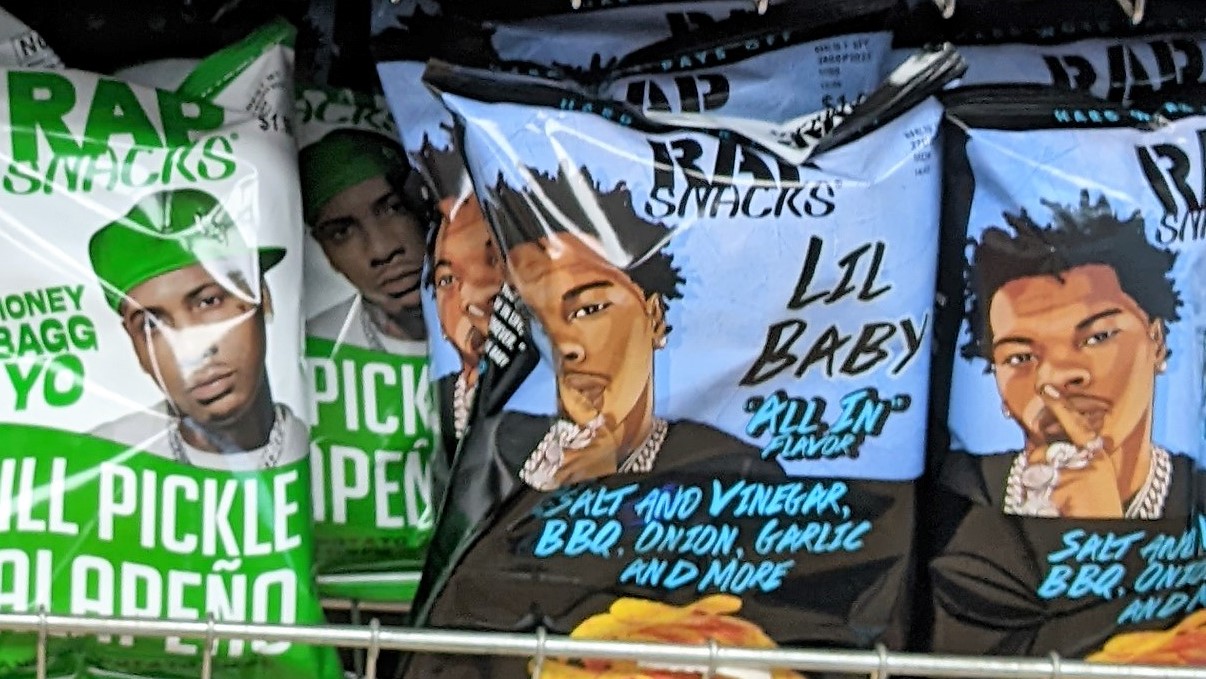
Rap Snacks reinvents the potato chip for Americans
![]() |
| Mapco Rap Snacks rack. RJ Peltz-Steele CC BY-NC-SA 4.0 |
It turns out Rap Snacks has been around since 1994. It was the brainchild of Philadelphia native, Miami-based entrepreneur James Lindsay, CEO. According to his bio, Lindsay cut his teeth in marketing in ethnic hair products. In 1994, he thought to partner with Universal Records, simultaneously capitalizing on and expanding the brands of rappers and hip-hop artists, selling chips (crisps) and quickly building a $5m company.
Recently I binged season 11 of Jared Keeso's brilliant, if not safe for work, Canadian sitcom, Letterkenny. In episode 1, "Chips," the gang debates the best potato chip. They rightly note that flavored chips were pioneered in North America by Canadians, who have long had a more diverse chip palate than Americans. Flavors such as dill, ketchup, and roast chicken have been around for decades. I remember being awed by the range of available delights when I first visited my cousins in Ontario in 1989.
The chìp de résistance of the Canadian market is the "all-dressed." Mainer Liz Provencher for Thrillist sang the chip's praises, describing its mélange: "a masterpiece of ketchup, barbecue, sour cream and onion, and salt and vinegar flavors all rolled into one chip." When the characters of Letterkenny debated the best chip, they agreed that the all-dressed would have to be excluded, or there would be no contest.
![]() |
| The Lil Baby "All In." RJ Peltz-Steele CC BY-NC-SA 4.0 |
Mmmm. The All In was Right On. Welcome to America, flavor.
You can find Rap Snacks with the store locator, or order in bulk online. Visit the flavor booth to put your own face on a bag of chips.
Sunday, July 10, 2022
Burgundian Liège Belgian waffles melt in mouth
![]() |
| The Burgundian, Attleboro, Mass. (All photos RJ Peltz-Steele CC BY-NC-SA 4.0.) |
![]() |
| Burgundian's classy, European-esque interior |
![]() |
| "Banana churros" dessert at the Burgundian. Yeah, that happened. I'm not proud. |
As long as I'm confessing my sin of gluttony today, a shout out to a post-pandemic-new and exceptional establishment in my home state of Rhode Island, Hunky Dory in Warren. My wife confirms that this "southern-influenced celebration of New England" from dachshund Sherbert's parents Sam—himself of "southern mama and Appalachian dad"—and Bay Stater Joanna delivers on its promise.
![]() |
| The "veggie and sweet potato hash" feat. "smoked poblano crema," and a "basic brunch" at Hunky Dory, Warren, R.I. We devoured "Mom's zucchini bread" before I could snap a picture. |
![]() |
| The outdoor patio at Hunky Dory with its thriving vegetable garden |
Wednesday, July 6, 2022
Belgian-waffle makers battle over whose doughy goodness won pride of place on Oprah's list
![]() |
| PxHere CC0 |
Oprah's 2021 "favorite things" featured "Eastern Standard Provisions Gourmet Liège Belgian Waffle Gift Box." Yum.
Eastern Standard Provisions is based in Waltham, Mass., and lists its "Classic Liège Belgian Waffles" for sale online. Here's the pitch:
Our artisanal Classic Liège Belgian Waffles are crafted with real butter and pearl sugar imported from Belgium for a light, sweet crunch. Our Classic Liège Belgian Waffles are different than other waffles you may be used to. Most waffles are made with batter, but our Classic Liège Belgian Waffles are made from dough delivering a soft, brioche-like texture and a one-of-a-kind waffle experience.
This is not Eastern Standard's Oprah debut. Its "artisanal soft pretzels" made the grade in 2019.
But wait. Based in Attleboro, Mass., the Burgundian gourmet street-food brassiere claims in a lawsuit (via WCVB) that Oprah picked Burgundian waffles for the list, because Eastern Standard ripped off the Burgundian recipe it had learned under a non-disclosure agreement when the two explored a co-branding venture.
According to the lawsuit, Burgundian founder Shane Matlock learned how to make the Liège waffles while serving in the U.S. Army, when, for three of 15 years, he was stationed on the France-Belgium border, and, the Burgundian website says, he premiered the waffles in Providence, Rhode Island (my home state, near Attleboro) in 2017.
All I know for sure is that I now have a craving for waffles.
The case is The Burgundian LLC v. Hawthorne Food Co. (Mass. Super. Ct. Suffolk Dep't Bus. Litig. Sess. filed Feb. 3, 2022). The plaintiff alleges, inter alia, breach of contract, violation of state trade secret law, passing off, false advertising, and unfair trade practices.
Saturday, June 5, 2021
Brood X cicadas taste terrible, but teach life lessons
![]() |
| A Brood X cicada that emerged early, in 2017 (Flickr by Katja Schulz CC BY 2.0) |
I met Brood X face to face only once, when I was a teenager in Baltimore, Md., in 1987. Every 17 years, the big red-eyed bugs realize that heaven is a place on earth, not under it, and they rise up with a screeching rhythm that's gonna get you. Unlike locusts, cicadas are clumsy fliers and seem oblivious to humans as a threat. So simply going outside invites cicadas to crash into your nicest denim jacket.
This time, the cicadas have failed to anticipate a new human threat. People are popping cicadas onto the grill for purportedly finger-licking-worthy indulgence.
![]() |
| Fried cicadas in China, 2013 (Flickr by Sharon Hahn Darlin, who didn't eat them, CC BY 2.0) |
Nowhere was that shellfish flavor more evident than in the oven-roasted cicada, though I was quickly distracted from that thought by the realization that the bug had exploded in my mouth like a Gusher. My tongue awash in bug guts, I reconsidered all the choices I’d made in my life that had brought me to that moment.
Oh, heads up, the FDA warns not to eat cicadas if you're allergic to shrimp. Because that makes sense.
Well, another voice in the inexplicable camp of cicada supporters is my uncle, Tom Peri, a Baltimore biology teacher with a new video series about Brood X. In four short installments, Buggin' Out with Mr. Peri is now available on Facebook from Notre Dame Preparatory School (NDP). Each short installment teaches us, as Mr. Peri puts it, that cicadas "aren't the monsters you think they're going to be." In episode 1, Mr. Peri promises us life lessons to be learned from the humble cicada, such as, "you're at your best when you're rising from a low point."
Give Buggin' Out a try (ep. 1, 2, 3, 4), and especially share it with kids. Maybe we can condition young minds to think differently from mine. Then, in 2038, our only anxiety will be over which cicada food truck to choose.
An NDP upper-level science teacher with decades of classroom experience, Tom Peri won a prestigious Lead. Learn. Proclaim. Award from the National Catholic Educational Association in 2018. He is a former headmaster of St. John’s Prospect Hall and Towson Catholic High School.
Sunday, May 17, 2020
Report from a Social Distance Week 8: Speaking of Football, Magic, and Beer ...
![]() |
| Del's is a Rhode Island tradition. (Photo by Lady Ducayne CC BY-NC 2.0.) |
Though still experiencing a record-cold spring, the temperature here is at last topping 60°F (15.5°C) as many days as not. My sprained ankle seems healed, thanks to my Instagram medical team, so I'm looking forward to more time out of the house. We're reopening in Rhode Island, but there's not yet any timeline for phase 2, much less phase 3. As I wrote yesterday, people's patience is wearing thin even here in staid New England. Here's hoping that falling infection numbers bear out our anxious economic plan.
This has been my week 8 since coming home from Africa, and week 8 at home. Literally, at home.
What I'm Reading
Mary Sidhwani, How to Find the True Self Within: Secrets of Relieving Stress and Anxiety (2019). I'm not the self-help sort. But my aunt wrote this book. I can't imagine a more fitting title to kick off my time away from work. I'm only as far as the introduction, and I'm keeping an open mind. Audio chapters are available also. Dr. Sidhwani is the compassionate soul behind the Women's Therapeutic Health Center, based in Ellicott City, Maryland.
John Maynard, The Aboriginal Soccer Tribe (2019). This unusual nonfiction selection was a gift—name drop ahead 🤭—from Bonita Mersiades, whom I met last year at Play the Game, and of whom I became an instant admirer. Mersiades is known in world sport circles as "the Australian whistleblower" for exposing FIFA corruption in soliciting nations' World Cup bids years before the 2015 indictments made whistleblowing fashionable. She suffered enormously for the perceived betrayal, persecuted both professionally and personally. Watch her talk about it at Play the Game, or read my account of the session. A powerful personality already schooled in fighting the establishment as an executive in women's sport, Mersiades was not so easily deterred. She wrote her own book, aptly titled Whatever It Takes: The Inside Story of the FIFA Way (2018); started her own boutique publishing house, Fair Play; and became a renowned commentator on the global business of football.
Knowing my interest in comparatism and sport and society, including research on Australian indigenous media, Mersiades gifted me the 2019 Maynard release. John Maynard hails from a Worimi Aboriginal community on coastal New South Wales. He is a professor of indigenous history at the University of Newcastle in Callaghan. Maynard's cultural-comparative work has set Aboriginal politics alongside African American and Native American policy problems. He's also an avid football fan, and this book is a definitive biography of soccer and Aboriginal society. The 2019 book from Fair Play is actually a revised update of an out-of-print 2012 original. If you're a football fan, or you want to buy a gift for one, check out Fair Play's many other titles, too. They include histories of Aston Villa, Liverpool, and Everton, as well as other socio-cultural studies of Asia and Brazil.The 12 Minor Prophets. With our church, we continue our year-long reading program, moving on to the intriguing teachings of the 12 minor prophets. As usual, the BibleProject has fabulous drawing videos, starting with Hosea, Joel, Amos, and Obadiah. Worship services are continuing online for now, and, as always, all are welcome, 0930 EDT on Sundays.
What I'm WatchingThe English Game (2020). This limited series was developed for Netflix by none other than Julian Fellowes (Downton Abbey). Its six episodes are sometimes in a clumsy rush to deliver its upstairs-downstairs social message. Overall, though, this story about the origins of association football (soccer) in late-1870s England makes for a thoroughly rewarding work of television. The series uses football, today the world's game, as a lens through which to view evolving society. The show brings within its scope not only thinning social strata, but emerging women's and labor rights. Football itself was at a pivotal point of development at this time, transitioning from elite pastime to professional play, and introducing a more sophisticated form of passing play, recognized as the norm today, relative to a simple strategy of dribbling attack.
The story of a working-class mill team making an unprecedented run to steal the FA cup from elite-establishment collegiate players is very loosely based on real events. Read more at the publication of your choice: Daily Mail, Digital Spy, Esquire, Express, i news, Mirror, Radio Times, The Spectator, or The Telegraph. Kevin Guthrie is stately as earnest Scottish footballer Fergus Suter; Guthrie was Abernathy in Fantastic Beasts.
The Great (2020). I watched the first few episodes of HBO's Catherine the Great with the resplendent Helen Mirren, who received a Golden Globe nomination for the lead role. I've been embarrassed to admit that I found the show too slow and didn't finish it. Now comes Hulu's The Great to tell me, it's OK, and to make Catherine's remarkable story so much more delightfully digestible. This dark comedy features Elle Fanning (Maleficent's Princess Aurora and Dakota Fanning's sister) as Catherine and Nicholas Hoult (X-Men's Beast, the big screen's J.R.R. Tolkien, and the most recent Watership Down's Fiver) as Peter III.At times laugh-out-loud funny and taking great liberties with history—TV Catherine only arrives in Russia for her wedding to the already-emperor, whereas the real Princess Sophia had been brought to court decades earlier—the story is, as the show's title card disclaims, "occasionally true"—as in portraying Count Orlov, played ably furtively by Sacha Dhawan (Doctor Who's latest Master), as an enlightened co-conspirator in Catherine's inevitable coup. The magnificent sets meant to emulate 18th-century Russian imperial opulence include one real Italian palace and several English castles and houses. Be warned, there are brief and highly fictionalized portrayals of violence against animals.
The Politician s1 (2019). This creation from Glee trio Ryan Murphy, Brad Falchuk, and Ian Brennan was much hyped, but ... weird. I was interested enough to watch it all the way through. But Glee it is not. The Politician lives somewhere amid a wicked ménage à trois of Napolean Dynamite, My So-Called Life, and Alex P. Keaton. Dear Evan Hansen's defining stage star Ben Platt snagged a Golden Globe nomination for the lead role, and he's terrific. But the story of a socially awkward teen hell-bent on winning his high school presidency as a ticket-punch on his life-road to the White House is more aimless in the execution than the funny trailers suggest. Season two is expected in June; I'll probably skip it.
Good Eats Reloaded s1-s2 (2018-2020). Devoted fans of the 14-season Food Network phenomenon that was Good Eats (1999-2012), we went twice to see cinematographer-turned-food-guru Alton Brown share his scientific approach to the culinary art on stage, in 2014 and 2016. At the latter show, Brown caused an eruption of audience elation upon a cryptic clue that Good Eats might be coming back. It has, and season 15, retitled Good Eats: The Return, is now free to view in 13 episodes at the Food Network online. In the interim, Brown made two seasons of Good Eats Reloaded, the second coming out weekly now from the Cooking Channel, available there and on other platforms. At first I did not want to watch Reloaded, because they looked like just rebroadcasts of the old show. I was wrong; they're much more.Hosted by Brown, Good Eats Reloaded is an often hilarious, sometimes MST3K-like look back at Good Eats highlights with plenty of new content. Contemporary Brown mercilessly mocks his younger self, often breaking away to tell us, for example, how he cooks a burger now, with decades' more experience, or that he no longer uses rolling pin rings because, what seemed like a good idea at the time, they broke soon after the show was filmed. Sometimes there are all new recipes; he cuts out early from s1e01 Steak Your Claim: The Reload to show us how to make my favorite Korean comfort food, bibimbap. But, I say, leave out the fish sauce 😝 for the authentic urban-Seoul variant. Speaking of eats ....
What I'm EatingLasagna. My wife made her incomparable vegetable lasagna (pictured before the oven) for Mother's Day. Get off my case. I made breakfast. She likes to cook. It's her escape. Heaven knows she deserves to escape.
Antoni's baked turkey mac'n'cheese. Furthermore for Mother's Day, we had a family Zoom on my wife's side, wherein everyone made mac'n'cheese comfort food, feat. ground turkey, from Antoni's cookbook, Antoni in the Kitchen. (That was just one of three Mother's Day Zoom calls.) The product was tasty, but heavy.Crepe cake. Another self-sacrifice 😉 in the #SaveOurRestaurants campaign, we went back to neighbor-owned Crepelicious for its signature, 14-layer, green-tea crepe cake. Speaking of heavy...
I'll lose weight after lockdown. Promise.
What I'm Drinking
Mardi Gras King Cake. My last order from Community Coffee brought Mardi Gras King Cake to my door. It tastes almost sweet on its own, flavored as it is with cinnamon and vanilla. It recalls my wife's king cake from March and reminds us of our beloved New Orleans, an especially welcome nostalgia since the cancellation of this summer's AALL conference there.Koloa Estate. We took an interlude from Community to visit the far side of the continent with medium-roast Koloa Estate from Kauai Coffee. Kauai brands often get a bad rap because they're not 100% Hawaiian grown. You're forgiven if the package led you to think otherwise. Still, if you don't overpay, it's a solid coffee, for a blend, with some of that nutty flavor that characterizes beans grown in Pacific Rim soil.
Sharish Blue Magic Gin. I brought this gin back from Lisbon. Its name is the Arabic name of its home town, Monsaraz, in the southeastern Alentejo region of Portugal, and the unusual whale-fin bottle shape pays homage to the region's easterly hills. Sharish is made by António Cuco, who, according to various accounts, was an unemployed teacher when he started experimenting with distillation in his home pressure cooker in 2013, set to head a multimillion-euro operation in a few short years.Sharish's defining feature is its brilliant blue color, more indigo in brighter light and undiluted density, and its "magic" is that this color turns to pink in the presence of tonic. I experimented, and it was fun. The blue color comes from the flower of the blue pea blossom, clitoria ternatea, in fact named for its, uh, feminine shape. Tonic really does change the color, not just dilute it, shifting the acidity balance to alkaline, like when we played with pH paper in grade-school science class. When the novelty wears off, a gin with a rewarding and summery flavor remains. Sharish leads with its fruits, raspberry and strawberry, and they're backed up by a palette of Alentejo-grown botanicals: angelica, cardamom, cinnamon, ginger, and licorice, besides the blue pea and juniper. Sharish goes down so pleasantly, even straight, that its 40% ABV sneaks up on you.
Clitoria ternatea is not a European native, and this is not the only gin that uses it. The flower goes by many names around the world, including butterfly pea and Asian pigeonwings. It's an Asian native and has long been known in Asian cuisine, notably Thai blue rice. The flowers give Empress 1908 gin an indigo hue and a savour overlapping with Sharish. Made in British Columbia and shipped worldwide, Empress is easier to find in North America, though I think a rung below Sharish in finish.
French 75. I wanted to make a special cocktail for my wife for
Mother's Day. The French 75, a champagne-and-gin mix, was the signature
favorite of Count Arnaud Cazenave in 20th-century New Orleans,
according to the John DeMers book, Arnaud's, that I wrote about two weeks ago. I used a Bon Appetit recipe,
a French champagne, and New Amsterdam gin. My French 75 made me feel
like a high-class continental cultural import. I was so carried away
that I briefly joined the neighbor's bichon frisé in looking down
(figuratively) on our lab mix.
Death by King Cake. I ventured to the "essential" liquor warehouse to bring my wife two new beers to try for Mother's Day. We love whites and sours. Both of these were indulgent treats. Death by King Cake let us end the day the way we started it. From Colorado-based Oskar Brewing, King Cake is a 6.5% ABV white porter brewed with vanilla, cinnamon, nutmeg, cacao nibs, orange peel, and pecans. Oskar promises Death by Coconut coming soon, an Irish-style porter in the same "series."It was a Zoom Mother's Day

Stay thirsty, my friends!
Zoom captures by RJ Peltz-Steele CC BY-NC-SA 4.0 with no claim of data protection waiver