Friday, September 2, 2022

Motel not liable for guest's suicide, court rules, despite family warning of risk, asking for room number

CC0 1.0 via Wikimedia Commons
The Massachusetts Appeals Court yesterday rejected Motel 6 liability for the suicide of a guest.

The September 1 decision broke no new ground, but reiterated the interrelationship of duty doctrines in negligence and Massachusetts repudiation of the common law "suicide rule."

Decedent Michael C. Bonafini took his own life in a room of the Motel 6 in Chicopee, Massachusetts, just north of Springfield in 2015. The mother and wife of the decedent blamed the motel because they went there in the night and morning trying to reach him, and motel staff would not reveal his room number. In the morning, the mother told the motel clerk that the decedent was at risk of suicide. The clerk called the room, but the decedent answered and immediately hung up. He was found dead when the motel manager entered the room at noon checkout time.

The case implicates potentially conflicting duty relationships in the common law of negligence. The reputed "suicide rule" of historical common law held that there can be no liability for a suicide. At the same time, common law recognizes an affirmative duty of an innkeeper to a guest, and the Massachusetts Supreme Judicial Court has recognized a duty to prevent suicide in some circumstances.

Historically, courts were loath to impose accident liability for an intentional act of self-harm on an earlier-in-time actor, especially when the intentional act was an attempt to commit suicide. The conclusion could be reached either by ruling that there was no duty to prevent another from intentional self-harm, which usually was criminalized, or by reasoning that the abrupt, violent, and intentional act of suicide dispositively interrupted the requisite chain of proximate causation.

It's arguable that there never was a "suicide rule," per se, rather a doctrine of duty and causation that was informed by social norms. Norms change. Suicide is less often today regarded as a matter for criminal justice, even if criminal laws remain on the books to justify the intervention of authorities. The trend in tort law is to employ the usual doctrines of duty and causation to analyze the facts of each case. That said, the "suicide rule" still holds sway, because the doctrines of duty and causation still disfavor the imposition of an affirmative duty to prevent injury and disfavor negligence liability for causal actors earlier in time than intentional injurers (this blog, Feb. 9, 2021).

On the question of duty, the instant case is complicated in two respects, one on the law and one on the facts. First, an innkeeper-guest relationship is one in which common law historically does impose an affirmative duty, on the innkeeper for the protection of the guest. Second, insofar as an affirmative duty might exist, it can be predicated on knowledge of risk, which the decedent's mother gave to the motel clerk.

The innkeeper-guest relationship did not get the plaintiffs to the finish line. The purpose of the common law duty is to oblige an innkeeper, like a landlord, to protect the guest from risks the innkeeper might know about, and the guest does not, in the vein of premises liability; or, at the extreme, risks of any nature that an innkeeper might be better positioned to mitigate than a guest can.

The court summarized past cases in which Massachusetts courts recognized an innkeeper-to-guest duty: failure to prevent stabbing by intruder for want of an adequate security system; failure to protect guest from fire set by arsonist; and failure to prevent battery by another guest. All three examples implicate an intermediate intentional, and tortious or criminal actor. But in the first two cases, the causal risks relate to the premises: a security system and fire response. There is no intermediately causal premises risk in the instant case.

The battery case seems more on point, and the court here did not make the distinction plain. But on the facts of that case, the plaintiff was stabbed at an event for which the defendant innkeeper had hired security guards. The case is best understood as a duty voluntarily undertaken by the defendant, and then executed negligently. In one count based on innkeeper-guest duty and one count based on ordinary negligence, the plaintiff complained that the security guards had negligently failed to restrain a drunken patron. The jury returned a generalized plaintiff's verdict that the court concluded was supported by the evidence.

So the problem for the plaintiff-representative in the instant case is that the decedent was not injured by the premises, and the defendant motel voluntarily undertook no duty to protect the decedent beyond the usual duties of an innkeeper. In fact, the innkeeper-guest duty arguably cuts against the plaintiff's position. Were a clerk to violate a guest's privacy by revealing the room number to a requester concealing ill intentions, the motel could be held liable for injury inflicted on the guest by the requester-intruder.

That said, the decedent's mother and wife were understandably frustrated with the clerk's stubbornness, under the circumstances, and their fears were vindicated tragically. The plaintiff's best strategy was to tie the alleged misconduct of the defendant to the responsibilities of an innkeeper, moving the causal focus away from the decedent's intentional act and changing the conversation from negligent failure to act to negligent action. In this vein, the plaintiff alleged not that the clerk necessarily should have revealed the room number, but that, instead of telephoning and giving up, the clerk should have summoned police to conduct a wellness check.

The court did not indulge the plaintiff's theory long enough to parse the details. But the basic problem even with the plaintiff's best gloss on the case is that the mother and wife could have called the police, too, and did not. Indeed, the court, fairly or not, faulted the family for being coy in characterizing the risk: "Indeed, all that is alleged is that [the] mother and wife informed motel employees that [decedent] was at risk of suicide, and asked for his room number so they could assist him. They did not tell the employees that [he] had stated an intention or plan to commit suicide or that he had recently attempted suicide." Perhaps the family feared negative repercussions of police intervention.

The plaintiff's case was buoyed modestly if insufficiently by Massachusetts high court holdings that a university may be held liable for a student's suicide. In 2018, the Supreme Judicial Court ruled that MIT did not owe a duty to a student who committed suicide on the facts of the case (this blog, May 7, 2018). But the court left the door open to a different analysis on different facts, and, the next year, the court allowed a case to go forward against Harvard (this blog, Sept. 30, 2019).

The Appeals Court distinguished the instant case from the Harvard case because the motel did not have enough information to ground an affirmative duty. In the Harvard case, the court looked to "stated plans or intentions to commit suicide." Here, again, the mother and daughter were coy as to the severity of the risk. And, the court added, there was no evidence that anything the decedent said or did suggested suicidal intentions to motel staff. Indeed, while a university knows a lot about its students, sometimes even affirmatively providing mental healthcare, innkeepers, the court opined, "usually are unlikely to know much—if anything—about their guests."

Incidentally, criminal liability for another person's suicide is a different problem. I mention it only because Massachusetts is the state in which Michelle Carter was convicted of involuntary manslaughter in the suicide death of Conrad Roy. A civil case was settled in 2019. Just a couple of weeks ago, I watched The Girl from Plainville (2022), a serial dramatization, and I don't recommend it. Maybe too soon to be reminded that the matter was a tragedy for everyone involved.

The instant case in the Appeals Court is Bonafini v. G6 Hospitality, LLC, No. 20-P-1409 (Sept. 1, 2022) (temporary court posting). Justice Gabrielle R. Wolohojian wrote the opinion of the unanimous panel.

Thursday, September 1, 2022

Shoe on other foot as US claims sovereign immunity in foreign court for firing Malaysian embassy worker

The U.S. Embassy in KL commemorates flight MH17 in 2014.
(Embassy photo, public domain, via Flickr)
Malaysian courts have been wrestling with the big bear of foreign sovereign immunity in an ursa minor case arising from the dismissal of a security guard from the U.S. Embassy in Kuala Lumpur.

As a torts and comparative law teacher, I'm interested in how courts manage foreign sovereign immunity. But most of the cases I read are about foreign-state respondents in U.S. courts. I suppose the inverse, the United States as respondent in a foreign court, happens often. But it doesn't often make my newsfeed.

Well, this story did. The shoe is on the other foot with the United States seeking to evade the hearing of an employment grievance in Malaysian courts.

Consistently with international norms, in the United States, the Foreign Sovereign Immunities Act (FSIA) (on this blog) generally codifies sovereign immunity for foreign states in U.S. courts. But an exception pertains for "commercial activity." 

The commercial exception, also consistent with international norms, only makes sense. When a foreign country is acting like any other commercial actor, say, buying toilet paper for the mission restroom, it should not be able to claim sovereign immunity to override its obligation to pay for the toilet paper (contract), nor to escape liability for its fraud in the transaction (tort). Sovereign immunity is rather reserved for when a state acts as a state, doing things only states can do, such as signing treaties and, however unfortunately, waging war—usually.

The exception is easier understood in the abstract than in application. In a case bouncing around the Second Circuit, and reaching the U.S. Supreme Court in 2018 on a related but different question, Chinese vitamin makers claim immunity from U.S. antitrust law. The respondent makers say that they are agents of the Chinese state insofar as they are compelled by Chinese economic regulations to fix prices. U.S. competitors see the cut-rate pricing as none other than anti-competitive commercial activity. The question arises under trade treaty, but the problem is analogous to the FSIA distinction.

Also regarding China, the commercial activity exception was one of the ways that state lawsuits against the People's Republic over the coronavirus pandemic tried to thread the needle on sovereign immunity. In the lawsuit filed in 2020 by the State of Missouri against the PRC filed in 2020, the Missouri Attorney General characterized the Chinese lab in Wuhan as a commercial healthcare enterprise. The district court disagreed in July, and the AG is appealing.

In the Malaysian case, according to the allegations, the U.S. Embassy gave no reason when it terminated a security guard in 2008 after about a decade's service. The security guard probably would not be owed any explanation under U.S. law. But the Malaysian Industrial Relations Act is not so permissive, authorizing complaints to the labor authority upon dismissal "without just cause or excuse."

The opinion of the Malaysian Court of Appeal in the case hints at some bad blood in the workplace and a bad taste left in the mouth of the dismissed guard: "He said he had been victimised by another staff named Rama who had tried to tarnish his good record as he had raised the matter of unreasonable management of the security post.... He said he could not believe that the US Embassy that is recognised the world over as the champion of human rights could have done this to a security guard like him."

Inexplicably, "a long languishing silence lasting some 10 years" followed the administrative complaint, the Court of Appeal observed. "Nobody involved and interested in this case heard anything from anyone. It is always difficult to interpret silence. That silence was broken with a letter from the DGIR [labor authority] calling for a conciliation meeting [in] September 2018.... There was no settlement reached.

"Unbeknown to the workman, the Embassy had [in] March 2019 sent a representation to the DGIR arguing that sovereign immunity applied and that the matter should not be referred at all to the Industrial Court." The United States thereafter succeeded in having the case removed to the Malaysian high court, a general-jurisdiction trial court.

The high court dismissed the case on grounds of U.S. foreign sovereign immunity. The Court of Appeal reversed, holding that the case should not have been removed. The Court of Appeal remanded to the Industrial Court, a specialized labor court, to take evidence on the immunity question. The Malaysian Federal Court recently affirmed the remand, lawyers of Gan Partnership in Kuala Lumpur have reported (Lexology subscription).

Like the FSIA, Malaysian law on foreign sovereign immunity distinguishes commercial activity, jure gestionis, from state action, jure imperii. The dismissed guard argues that his was a simple employment contract, so the United States was acting in a commercial capacity and is not entitled to sovereign immunity. The United States argues that the security of its embassy is a diplomatic matter entitled to the exercise of sovereign discretion.

The case in the Court of Appeal was Letchimanan v. United States (May 18, 2021). Gan Khong Aik and Lee (Ashley) Sze Ching reported the Federal Court affirmance to the International Law Section of the American Bar Association for Lexology on August 30 (subscription). Khong Aik and Sze Ching wrote about the Court of Appeal decision, United States v. Menteri Sumber Manusia (Minister of Human Resources) Malaysia, in July 2021 (Lexology subscription), and with Foo Yuen Wah, they wrote about the high court decision in August 2020 (Lexology subscription).

Wednesday, August 31, 2022

Librarian Peltz-Steele joins Roger Williams Law

M. Peltz-Steele
I am overjoyed to announce that my wife, Misty Peltz-Steele, has joined the law library at Roger Williams University Law School, where she heads research services as associate law librarian for research and administration.

Before she joined RWU Law, Peltz-Steele (RWU, LinkedIn, SSRN) was assistant dean and assistant director of the UMass Law Library (where students distinguished her from her poorer half as "Dean Peltz-Steele"). Peltz-Steele holds a master's in library and information studies from the University of Rhode Island and a law degree from the University of Arkansas Little Rock. Before training for librarianship, she practiced as a legal services attorney and clerked for the public defender. A graduate of the U.S. Naval Academy, she served as an officer of the U.S. Navy and is a veteran of the Iraq War.

At Roger Williams, Peltz-Steele works alongside an alumna of my torts classes of whom I am especially proud, Brittany Raposa. Raposa serves RWU Law as associate director and professor of bar support.

Peltz-Steele is the proud parent of a film director and the magnanimous spouse of a blogger. She also makes a mean savory torte, pictured, in fact, at the top of this page.

Tuesday, August 30, 2022

'Dr. G' opens law program for Acropolis Group in India

Congratulations to my friend and colleague, Professor Geetanjali Chandra, LL.D., on her appointment to found the bachelor of laws program at the Acropolis Institute of Management Studies and Research in Indore, Madhya Pradesh, India.

"Dr. G," as her students affectionately know her, brings a track record of success to Acropolis. I met Dr. G when I was privileged to be a guest of Amity University Dubai in 2019. She was then founding head of the law school there. Before Amity, Dr. G was founding head of the law school at Chandraprabhu Jain in Delhi and chief learning officer in law for LedX.

In Dubai, Dr. G graciously invited me to join her media law class and arranged introduction of my wife, a law librarian, to her counterparts. The enthusiasm of Dr. G's students for their study under her tutelage was palpable, and it was a memorable joy to spend time with them.

Friday, August 26, 2022

McMahon debates incumbent insider in DA race

[UPDATE, Sept. 7, 2022.] With 90% reporting, the N.Y. Times lists Quinn prevailing with 65% of the vote to McMahon's 35%. This result is not surprising with a well known, insider incumbent. McMahon's strong showing as an out-of-the-box challenger will, I hope, keep the DA's office mindful of its accountability to the public. And I hope we'll see McMahon again in politics and public service soon.

Shannon McMahon and Thomas Quinn, candidates in the September 6 primary for Bristol County, Mass., district attorney, faced off August 12 in what South Coast Today described as a "bare-knuckles debate," sponsored by Dartmouth media and available on YouTube, below.

McMahon is a former student of my advisership.  I assessed the race in the spring.

Thursday, August 25, 2022

University proctor's scan of student's bedroom before online exam violates Fourth Amendment

Nicholas Todd's Bedroom Workspace (Nicholas Todd CC BY 2.0)

In a case with implications for remote testing in all public universities, Cleveland State University violated a student's constitutional rights by requiring a visual scan of his bedroom before he took an online exam, a federal court ruled Monday.

Plaintiff-student Aaron Ogletree complained about the visual scan of his bedroom before a remote exam in General Chemistry II in spring 2021.  The court described the process of the Cleveland State testing service: 

First, at the outset of a proctored online exam, whether proctored through an electronic application or an actual person, students must “show their ID next to their face so you can clearly see and read the ID and be able to tell that that person is the same person that is on the ID.” Second, either the proctoring application or the proctor prompts the student to conduct a room scan of his environment. Other students taking the remote test can see the room scans of other students.

Live exams were not permitted at the time because of the pandemic. Ogletree, who lived with his mother and two siblings, said "that he 'currently [had] confidential settlement documents in the form of late arriving 1099s scattered about [his] work area and there [was] not enough time to secure them,'" the court reported. "The proctor testified that she did not see any tax documents or medications."  A recording of the exam including the room scan was retained by a Cleveland State contractor.

Cleveland State sought to exempt the case from Fourth Amendment purview by analogizing to home visits by benefit administrators. The court rejected the analogy:

[T]he Sixth Circuit[] ... accurately reads this line of cases as applying to a fairly distinct set of circumstances materially different than those at issue here: making welfare benefits contingent, for all recipients, on a limited and consensual search to confirm expenditure of the funds for the interest of a child. In contrast, ... this case involves the privilege of college admission and attendance and does not involve a benefit made available to all citizens as of right. Additionally, the record here shows a variable policy—enforced, unevenly, in the discretion of a combination of proctors and professors—of using remote scans that make a student’s home visible, including to other students, with uncertain consequences.

In the Fourth Amendment reasonableness analysis, Cleveland State pointed to Supreme Court precedents that have been generous to K12 public school officials in searching and drug testing students and their possessions. The court agreed with the plaintiff that an adult attaining a higher education by choice is a different matter from the custodial relationship of a school to a minor child.

The room scan moreover was an ill fit with the aim of exam security. Students were able to access their cell phones and to leave the camera view during exams. And the school could have required papers instead of exam, the court suggested.

Cleveland State is hardly the only university to use room scans. Room scans have been touted as a way of ensuring the security of remote exams. Proctoring contractors might use the technique without a university realizing it. And like other remote services precipitated by the pandemic, remote exams might persist for sake of convenience.

Bar exam authorities typically are public entities, too, subject to the Fourth Amendment. The LSAC that administers the law school admission test (LSAT) is a nonprofit corporation, not a public entity, though there might be Fourth Amendment implications if a public law school requires the LSAT for admission. Either way, it's a bad look for an education gatekeeper to violate privacy.

The LSAC partly averts the privacy problem by requiring test takers to clear their environment of distracting or potentially compromising items. Proctors visually inspect only the test taker's workspace. Despite, or even with, such more limited protocols, law exam administrations in the US and UK have generated ugly headlines about students unable to urinate in privacy. Suffice to say, remote testing security is a work in progress.

The case is Ogletree v. Cleveland State University (N.D. Ohio Aug. 22, 2022), the Honorable J. Philip Calabrese presiding. HT @ Monica Chin for The Verge.

Wednesday, August 24, 2022

Invasion of Ukraine marks six months; Russian propaganda flows despite court OK of EU media ban

#IStandWithUkraine
On July 27, the European Union (EU) General Court upheld a continental broadcast ban on Russia Today (RT).

The EU Council promulgated the ban in March 2022. The Council accused the Russian Federation of channeling propaganda through Russian-funded but purportedly "autonomous" RT in furtherance of a "strategy of destabilisation" of European countries by "gravely distorting and manipulating facts."

The regulation asserted that "propaganda has repeatedly and consistently targeted European political parties, especially during election periods, as well as targeting civil society, asylum seekers, Russian ethnic minorities, gender minorities, and the functioning of democratic institutions."  RT agents are allowed to continue reporting in the EU through research and interviews.

By "broadcast," the regulation is not talking only airwaves. The ban purports to apply across media outlets: "cable, satellite, IP-TV, internet service providers, internet video-sharing platforms or applications." 

I'm Team Ukraine, but the broadcast ban struck me as a curious development. It sets a troubling "kill the messenger" precedent and seems to conclude that the John Stuart Mill "truth will out" premise is hifalutin hooey.

I'm actually OK with that conclusion. When I teach free speech to students in tort, constitutional, or information law classes, I make a point of demonstrating the many flaws of marketplace theory in the real world. But closing the book on the theory as a matter of supranational regulation is an unsettling further step.

Similarly, it must be conceded that war propaganda is efficacious, notwithstanding its truth or falsity. Research and experience have confirmed that concession time and again since Edward Bernays published his classic treatment, Propaganda, in 1928. I read Bernays for a seminar in journalism school in the wake of the fall of the Berlin Wall. That study first interested me to the confounding problem of expressive liberties in wartime

In its July 27 judgment, the Grand Chamber of the General Court navigated these murky waters to conclude that the broadcast ban justifiably impinged on the freedom of expression. In the challenge by RT France, the Council adduced evidence to satisfy the court that RT was in fact a mouthpiece for Russian antagonism to European security. Conducting the necessity and proportionality analysis of European free speech law, long developed by the European Court of Human Rights, the general court concluded that the ban on RT appropriately furthered the twin aims of preserving order in the EU and abating the attack on Ukraine.

The court took pains to describe the RT ban consistently as temporary and to emphasize the context of Russian military aggression, thus signaling that the ruling is grounded heavily in extraordinary circumstances and has limited precedential value.

For therein lies the hazard of effectively suspending civil liberties in a time of exigency but undeclared war. Western EU ministers must be mindful that their critical populist adversaries in Hungary and Poland have restricted media freedom in the name of public order. Proceed down the slippery slope: Should we ban World Cup 2022 coverage by Qatar-funded Al Jazeera?

Characteristically, Russia answered the EU court ruling with a threat of retaliatory restrictions on western media in Russia. But on both sides, media bans might be so much posturing anyway.

RT.com via VPN based in Dublin
The actual efficacy of the ban is doubtful, if for no other reason than the internet's famous resilience to censorship. In a study published in July, the Institute for Strategic Dialogue found that RT content was still reaching European consumers through alternative domain names and mirror websites.

It might not be even that difficult to find RT. Using my Dublin-based VPN, I just now accessed RT.com directly and through a Google.ie search without impediment.

Today, August 24, marks six months since the invasion. The International Law Section of the American Bar Association (April) is organizing a social media campaign to maintain the visibility of the war in Ukraine. Lawyers are asked to post the Ukraine flag on LinkedIn and Twitter with the hashtag #IStandWithUkraine and tags @American Bar Association International Law Section and @Ukrainian Bar Association on LinkedIn and @ABAInternatl and @Association_UBA on Twitter.

Thursday, August 18, 2022

'Marketplace' features book, film, Wisconsin law class on wild risks at shuttered N.J. water park

Action Park fun in 1994
(Joe Shlabotnik CC BY 2.0 via Wikimedia Commons)
Marketplace today features a torts course about accident risk and liability at a water park.

The 2020 HBO documentary Class Action Park (2020) (trailer) told the story of Action Park, a New Jersey theme park in the 1980s and 1990s.  Here is a compelling excerpt of the film's pitch:

It was known as a lawless land, ruled by drunk teenage employees and frequented by even drunker teenage guests. The rides were experimental and illogical, and seemed to ignore even the most basic notions of physics or common sense—not to mention safety.

Let’s put it this way: There was an enclosed tube waterslide that went in a complete loop—and that wasn’t even close to the most dangerous ride at the park.

Lying somewhere between Lord of the Flies and a Saw movie, Action Park is remembered as a place so insane and treacherous that, decades later, anybody who ever stepped foot in it is left wondering whether their memories could possibly be true. It became a nearly perfect breeding ground for urban legends and myths.

And then there was the park’s founder: A genius madman who was willing to break any rule to bring his vision to life, including the creation of a fake insurance company in the Cayman Islands to circumvent insurance regulations. As cunning as he was criminal, Action Park became the pure expression of his particular worldview, which valued self-responsibility above all else—including basic safety measures and physically practical rides.

There is a book, too: Action Park (2020) by Andy Mulvihill and Jake RossenAndy Mulvilhill is the son of the "genius madman," Gene, who died in 2012. Andy wrote a narrative about his father in Esquire in 2020.

Attorney Bill Childs, adjunct professor at Mitchell Hamline Law School and assistant general counsel at 3M, has taught a course about Action Park, Recreation and Risk: no doubt an informative exploration of how the tort system is supposed to regulate social and economic activity and how its dysfunctions often cause it to fail. For the Marketplace story, David Brancaccio interviewed Professor Childs.

I start Torts I each fall with consideration of the relationship between the thriving market in extreme supports in New Zealand and the suspension of tort litigation in favor of the nation's administrative accident compensation system. N.Z. bungee-jump entrepreneur A.J. Hackett told Australian Broadcasting in 2012 that he closed his Las Vegas franchise because of frivolous litigation. I have doubts about the frivolity of the claims, but there's no doubt that the threat of tort litigation in the United States calls on business models to moderate risk, for better and for worse, more than they might have to in other countries. In the same vein, I am keen myself to learn more about what went wrong or right in claims arising at Action Park.

Theme parks, because they aim to entertain the public at large, not especial risk takers, do not trigger the rare preservation of implied-assumption-of-risk doctrine (IAOR) that pertains in sport, sometimes to deprive even amateur athletes of a cause of action. In U.S. jurisdictions today, IAOR is largely superseded by the adoption of comparative fault, a partial defense. But athletes knowingly engage in a suspension of the social contract, voluntarily undertaking a degree of risk that the general public ordinarily does not.  So some jurisdictions preserve IAOR for that occasion.

The inapplicability of IAOR to Action Park risk is on my mind because of a recent article in which Toronto attorney Will Keele and Windsor law student Keanin Parish revisited a 1993 case, Hall v. Hebert, in which the Supreme Court of Canada preserved IAOR in a non-sporting context. After "equally drunk" Hall and Hebert's Pontiac "muscle car" dropped 30 feet into a ditch in 1986, Hall sued Hebert for having let him drive. On those facts, the court favored volenti, a functional equivalent of IAOR, as a complete defense over comparative fault as only partial defense. In other words, Hall had it coming. Keele and Parish opined that that conclusion squares with later cases in the 21st century that preserved IAOR as a defense against injury claims arising in golf and hockey.

The extremity of risk at Action Park shows that the line is not so bright between IAOR preservation for the plaintiff who consents to risk and the abolition of IAOR for the plaintiff who engages with risk unreasonably—or, I might say, between informal sport and general-public thrill-seeking. Were Action Park's "drunker teenage guests" so clearly different from Hall? The salient distinction arises less in the plaintiff's subjective consent and more in the nature of the risk known to arise from the activity the plaintiff undertakes. A car crash is a known hazard of drunk driving, but even a drunk theme park rider does not expect the ride to be operated unsafely—usually. At some point—"memories could possibly be true"?—the distinction runs out. 

I have not had an HBO subscription for a while, but if we sign up later this month for House of the Dragon, I'll check out Class Action Park, too.

Saturday, August 13, 2022

NBC resists TV free market, overcharges U.S. viewers: PL football costs $20 in Canada, $70 in United States

Each year, I become freshly enraged at the cost of seeing Premier League football in the United States, a ready example of antitrust non-enforcement in the communication sector.

The Sporting News had the audacity, or stupidity?, to describe NBC carriage of PL matches in the United States as a "luxury." I guess it is, a luxury only the rich can afford. To follow one's team, one must, at minimum, subscribe to NBC partner FuboTV for $70 per month. Access via FuboTV costs just US$20 per month in Canada.

The tangled cross-ownerships of what used to be broadcast TV are indicative of the dearth of consumer protection in the area. NBC "competitor" CBS (Viacom) owns a stake in FuboTV. The legacy broadcasters are using their weight in contracting power to lock down content in channel consolidators that emulate the old cable TV business model, by which consumers were compelled to overpay for a sliver of content in a library they didn't want. Hardly the free market promise of streaming.

But the FCC long ago left the helm unmanned on consumer protection when broadcasting gave way to cable. And the FTC and DOJ have had little interest in expanding their purview in times of corporate-captured governance. As usual, the United States purports to model free market capitalism in an oligopolized market that is anything but.

FuboTV in Canada at left, United States at right.
The package in Canada has fewer channels,
but if PL is all you want, that's not an option.

Monday, August 1, 2022

Tortfeasor Parking Only

I'm not sure what's happening in the illustration on this sign, but it sure looks like a tort.

Photo near Vista do Rei, São Miguel, Azores, by RJ Peltz-Steele, CC BY-NC-SA 4.0. HT @ Chris Becker.

Sunday, July 31, 2022

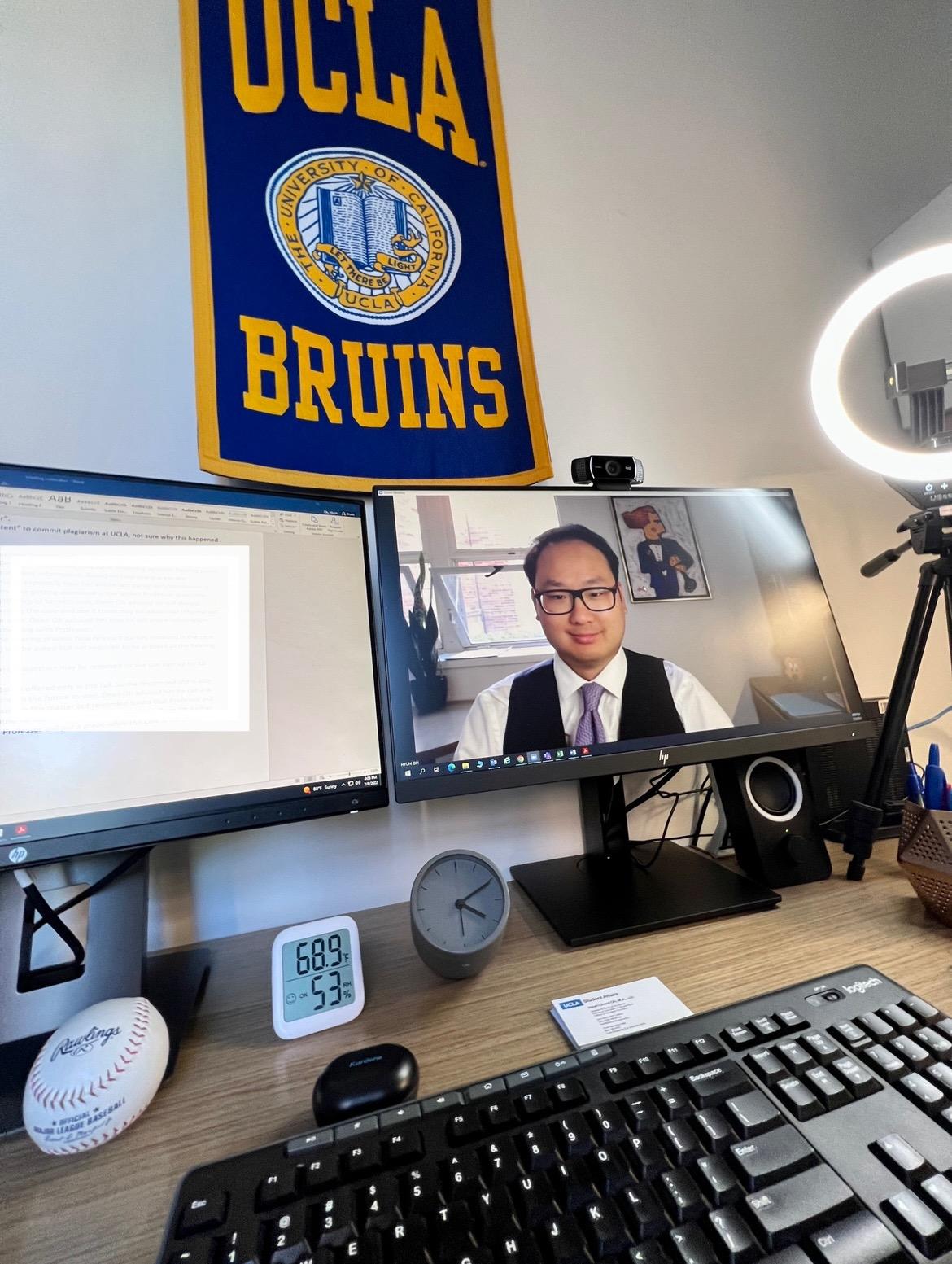
Oh brings dispute resolution skills to UCLA

Dean Oh selfie in his virtual office
(© Hyun C. Oh, licensed exclusively)
Hyun Cheol Oh, my friend and former student, has joined the higher ed ranks as an assistant dean of students at the University of California Los Angeles (UCLA), I am immensely proud to report.

Dean Oh is a 2010 alumnus of UCLA, where he earned a bachelor's in international development studies, and of the law school where I work, where he was the founding president of the campus chapter of the Asian Pacific American Law Student Association (APALSA). He also holds a master's in education, culture, and society from the University of Pennsylvania. In his 2014 master's thesis, Multiculturalism in the Republic of Korea, Oh examined approaches to multiculturalism in South Korean civic education.

At UCLA, Oh is putting his legal training to work, specializing in dispute resolution within the offices of the dean of students and of student conduct. Oh lives in Los Angeles with his family, which includes his better half, the profoundly gifted pianist Inhyun Lee.

The Bruins are lucky to have Dean Oh on their team.

Saturday, July 30, 2022

Rats reveal human history, sometimes set its course

RJ Peltz-Steele CC BY-NC-SA 4.0
A rat extermination program is well signed on the islands of the Azores.

As a tort lawyer, I can be a little obsessed with signs, especially warnings. So I was struck by the abundance of these signs on the islands of the Azores, specifically São Miguel, Terceira, and Pico, where I spent some time this month. The signs warn not to remove bait traps loaded with lethal rodenticide and not to litter, such as might provide food for rats.

Being a key port in the European age of discovery, the Azores are inextricably bound up with the history of human exploration and expansion. A remarkably successful species, rats are a part of that history, because they go where we go. The Azorean bat is the only native land mammal of the Azores. But people long ago brought more, including hedgehogs, rabbits, cats, and the islands' iconic cows, all besides, of course, rats.

The Azorean bat is found in dry forests. In contrast,
I am found here in the much wetter Reserva Florestal
Natural Parcial do Biscoito da Ferraria, on Terceira.
(Photo © Emma Falk, licensed exclusively.)
Unfortunately, the rats are now spreading a potentially fatal pathogen, leptospira, which threatens people and animals in the Azores. So officials have set about efforts to reduce the rat population.

There's been an abundance of research sequencing rat DNA to study the history of human exploration. For example, Gabriel, Mathias, & Searle (2014) studied rats in the Azores specifically. There are books on the history that rats and people share: Anthony Barnett's The Story of Rats (2002) and the New York City-focused Rats (2005) by New Yorker contributor Robert Sullivan. As the latter book suggests, rat research also informs contemporary urban development. Canadian "rat detective" Kaylee Byers wrote a fun first-person narrative for The Conversation (2019) on the value of "23andme" for rats.

Rats have a fan club.

The signs in the Azores reminded me in particular of a superb episode of the Throughline podcast in the spring, "Of Rats and Men," which well summarized the subject.

Friday, July 29, 2022

Charitable immunity does not protect diocese from claims of sexual assault in 1960s, high court rules

St. Michael's Cathedral, Springfield, Mass.
(John Phelan via Wikimedia CC BY-SA 3.0)
Charitable immunity does not protect Catholic Church leaders in Springfield, Mass., from civil allegations of sexual assault, but it does shield them against liability for negligent supervision, the Massachusetts Supreme Judicial Court ruled yesterday.

Pseudonymous plaintiff John Doe alleged sexual abuse, including a "'brutal[] rape'" while being held down by fellow altar boys and priests in the 1960s. Doe alleged that he first recovered memory of the abuse in 2013; he first complained to the church in 2014.

After investigations, the church offered the plaintiff an apology in 2019, and in 2021, he sued over both the abuse in the 1960s and the handling of the complaint since 2014. The Superior Court denied the defendants common law charitable immunity and ecclesiastical abstention under the First Amendment, prompting interlocutory appeal. The Supreme Judicial Court declined any First Amendment question as premature in advance of final judgment.

By statute, Massachusetts curbed charitable immunity to a $20,000 quantitative limit ($100,000 in medmal) in 1971. But the statute is not retroactive to Doe's 1960s claims.

The purpose of common law charitable immunity, the court reasoned, is to protect charitable actors "from the burden of litigation and trial." But in the context of sexual assault allegations, the defendants cannot be said to have been performing a charitable function. In contrast, "negligent supervision ... is exactly the sort of allegation against which common-law charitable immunity was meant to protect," for it implicates managerial functions in the selection of subordinates.

The case arises in the home state of the Boston Globe Spotlight team, whose 2002-04 investigation surfacing church abuse became the subject of a 2015 feature film. The bishop named in the instant suit as a perpetrator, who died in 1982, was implicated in the Spotlight investigation.

The case is Doe v. Roman Catholic Bishop of Springfield, No. SJC-13219 (posted temporarily). Justice David A. Lowy wrote the unanimous opinion.

Scholars seek to stimulate socio-legal studies in Africa

At the global meeting of the Law and Society Association (LSA) in Lisbon earlier this month, scholars in the collaborative research network dedicated to Africa ("CRN 13") agreed to move forward with an independent Africa Law & Society Network.

Working alongside but apart from CRN 13, the "Africa Law & Society Network" has a web page and for the time being claims a mailing address at the Centre for Law and Society at the University of Cape Town (UCT). The aim, in time, is to build a vibrant organization that is representative of scholars throughout the continent. 

The network thus hopes to stimulate the coordination of socio-legal studies by African scholars in two respects in which previous efforts have floundered: to have African scholars charting their own direction for research, rather than being coordinated by Western-dominated organizations; and to decentralize and diversify leadership, overcoming the tendency to lean exclusively on South African institutions.

CRN 13 leaders at the meeting sported the slogan "#CiteAfricanScholars" on T-shirts. Citation to African scholars often is limited by structural constraints that Western researchers might not even be conscious of, such as the simple availability of the work. With limited institutional resources, African academics cannot always enter their works into the subscription databases on which researchers often over-rely. And academic writers not backed by well known institutions are disproportionately unable to negotiate copyright and access terms with publishers that favor long-term pay walls over open source.

Professor Dee Smythe (LSA, UCT, LinkedIn) addresses the CRN 13 meeting in Lisbon.
(RJ Peltz-Steele CC BY-NC-SA 4.0)


Lawsuit alleges excessive force against federal immigration detainees held near public law school

Warning: indecent language.

Latino detainees of the Bristol County House of Corrections, which is located just three-quarters of a mile from the University of Massachusetts Law School, sued the county sheriff and Immigration and Customs Enforcement, alleging serious physical abuses.

Filed in April, the complaint, stating Bivens and § 1983 claims for excessive force, is available from the federal district court docket at Court Listener. The factual allegations detail incidents of violence and some not so flattering quotations of officers, such as: "Shut the fuck up. You bitches are a bunch of immigrants without papers. You have no rights."

Sheriff Hodgson shakes hands with former President Trump
at a White House event recognizing sheriffs in 2019.

(Official White House photo by Joyce N. Boghosian via Flickr.)
Named in the lawsuit is Bristol County, Mass., four-term "tough on crime" Sheriff Thomas M. Hodgson. This lawsuit is not his first tangle with unsavory allegations.

A 2020 report by the office of Attorney General Maura Healey determined that authorities employed excessive force in violation of the civil rights of federal immigration detainees (press release). New Bedford, Mass., tort lawyer Betty I. Ussach has written letters to local media complaining of the high cost of defending Hodgson's style of criminal justice (EastBayRI, Dartmouth Week Today).

But in past years, Hodgson's name recognition has seemed to work a no-publicity-is-bad-publicity magic in his reelection bids. Hodgson faces a slate of challengers this year.

I wonder whether the geographic juxtaposition of the Bristol prison and the Immigration Clinic at the state's only public law school is not telling of state conflict-of-interest policy, which would complicate if not prohibit clinic litigation against state and local actors. 

Clinic director Professor Emerita Irene Scharf retired just one one month ago. She exited amid some turbulence over how and even whether the law school would take responsibility for existing clients. It remains to be seen what the clinic will look like under new management. Scharf and sociology and anthropology Professor Lisa Maya Knauer have labored diligently for decades on behalf of the immigrant Latino community in south coast Massachusetts. But university personnel at Dartmouth, Mass., far from the aegis of the "flagship campus" at Amherst, must tread lightly in politically sensitive matters, lest they jeopardize the very existence of the system's less favored locations.

The present lawsuit, Morocho v. Bristol County Sheriff's Office (D. Mass. filed Apr. 29, 2022), was filed by Washington, D.C.-based NGO Rights Behind Bars and signed by its Boston-based litigation director, attorney Oren Nimni. Nimni is a graduate of Northeastern Law and an adjunct professor at Suffolk Law. So let the record reflect that monied Boston private law schools can make grief for public officials, too.

Thursday, July 28, 2022

While Pope apologizes in Canada, U.S. reckons with legacy of federal Indian boarding schools

Children at Rehoboth Mission School, New Mexico
(from DOI report p. 39, credited: Hartog, C. (1910).
Rehoboth School [Photograph]. Indian mission sketches:
Descriptions and views of Navajo life, the Rehoboth Mission School
and the Stations Tohatchi and Zuni, 22. Gallup, N.M.: The Author.
Hathi Trust Digital Library)
The Pope's visit to Canada to ask forgiveness for the role of the Church has brought the tragedy of Indian boarding schools to light, but coverage has been thin on the U.S. legacy.

In the United States, Indian boarding schools were government policy and attempted a cultural genocide no less shamefully than the Church effort in Canada. This U.S. angle on the story hasn't been mentioned in my evening news the last few nights. But it was explicated by an Interior Department (DOI) report in May just this year and is being addressed in some media outlets (e.g., NPR).

The DOI report is just volume 1 in the ongoing investigation of the Federal Boarding School Initiative, "a comprehensive review of the troubled legacy of federal boarding school policies," launched in June 2021. A transmittal letter at the front of the report explained:

This report shows for the first time that between 1819 and 1969, the United States operated or supported 408 boarding schools across 37 states (or then-territories), including 21 schools in Alaska and 7 schools in Hawaii. This report identifies each of those schools by name and location, some of which operated across multiple sites.

This report confirms that the United States directly targeted American Indian, Alaska Native, and Native Hawaiian children in the pursuit of a policy of cultural assimilation that coincided with Indian territorial dispossession. It identifies the Federal Indian boarding schools that were used as a means for these ends, along with at least 53 burial sites for children across this system-with more site discoveries and data expected as we continue our research.

When I say "attempted cultural genocide," or "ethnocide," this isn't just me throwing around woke words. The DOI report detailed official policy dating to President Washington to "subdue[] the Indians" by assimilation, "helping the whites acquire desirable land." An 1803 memo by President Jefferson outlined a plan to relocate native Americans and push them into farming with the express aim that they would thereby fall into debt and have to cede their land. (And, I note, today still our corporate overlords are pushing all of us into asset ownership—homes, cars, cell phones—on the debt model rather than the capital model. You don't have to be native American for the strategy to make the rich richer and you poorer.)

Hundreds of thousands of children were taken from their families and sent to boarding schools often distant from their home communities. That generations of people were so traumatized explains a lot about the fragile social and economic state of reservation communities today.

In military school fashion, the children's every 24 hours in the boarding schools were regimented. Using quotes from contemporary accounts (notes and sources omitted here), the report recounted:

"The children are improved rather in their habits than in what they learn from books." For example, to teach them "obedience and cleanliness, and give[] them a better carriage," Department records detail examples of organizing Indian male children "into companies as soldiers, and the best material selected for sergeants and corporals." "They have been uniformed and drilled in many of the movements of army tactics."

The report explained the means and ends of the boarding schools with revealing perspective:

Systematic identity-alteration methodologies employed by Federal Indian boarding schools included renaming Indian children from Indian names to different English names; cutting the hair of Indian children; requiring the use of military or other standard uniforms as clothes; and discouraging or forbidding ... Indian languages, ... cultural practices, and ... religions. "When first brought in they are a hard-looking set. Their long tangled hair is shorn close, and then they are stripped of their Indian garb thoroughly washed, and clad, in civilized clothing. The metamorphosis is wonderful, and the little savage seems quite proud of his appearance."

"No Indian is spoken[:]" "There is not an Indian pupil whose tuition and maintenance is paid for by the United States Government who is permitted to study any other language than our own vernacular—the language of the greatest, most powerful, and enterprising nationalities beneath the sun."

Then there was enforcement for violating the rules, including the prohibitions on language and religious practice. Whipping was the preferred punishment for attempted runaways.

Indian boarding school rules were often enforced through punishment, including corporal punishment, such as solitary confinement, "flogging, withholding food, ... whipping[,]" and "slapping, or cuffing." At times, rule enforcement was a group experience: "for the first offense, unless a serious one, a reprimand before the school is far better than a dozen whippings, because one can teach the whole school that the offender has done something that is wrong, and they all know it and will remember it, while it is humiliating to the offender and answers better than whipping."

Conditions for even compliant children were less than optimal. Citing prior DOI investigations in 1928 and 1969, the 2022 report stated:

The Department has acknowledged "frankly and unequivocally that the provisions for the care of the Indian children in boarding schools are grossly inadequate." Rampant physical, sexual, and emotional abuse; disease; malnourishment; overcrowding; and lack of health care in Indian boarding schools are well-documented.

Moreover, the children's labor was used to operate the schools, for example, the children's clothes were made by female students as part of their vocational training.

Lest the severity of these conditions be confused with mere norms of less gentle times, we might consider that schools, even in the 19th century, rarely had their own graveyards. DOI found 53 burial sites at Indian boarding schools, at least six unmarked.

U.S. Indian boarding schools have been examined thoughtfully in media outlets: The Atlantic, National Geographic (limited free), NPR, N.Y. Times, and Time (paywall).

There are books, too, of course: Ward Churchill's well regarded Kill the Indian, Save the Man (2004); the first-person Pipestone (2010) by Adam Fortunate Eagle; and the documentary compilation Boarding School Seasons (2000) by Brenda J. Child.

There are online resource collections at The National Native American Boarding School Healing Coalition and the Library of Congress.

My favorite media treatment in this area is a 2015 Radiolab segment, rebroadcast in 2018, "Ghosts of Football Past." Follow it up with a compelling reflection by Professor Justin De Leon.

EEOC withholds records in arbitration matters; corporate frustration with secret justice is ironic

Janet Dhillon
According to employers' lawyers, the Equal Employment Opportunity Commission (EEOC) is denying public access to investigation files in matters committed to arbitration, even while conceding that files in litigation matters must be disclosed under the federal Freedom of Information Act (FOIA).

Yesterday the Labor and Employment Law Practice Group of the Federalist Society held a teleforum with the provocative title, "Is the EEOC misusing the Freedom of Information Act to penalize employers that adopt mandatory employment arbitration programs?" Here is the description:

The EEOC is denying employers' FOIA requests for the EEOC's charge investigation files when resulting employment claims are proceeding in arbitration rather than litigation. Our panel will discuss whether the EEOC's justifications for denying such FOIA requests are consistent with FOIA and other governing federal statutes. We will consider a number of related issues. What is the EEOC's basis for treating litigation and arbitration differently in responding to employers' FOIA requests?  How long has the EEOC been making this distinction between litigation and arbitration? In light of the increasing prevalence of employment arbitration, should employers challenge the EEOC's FOIA practices and, if so, how?

Speakers included EEOC Commissioner Janet Dhillon and Jones Day attorney Eric Dreiband.

I regret, I didn't make it. My guess is that the EEOC is denying access on basis of the various exemptions for law enforcement investigation records, besides deliberative process. Without having heard either side of the debate, my inclination, probably like Dreiband's, is to doubt seriously the viability of any asserted distinction between arbitration and litigation.

What I find compelling about the case, though, is less the effort at FOIA exemption and more the irony of corporations being stymied on transparency and accountability when mandatory arbitration is a choice of their own design.

I wrote just yesterday about the problem of arbitration superseding litigation as our principal means of dispute resolution. And the fact that arbitration happens in secrecy is a big part of that problem. In litigation, the tort system achieves the important objectives of norm-setting and deterrence, besides the anti-vigilantism I mentioned yesterday. Norm-setting and deterrence, in turn, avert tortious conduct by the same respondent and other actors in the future. Secret justice undermines these objectives. Even the same bad actor can persist in its misconduct without risk of punitive consequences.

I don't approve of selective opacity by EEOC. But there's a scrumptious hypocrisy in companies wanting transparency and accountability in public enforcement mechanisms while they jealously secret their own dirty laundry against the public functions of the courts.

Lisbon graffiti writer seeks internet access

I passed this graffiti in the Entrecampos area of Lisbon while attending the annual meeting of the Law and Society Association earlier this month (photo by RJ Peltz-Steele CC BY-NC-SA 4.0).

The text struck me as a curious coupling of "free expression" to excess and an unrealized "right to receive," or right of access to information and the internet.

It looks like someone tried to obliterate the middle section of the text, but as best as I can read it, it says, in whole: "I am a local artist in need of internet connection without any restriction. If you have a network that works and you [are] up for sharing, please text me the [user?] name, password and your approximate address to 969 158 614. In exchange, you(r) might get a poem."

I might have been better persuaded if the writer had asked in rhyme.

Wednesday, July 27, 2022

Grubhub drivers signed away right to sue, court rules

Haydn Blackey via Flickr CC BY-SA 2.0
Grubhub drivers signed away their right to sue on unfair wage claims, the Massachusetts Supreme Judicial Court ruled today.

Plaintiff Grubhub drivers complained that the company is stiffing them on minimum wages and tips under state law and, worse, retaliating against drivers who complain.

I have no knowledge of the validity of these claims, but I worry a lot about the exploitation of gig workers in our economy. This exploitation is a big slice of the broader problem of employers' over-classification of personnel as independent contractors to avoid having to provide fair wages and benefits. Sometimes employers cross the legal line and sometimes they don't; regardless, the effect of even the lawful leeway contributes to our glut of working people who cannot make ends meet, put us all at risk with insufficient insurance for healthcare and accidents, and spend so much on necessities as to have paralyzed American socioeconomic mobility. Our woefully outdated measures of employment fail to reflect this problem, which is why media pundits and Washington pointy-heads scrunch their faces in confusion over how we can have favorable job numbers and an "it's the economy, stupid" political crisis happening at the same time.

Collateral to labor exploitation, we have long had the problem of our court system being subverted by the supposed freedom to contract. At this point, we all know without even having to read the fine print that every terms-and-condition box we check, just like every product we liberate from shrinkwrap, binds us to arbitrate any disgruntlement and frees our adversaries from ever having to answer to us in the courts, which were designed for that very purpose. Many of us know furthermore that the terms of arbitration profoundly favor the respondent companies, both substantively, evidenced empirically by companies' overwhelming win rates, and, often, procedurally, by way of inconvenient venues, arcane procedures in contrast with small claims courts, and the burdens of transaction costs.  I've cited the definitive books on this subject by Nancy Kim and Margaret Jane Radin so many times, that, frankly, I just don't have the energy today to look up their URLs again.  Let's instead invoke the tireless Ralph Nader and his persistent admonition that we have undermined the Seventh Amendment, to which point I add humbly that anti-vigilantism is an important function of our civil dispute resolution system, and maybe we ought remember that in a society in which the least mentally stable among us apparently have ready access to firearms.

So it's the confluence of these two socio-legal problems that interests me in the present case, more than the merits. On the merits, the Grubhub complainants tried to work around their 2017 clickwrap agreement to arbitrate by characterizing themselves as a kind of interstate transportation worker that is exempt from the Federal Arbitration Act. But Grubhub drivers are not long-haul truckers. A for creativity, F for achievement. The court held that the drivers indeed signed away their right to sue.

F is likely to be the final disposition of the complaints in arbitration after remand, too.

You can read more in Archer v. Grubhub, Inc., No. SJC-13228 (July 27, 2022). Justice Dalila Argaez Wendlandt wrote the unanimous opinion (temporarily posted).  The case in Suffolk County Superior Court is no. 1984CV03277 (class action complaint filed Oct. 21, 2019).

The U.S. Chamber, dependable opponent of transparency and accountability, was among the amici on the prevailing side.  The Harvard Cyberlaw Clinic was among the amici for the workers. The office of Commonwealth Attorney General Maura Healey entered an appearance as amicus, but filed no brief. Healey's office sued Grubhub one year ago, alleging the company overcharged Massachusetts restaurants during the pandemic (complaint, press release). That case, no. 2184CV01719 in Suffolk County Superior Court, is pending currently on cross motions for summary judgment.