Saturday, July 1, 2023

Liske translates Yeats poem with link to dystopian sci-fi

© Cyprian Liske; used by permission.
My friend and scholar-translator Cyprian Liske has prepared a Polish translation (image) of W.B. Yeats's "Aedh Wishes for the Cloths of Heaven" (1899).

Here is the Yeats original:

Had I the heavens’ embroidered cloths,
Enwrought with golden and silver light,
The blue and the dim and the dark cloths
Of night and light and the half-light,
I would spread the cloths under your feet:
But I, being poor, have only my dreams;
I have spread my dreams under your feet;
Tread softly because you tread on my dreams.

Liske is a doctoral student in sustainable development and international trade law. We worked together in the American Law Program of the Columbus School of Law of The Catholic University of America and the law school of Jagiellonian University in Poland.

I don't speak Polish beyond a few words, so can't well appreciate Liske's skill as a translator. But I was intrigued by this project because, Liske informed me, the poem was inspiration for a 2002 science fiction film starring Christian Bale, Equilibrium.

The film didn't do very well. In the patriotic wake of 9/11, a dystopian parable might have been just a bit ahead of its time. I might now revisit it.  Ostensibly a romantic poem, "Cloths of Heaven" gets a lot of play in popular culture; its use in this context is compelling.  Equilibrium is set in a world in which emotion is outlawed: a response to the violence and hatred that rent the world in a third great war.  As the United States and Turkey condemn the burning of the Koran in Sweden, igniting, if you will, a perennial free speech debate, Equilibrium seems not as terribly far fetched as its prĂ©cis suggests.

I just finished watching HBO's Succession (s4), and it struck me that its Sorkin-esque dialog, timing, and staging marks it as a dystopian antithesis of my beloved West Wing: respective representations of our times, now and then.  Our dystopian restatements of contemporary society, perhaps like the corporatocracy itself, seem as yet not to have found rock bottom.

Monday, June 12, 2023

TORTZ volume 1 now available to print on demand

I'm pleased to announce the publication of TORTZ: A Study of American Tort Law, volume 1 of 2.

Hard copies can be printed at Lulu.com for just $30 plus shipping. A free PDF can be downloaded from SSRN.

Eight chapters cover the fundamentals of the culpability spectrum from intentional torts to negligence to strict liability. After two pilot deployments of content, in 2021 and 2022, this book will be my 1L students' Torts I textbook in fall 2023.

I anticipate publication of volume 2 in 2024.

Wednesday, May 24, 2023

Indian court refuses injunction of fantasy cricket league in unlicensed use of player names, likenesses

Free SVG
In case about fantasy sports, the Delhi High Court in India ruled in late April that satire, news, and art must enjoy protection from right-of-publicity liability.

The case involves athlete likenesses in fantasy sport leagues. Plaintiffs are a Singapore-incorporated fantasy sport provider that invested big money to develop non-fungible token and other electronic products making licensed use of the names and likenesses of co-plaintiff cricket athletes. The defendant business operated a less fancy but "explosive[ly]" popular online fantasy league service using the players' name and likenesses without licenses.

The court determined that Indian law does recognize right of publicity, inspired in part by the example of statutory tort actions in the United States. Accordingly, "passing off" is essential to infringement, the court held, meaning that customers must reasonably understand the defendant's proffered product as bearing the subject's endorsement. 

The court denied preliminary injunction. In the instant case, evidence was lacking that the defendant made such a representation or that reasonable users made such a mistake. To the contrary, the defendant online disclaimed any affiliation with or license from the depicted players.

The court also recognized a constitutional dimension to the position of the defense in the case, opining that "use of celebrity names, images for the purposes of lampooning, satire, parodies, art, scholarship, music, academics, news and other similar uses would be permissible as facets of the right of freedom of speech and expression under Article 19(1)(a) of the Constitution of India and would not fall foul to the tort of infringement of the right of publicity."

The case is Digital Collectibles Pte. v. Galactus Funware Technology Pte., 2023:DHC:2796, CS(COMM) 108/2023, 2023 LiveLaw (Del) 345 (Delhi High Ct. Apr. 26, 2023) (India), decided by Judge Amit Bansal, who holds an LL.M. from Northwestern University.

HT @ Lakshmikumaran & Sridharan.

Tuesday, May 23, 2023

Nike, Puma stop making shoes with kangaroo leather

Nike and Puma both announced this year that they will stop using kangaroo leather to make shoes.

I didn't know that kangaroo leather was used to make shoes. Or anything. I didn't know "kangaroo leather" was a thing. So this news was simultaneously stomach-turning and a relief to me.

Kangaroo leather is a thing, apparently prized for its strength and durability. According to People for the Ethical Treatment of Animals (PETA), somewhere between 1.5 and 5 million kangaroos are killed annually for "k-leather" clothing and accessories. (NPR reported 1.3m in Australia in 2021, per a government count there.) PETA described violent killing of adults and joeys by hunters; I'll refrain from sharing the horrifying details. 

PETA named Nike, Puma, Adidas, Diadora, Versace, and Prada as companies that used kangaroo leather, though all except Adidas have now announced that they'll stop. Footy Headlines reported in March that Adidas will offer 2024 kangaroo football (soccer) boots.

Nike was under pressure from more than NGOs. Nike World Headquarters is in Beavorton, Oregon, and a bill introduced in the Oregon legislature would have banned kangaroo leather products, NPR (and Oregon Public Broadcasting) reported in January. California has since the 1970s. The Oregon bill died in March, but not without having left a mark in public consciousness.

A California representative proposed a federal ban on kangaroo leather in the U.S. House of Representatives in 2021. ESPN gave some press to the Kangaroo Protection Act during the FIFA World Cup in Qatar in December, but the bill never made it out of committee.

Photos: Kangaroos at the Australia Zoo in 2005, RJ Peltz-Steele CC BY-NC-SA 4.0.

Monday, May 22, 2023

DA cannot shield officer, EMT identities from state FOIA disclosure, court rules in fatal police shooting

A Massachusetts Superior Court in March ordered the district attorney to release investigative records to the family of a man killed by police.

The privacy of public officials in the technology era has strained conventional accountability rationales for transparency. Since the advent of access to public information as a democratic norm, public officials and public figures have decried purported invasions of their privacy. The very notion of privacy in modern tort law, for better and worse, traces its roots to precisely such whinging in the late nineteenth century. Access usually prevailed.

Yet in the technological era, privacy complaints have gained new currency, and some of it is legitimate. Even, or perhaps especially, in the intensely emotional context of high-profile police shootings, interests are amped up on both sides. Of course, victims and families demand understanding and accountability, and they are entitled to it. At the same time, it's harder than ever to be a police officer, and passions that expose public servants and their families to harassment and threats pose a genuine policy problem. 

The two sides collided in Massachusetts over the death of Anthony (Antone) Harden in Fall River in 2021. The 30-year-old was shot twice and killed by police in his bedroom. Police investigators concluded that Harden had used a steak knife to attempt to stab the shooter's partner in the neck and head. A district attorney (DA) investigation in 2022 ruled the homicide justified.

Surveillance video shows officer arriving at Harden's apartment.
With the final report, Bristol County DA Thomas M. Quinn III released hundreds of pages of records, including video, audio, and photographs. But there was much that the DA did not release in response to a freedom-of-information request by Harden's brother, Eric Mack, an attorney. Though the family knew, and the lawsuit revealed publicly, the names of the involved officers by the time of the DA's report, the DA would not disclose their names.

The DA also withheld other records identifying responding personnel, including video interviews with emergency medical technicians. WBUR reported that the EMTs said they did not see the steak knife that police said necessitated lethal force.

Mack sued the DA under the state public records law, and the Superior Court in March granted his request for records on all counts. With regard to the identities of police and EMTs involved, the court wrote:

Upon balancing the rights of the parties, the public's need to access against the privacy rights at issues here, I find that the equities favor disclosure. The public officials here are not acting in the capacity of private citizens but in the course of their duties. Plaintiff has a right to have a full understanding of the facts leading to his brother's death including the identities of the public officials involved to ensure accountability and transparency. The failure to disclose this information would raise questions amongst the public about why this information was being withheld, which would only serve to undermine the integrity of the law enforcement departments involved and those reviewing their conduct. Any right to privacy that a public official might have under these circumstances, which is de minimis under the circumstances presented here, is overwhelmed by the public's right to know.

Before the resolution of the public records case, in January, the Harden family threatened Fall River with a $50m lawsuit for Harden's death, if the records were not released.

The case is Mack v. Office of the District Attorney, No. 2284-CV-00248 (Mass. Super. Ct. Suffolk County Mar. 6, 2023), decided by Justice James Budreau.

Sunday, May 21, 2023

Scholars examine efficacy of apology in book born of truth and reconciliation in South Africa

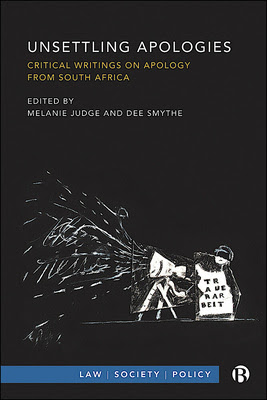
Colleagues of mine in African studies, Professors Melanie Judge and Dee Smythe published Unsettling Apologies: Critical Writings on Apology from South Africa.

Known for the truth and reconciliation processes that followed Apartheid, South Africa has been a font of experience and acquired wisdom about the role of transparency and truth in redressing mass atrocity. In this book, released in the fall from Bristol University Press, the South African editors compiled and co-authored some of the best and latest thinking and reflection on the function and debated efficacy of apology.

This is the précis.

There has recently been a global resurgence of demands for the acknowledgement of historical and contemporary wrongs, as well as for apologies and reparation for harms suffered. Drawing on the histories of injustice, dispossession and violence in South Africa, this book examines the cultural, political and legal role, and value of, an apology. It explores the multiple ways in which "sorry" is instituted, articulated and performed, and critically analyses its various forms and functions in both historical and contemporary moments. Bringing together an interdisciplinary team of contributors, the book's analysis offers insights that will be invaluable to global debates on the struggle for justice.

Even setting aside mass atrocities such as Apartheid, the theory of apology has resonance in tort law. "Apology laws" in the states seek to render apologies inadmissible as evidence in later litigation, especially in medical malpractice. Proponents posit that apology aids in healing and even averts litigation. That premise, and the efficacy of apology laws, is much studied and debated.

A masked Prof. Smythe previews the book at the annual meeting
of Law and Society in Lisbon, Portugal, in July 2022.

RJ Peltz-Steele CC BY-NC-SA 4.0
Judge and Smythe wrote the book's opening chapter, "The Power of Apology." The chapters thereafter offer a range of compelling titles. Smythe also co-authored, with educator Leila Khan, "Beyond Words: Apologies and Compensation in Sexual Offences." Smythe, a professor of public law on the faculty of law at the University of Cape Town, is a dear colleague who has been ceaselessly supportive of my research and teaching on African law and public policy.

Professor Sindiso Mnisi Weeks, a valued colleague at UMass Boston who generously has participated in my comparative law class in the past, contributed the chapter, "In Pursuit of Harmony: What is the Value of a Court-Ordered Apology?" University of Wisconsin constitutional comparatist Professor Heinz Klug authored, "Amnesty, Amnesia, and Remembrance: Self-Reflections on a 23-Year-Old Justification." Among all of the chapters, I especially appreciated the heart-rending history "On Not Apologising: Winnie Madikizela-Mandela and the TRC Hearing into the Mandela United Football Club" by Canadian Professor Shireen Hassim.

Abstracts of all chapters and the book's front matter are available at Bristol University Press Digital.

Saturday, May 20, 2023

EPA floats PFAS limits for drinking water

Rawpixel CC0 1.0
PFAS has been much on the lips of regulators, lately and at last. 

As I wrote in 2021, the movie Dark Waters (2019), based on a true story, first brought PFAS to my attention. I'm happy to report that we've since replaced almost all of our PFAS-coated cookware. And just yesterday, I followed the recent custom of removing a burrito from its plastic-coated-paper wrapper before heating it in the microwave.

When John Oliver gave his classic treatment to PFAS in 2021, Europe was moving to regulate it, but the United States was doing very little. Per John Oliver's invitation, I confirmed that my local water authority in Rhode Island was not testing for PFAS in drinking water.

Now, with Biden Administration support announced in March, the U.S. Environmental Protection Authority has a PFAS website and proposed regulations for drinking water. The proposal would drop acceptable levels of six PFAS chemicals from 70 to 4 parts per million (ppt).

That's a start, but not a solution. 

PFAS might now be in the drinking water of as many as 200 million Americans, The Guardian reported in March. Research shows human health risk upon any exposure to PFAS, so no safe level is known. The EPA's own guidelines since last year have called for voluntary limits on two PFAS chemicals at 0.02 and 0.004 ppt, a Harvard expert explained. Meanwhile, it's not clear that scientific testing is accurate enough to detect PFAS levels that low. Thus, the EPA proposal is vulnerable to criticism for not reaching the full range of PFAS chemicals and not setting maximum levels low enough. But the challenge truly to ensure human health might be practically insurmountable.

Spurred by burgeoning state regulation meanwhile, the private sector is ramping up capacity to test for PFAS nationwide. In February, Maine Laboratories became the first commercial lab in that state to offer testing. Maine Labs sells test kits for drinking water, waste water, ground water, and soil, with a two-week turnaround for results. Maine Labs's CEO is Katie Richards, a close friend and former college roommate of one of my sisters.