Tuesday, September 5, 2023

Court rejects 'super tort' theory in suit alleging animal cruelty, though concurrence mentions rights of nature

Kodiak bear at Olympic Game Farm, a private zoo in Washington.
Analise Zocher via Flickr CC BY 2.0
The Animal Legal Defense Fund tried but failed in August to convince the Washington Supreme Court to treat animal cruelty as an actionable "super tort."

The nonprofit Animal Legal Defense Fund (ALDF) sued a private zoo in Washington, alleging animal cruelty under state public nuisance law. In mid-August, the Washington Supreme Court rejected the theory as beyond the scope of the statute.

It is a clever theory. Like environmentalists, animal protection organizations face high hurdles using tort law to advance their work. Animal cruelty laws often are not vigorously enforced by public authorities and provide scant mechanisms for private enforcement. Nonprofits usually have no standing to sue without a statutory authorization.

State and local governments lately have been pushing nuisance law as a potential accountability mechanism for all kinds of social ills. Nuisance is a leading theory in lawsuits against Big Oil for the impact of climate change. And some governments found success with nuisance to leverage settlements with opioid sellers.

But this "super tort," as termed by the defense bar and tort reformers, is problematic for policy reasons. Overusing the tort system to regulate business exceeds the bounds of corrective justice, threatening the free market and the organic social contract. The courts are not equipped to make policy, and it's not their function in the constitutional design of separated powers. Converting, or perverting, social problems into civil litigation thus bypasses the political branches of government, enervating democratic accountability and threatening unintended consequences.

In 2020, I wrote about this issue in the context of the Rhode Island suit (my home state) against Big Oil. I spoke about the problem to a Jagiellonian University audience via Zoom earlier that same year.

Some states, such as Washington, allow the enforcement of public nuisance law with "private attorney general," or "citizen-suit," provisions. The potential for public authorities to expand the scope of public nuisance is thus multiplied by willing and creative advocacy organizations.

ALDF theorized that animal cruelty, which the nonprofit alleged in suing the private zoo in Washington, constituted a public nuisance. That's a reach, but not irrational.

Pollution, or environmental damage, is the classic example of a public nuisance.  A die-off of fish in a public waterway might adversely affect the interests of waterside property owners, but there is no incursion on any one property such as creates a privately enforceable nuisance. Public authorities are obliged to respond to the problem as a matter of policymaking—thus, environmental protection law and regulation. Add citizen suits to the public nuisance mix, and environmentalists acquire enforcement power.

ALDF's wish to enforce animal cruelty law is a short leap through analogy in natural resource protection. Moreover, nuisance law in some states has a "per se" concept, like negligence law, by which the standard of right and wrong can be informed by statute. So ALDF bolstered its public nuisance claim by pointing to anti-cruelty statutes and wildlife conservation laws as public policy properly pronounced by the legislature.

ALDF further analogized to a peculiar but exigent strain of public nuisance law tied to morality.  In my 2020 talk, I made scant reference to this theory, in the interest of succinctness, but probably I should have given it a more respectful nod.

Historically, public nuisance law was used to shut down the likes of brothels and saloons.  Sometimes red-light businesses externalize costs to surrounding property owners that are real but difficult to quantify—consider the long-running feud between a Chicago-area strip club and next-door nuns, by which the convent alleged injury by "secondary effects" (as known in First Amendment law), such as crime and litter.  But many times, too, public nuisance laws have been invoked on the mere basis of moral objection.

In that sense, runaway public nuisance is a problem of the law's own creation.  Common law courts opened the door to nuisance in the moral abstract, untethering the concept from physical property.  ALDF just stepped through the door.  Society's intolerance of animal cruelty is a moral statement no less than condemnation of human trafficking.  As an animal advocate myself—full disclosure, I'm a founding faculty adviser of the student ALDF chapter and a past ALDF supporter—I find this theory appealing.

To be objective, though, the difficulty arises in that not everyone, least of all the legal system, embraces ALDF and my view of unequivocal morality in the area of animal cruelty.  The law permits even purely recreational hunts to kill exotic animals.  For all her worthy work, even Temple Grandin has not succeeded in making humane methods universal in food production.  Despite advancements in the recognition of human grief as a compensable loss in tort claims for injury to pets, the law continues to regard animals, for the most part, as mere chattel.

Such was the tone of the Washington Supreme Court's response to the ALDF claim.  ALDF could not articulate a conventional nuisance theory, in the way of interference with peace and enjoyment of land, and the court refused to engage with ALDF's theory as a matter of policy indicated by the animal cruelty or wildlife conservation laws.

"While ALDF cites to some cases that identify wildlife as a public resource," the court opined, "it cites no cases or statutes indicating that the public has a right to use that resource as it sees fit or has any individual, personal property rights in wildlife."

ALDF pointed to a seeming precedent to no avail. ALDF prevailed in a claim against a Wisconsin private zoo in federal court last year, winning a permanent injunction on a citizen-suit nuisance theory. However, the defendant had given up the fight partway through and allowed a default judgment to be entered. The Washington Supreme Court observed that the federal trial court in the case made no ultimate finding of fact that the private zoo was a nuisance.

In concurrence, Chief Justice Steven C. González left the door open, just a crack, and made a shout out, remarkably, to the theory of the rights of nature (RoN), if not by name.  Though agreeing with the holding, the chief opined (selective citations omitted; links added):

[T]he world has changed much since the days when King Henry II, Kukulkan, and the Great Khan were young. Now, the private use of land has profound potential to harm our ecosystem and the various species we share it with. It may well be time to heed Justice Douglas's call to consider whether those places and things threatened with environmental catastrophe should have standing in court to sue for their own injuries. See Sierra Club v. Morton ... (U.S. 1972) (Douglas, J., dissenting) (citing Christopher D. Stone, Should Trees Have Standing?—Toward Legal Rights for Natural Objects, 45 S. Cal. L. Rev. 450 (1972)). Thus, I am wary of fully endorsing the majority’s sweeping conclusion that "[w]here the statutory framework and case law do not support a claim, none exists."
I'm all for ALDF's objectives, just like I'm gravely concerned about the impact of the opioid crisis. And I value the chief's assessment of common law evolution, an important capacity of American tort law that often is marginalized or forgotten in contemporary practice.  I have hastened to recognize the potential of common law evolution to reflect, not make, social policy in areas such as privacy and data protection.

But I worry, too, about misuse of the courts to make social policy; what the public will to do so tells us about possibly catastrophic dysfunction in the political branches; and what that means for the fabric of our democracy.

The case is Animal Legal Defense Fund v. Olympic Game Farm, Inc., No. 101264-1 (Wash. Aug. 17, 2023) (ALDF commentary).  Associate Chief Justice Charles W. Johnson wrote the opinion of the court.

Monday, September 4, 2023

Federal law shields car dealer in courtesy-car accident

CC0 by Open Grid Scheduler via Flickr
A car dealership could not be held vicariously liable to a pedestrian struck by a courtesy vehicle, the Massachusetts Supreme Judicial Court ruled in June.

A New Jersey Mercedes Benz dealer lent a customer, defendant Oke, a courtesy car while Oke's car was being repaired. After traveling to Boston (an apparent excess of the radius permitted by the courtesy-car contract), Oke left the key in the ignition, engine running, and his wife, Steele (no relation), in the passenger seat, while he attended to business. When a parking official demanded that the car be moved, Steele's attempt to do so resulted in collision with, and serious injury to, the pedestrian-plaintiff.

The laws of many states permit an injured person to pursue the owner of a vehicle in vicarious liability, regardless of the owner's fault. In a 2005 federal highway bill, Congress preempted and disallowed no-fault vicarious liability when the vehicle owner is a rental company. According to FindLaw, Congress was troubled by the likes of a $21m vicarious liability award against Budget in New York. The statutory language, "the Graves Amendment," was named for Rep. Sam Graves (R-Mo.), who estimated that vicarious liability awards cost car rental companies some $100m annually, a cost passed on to consumers.

The Supreme Judicial Court ruled that the Graves Amendment protected the New Jersey car dealer. The courtesy-car arrangement was part of the transaction for car service, the court reasoned, so akin to a rental agreement.

The court thus dismissed claims against the car dealer. However, reversing, the court remanded the plaintiff's claim against Oke for negligent entrustment. The trial court must resolve a question of fact, the court opined, before the negligent entrustment claim can be adjudicated. The plaintiff plausibly alleged that Oke had, under the circumstances, implicitly authorized Steele to move the car if necessary.

The surviving claim based on negligent entrustment provides a worthwhile reminder that, upon other facts, the Graves Amendment does not let car rental companies off the hook for liability theories in negligence, such as negligent entrustment and negligent maintenance.

The case is Garcia v. Steele, No. SJC-13378 (Mass. June 27, 2023) (FindLaw). Justice Dalila Argaez Wendlandt wrote the court's unanimous opinion.

Saturday, September 2, 2023

Friday, September 1, 2023

Acuerdo en inglés para arbitrar vincula al firmante de habla hispana aunque no lo entendió, tribunal concluye

(English translation by Google: Agreement in English to arbitrate binds Spanish-speaking signatory even though he did not understand it, court rules.)

Un hombre de habla hispana se comprometió a un acuerdo de arbitraje en inglés incluso si no lo entendía, dictaminó ayer el Tribunal de Apelaciones de Massachusetts.

El día de su cirugía para corregir la visión con Lasik, el demandante Lopez firmó cuatro formularios en inglés, incluido el consentimiento y el acuerdo para arbitrar cualquier disputa. Más tarde, insatisfecho con la cirugía, Lopez presentó una demanda, alegando negligencia médica.

CC0

Revocando la decisión del Tribunal Superior, el Tribunal de Apelaciones ordenó la desestimación tras la moción del demandado de obligar al arbitraje.

Las cláusulas de arbitraje obligatorio han sido un punto de dolor para los defensores de consumidores durante décadas. Son una parte del problema de los términos de servicio densos y no negociables que son omnipresentes en las transacciones de consumo contemporáneas, tema de libros como Wrap Contracts (2013), por Nancy Kim, y Boilerplate (2012), por Margaret Jane Radin.

Los defensores de consumidores como Ralph Nader lamentan la eliminación masiva de disputas del sistema de justicia civil, un impacto en la Séptima Enmienda y una propagación democráticamente problemática de la justicia secreta. Y detrás de las puertas cerradas del arbitraje, las probabilidades favorecen a los negocios de manera tan abrumadora que alimentan dudas sobre la justicia. Los árbitros que no dictaminan la forma en que los demandados recurrentes corren el riesgo de quedarse sin trabajo.

A pesar de estos potentes motivos de preocupación, los legisladores y los tribunales se han puesto del lado de las empresas para proteger y hacer cumplir el arbitraje obligatorio, supuestamente para proteger al comercio de los intolerables costos de transacción de los litigios.

En el ley común de daños, el consentimiento y la asunción expresa del riesgo niegan la responsabilidad, porque se debe permitir que dos personas establezcan los términos de su propia relación. Podrán apartarse del contrato social siempre que los términos que fijen no violen el orden público; es posible que, por ejemplo, no acepten cometer una herida. En teoría, ambas defensas se basan en el acuerdo voluntario y consciente del demandante.

El demandante que firma un contrato sin leerlo cuestiona esta teoría. La firma evidencia el acuerdo subjetivo del demandante. De hecho, no existe ningún acuerdo subjetivo; el conocimiento y la comprensión de los términos acordados no se pueden encontrar en la mente del demandante.

La regla general es que la firma vincula de todos modos. Y en gran medida, esta regla es necesaria, incluso si significa que las personas están obligadas a cumplir términos que no habrían aceptado si los hubieran entendido. El comercio depende de la fiabilidad de los contratos. Si una parte del contrato  siempre pudiera impugnar la aplicabilidad basándose en testimonios interesados de malentendidos, entonces el litigio sería tan gravoso que paralizaría los negocios.

Un malentendido subjetivo puede causar un incumplimiento del contrato en el derecho de daños si mitiga la evidencia de la aquiescencia del demandante. Así, por ejemplo, las empresas a veces buscan establecer la asunción expresa del riesgo por parte de los clientes con un cartel que diga que "cualquiera que proceda más allá de este punto asume el riesgo de sufrir daños por negligencia." (A veces, tales carteles son exigibles por ley.) En tal caso, el demandante puede al menos argumentar que no vio el cartel, o, mejor, no lo entendió debido al lenguaje.

Desafortunadamente para Lopez, no conocía esos datos. El tribunal relató: "Lopez testificó que había vivido en Massachusetts durante doce años en el momento de su cirugía y había aprendido 'un poco' de inglés 'en las calles.'" (Las opiniones de los tribunales y el testimonio citado están en inglés; todas las traducciones aquí son mias.) El Tribunal Superior había determinado que "Lopez no tenía un comprensión suficiente del inglés para permitirle leer el Acuerdo de Arbitraje." Al mismo tiempo, la oficina de cirugía tenía un traductor de español disponible; Lopez no pidió ayuda. El hecho de su firma era inequívoco.

El tribunal razonó:

"Los contratos escritos tienen como objetivo preservar los términos exactos de las obligaciones asumidas, de modo que no estén sujetos a la posibilidad de una falta de recuerdo o una declaración errónea intencionada." [Grace v. Adams (Mass. 1868).] Esta regla de larga data 'se basa en la necesidad fundamental de seguridad en las transacciones comerciales." [Williston on Contracts (4a ed. 2022).] Estos principios legales subrayan que existe una "solemnidad [para] firmar físicamente un contrato escrito" que hace que una firma sea algo más que un simple adorno elegante en un documento. [Kauders v. Uber Techs., Inc. (Mass. 2021).]

Lopez testificó que no habría firmado el acuerdo de arbitraje si hubiera podido entenderlo. El mayor problema político para la protección del consumidor en Estados Unidos es que esta afirmación probablemente sea falsa, sin el beneficio de la retrospectiva. Es prácticamente imposible vivir en el mundo moderno—tarjetas de crédito, teléfonos móviles, sitios web, servicios públicos, viajes—sin aceptar un arbitraje obligatorio todos los días.

El caso es Lopez Rivera v. Stetson, No. 22-P-904 (Mass. App. Ct. Aug. 31, 2023). El juez Christopher P. Hodgens redactó la opinión del panel unánime, en el que también estaban los jueces Wolohojian y Shin.

Thursday, August 31, 2023

Wrongful death depends on viability of decedent's action at time of death, Mass. high court rules

Via Picryl
When a statute of limitations precluded smokers' suits against tobacco makers, the smokers' families also could not sue in wrongful death after the smokers died, the Massachusetts Supreme Judicial Court ruled in July.

It's harder nowadays, than it once was late in the last century, for smokers to sue Big Tobacco for the health consequences of smoking. In accordance with the peculiar lifecycle of many product liability theories, tobacco makers have acquired strong defenses against smokers who persist despite now well known risks. There are occasional plaintiff wins, still. But over time, fewer cases can pass muster by proving recent manifestation of injury incurred long ago.

In one strategy to circumvent the natural expiration of product liability exposure, Massachusetts plaintiffs, whose family members succumbed to smoking-related illnesses, theorized that wrongful death in commonwealth statute is a cause of action independent of the decedent's causes for personal injury. In this theory, the wrongful death action comes into being only upon the death of the decedent and might resist defenses that would have defeated the decedents' own personal injury claims—namely, the statute of limitations.

In the consolidated Fabiano v. Philip Morris USA Inc. and Fuller v. R.J. Reynolds Tobacco Co., the plaintiffs alleged negligence and breach of warranty pursuant to the wrongful death statute, even while they did not dispute that the smoker-decedents, plaintiffs' family members, could not have sued in personal injury at the time of death because of the expiry of the limitations period for those actions. Accordingly, there also could be no survival claims in the names of the decedents.

The court rejected the plaintiffs' theory, affirming the judgment of the courts below in favor of the defendants. Even though it has its own statute of limitations, wrongful death was nonetheless intended by the legislature to be a derivative cause of action, the court opined. The cause vests in family only if the decedent has a viable cause at the time of death.

The court had said as much before as to personal injury actions, so affirmed that rule, and moreover held that plaintiffs in Fabiano and Fuller failed to distinguish breach of warranty claims. All of the family's liability theories are constrained by the wrongful death statute, and so by its limitations.

The court acknowledged that not every state agrees. Colorado and West Virginia seem to regard the wrongful death action as an independent statutory action. But they are out of step with the "overwhelming majority" rule in the states, the court observed.

In teaching torts, I prefer to describe wrongful death claims as "parasitic," rather than "derivative." The concepts are not co-extensive, but both terms capture the notion of dependency on the underlying personal injury claim. I admit, I had never considered the plaintiffs' theory and did not know about the Colorado and West Virginia approach.

There is a logic to the minority rule. A wrongful death claim means to compensate "parasitic plaintiffs" for their losses, not the losses of the decedent. The wrongful death plaintiff thus does not incur injury until the time of death. At the same time, the policy of the statute of limitations attached to the decedent's claim, which statute protects defendants against excessive liability exposure, is somewhat undermined by tacking on the enduring potential of a recovery upon death at an indefinite later time.

Justice David A. Lowy wrote the court's unanimous opinion in Fabiano and Fuller, No. SJC-13282 & No. SJC-13346 (Mass. July 6, 2023) (FindLaw).

Wednesday, August 30, 2023

Libro estudia poder de corte constitucional ecuatoriana

El abogado Ugo Stornaiolo Silva ha publicado un libro, Jueces Como Soberanos: Una Exploración Jurídico-Política del Poder Supremo de la Corte Constitucional Ecuatoriana (Amazon). (English below.)

Stornaiolo es un abogado ecuatoriano y estudiante de LL.M. Nos conocimos cuando él era estudiante mío en el Programa de Derecho Americano de la Universidad Católica de América en la Universidad Jagellónica de Cracovia, Polonia. Visitó generosamente mi clase de Derecho Comparado en UMass, a través de Zoom en la primavera, para hablar sobre derecho constitucional comparado, especialmente a la luz de notables decisiones recientes de los tribunales ecuatorianos con respecto a los derechos indígenas y los derechos de la naturaleza.

Aquí está el resumen del libro nuevo.

Por lo dispuesto en la Constitución actualmente vigente, la Corte Constitucional ecuatoriana es una de las instituciones más importantes del diseño constitucional ecuatoriano, y sus extensos poderes, sin contrapesos o fiscalización, podrían sugerir que es un ente soberano dentro de nuestro país frente a una institucionalidad de poderes separados que no puede ejercer sus funciones fuera de su control.

Sin embargo, la soberanía de la Corte Constitucional no es un fenómeno expreso, por lo que demostrar su condición soberana podría significar un cambio de paradigma en el entendimiento crítico de nuestro propio ordenamiento político y jurídico.

Stornaiolo escribe para el websitio, The Libertarian Catholic (El Católico Libertario). Para conocer una muestra en inglés de su trabajo sobre el constitucionalismo ecuatoriano, consulte su artículo de 2021,  "Originalism and Textualism Are Not Enough Against Constitutional Lawfare" ("El Originalismo y el Textualismo No Son Suficientes Contra la Guerra Jurídica Constitucional").


Attorney Ugo Stornaiolo Silva has published a book, Jueces Como Soberanos: Una Exploración Jurídico-Política del Poder Supremo de la Corte Constitucional Ecuatoriana (Judges as Sovereigns: A Legal-Political Exploration of the Supreme Power of the Ecuadorian Constitutional Court) (Amazon).

Stornaiolo is an Ecuadorean lawyer and LL.M. student. We met when he was a student in my class in the American Law Program of The Catholic University of America at Jagiellonian University in Kraków, Poland. He generously visited my Comparative Law class at UMass, via Zoom in the spring, to talk about comparative constitutional law, especially in light of recent noteworthy decisions by Ecuadorian courts regarding indigenous rights and the rights of nature.

Here is the précis of the book (my translation).

Based on constitutional law as presently in force, the Ecuadorian Constitutional Court is one of the most important institutions in the Ecuadorian constitutional design, and its extensive powers, without checks or oversight, could suggest that it is a sovereign entity within our country, in opposition to the separation-of-powers framework, by which one cannot exercise power beyond the scope of authority.

However, the sovereignty of the Constitutional Court is not an explicit phenomenon, so demonstrating its sovereign condition could mean a paradigm shift in the critical understanding of our own political and juridical order.

Stornaiolo writes for the website, The Libertarian Catholic. For a taste in English of his work on Ecuadorian constitutionalism, check out his 2021, paper,   "Originalism and Textualism Are Not Enough Against Constitutional Lawfare."

Tuesday, August 29, 2023

Journal of Civic Information seeks associate editor

If you're a transparency scholar looking for a side hustle, check out the posting by the Journal of Civic Information seeking an associate editor.

Present editor and FOI advocate extraordinaire David Cuillier has moved into the leadership role at Florida's Brechner Center, so he needs someone new at the helm of the journal. The associate editorship is a three-year gig with a $2,500 annual stipend.

I serve on the Journal's Editorial Board. So you know it's a worthy cause.

The deadline for application is October 1, 2023.

Russians travel in Asia despite, or because of, war

An Aeroflot plane awaits departure in Almaty, Kazakhstan,
earlier this month. EU and U.S. sanctions banned the airline in 2022.

RJ Peltz-Steele CC BY-NC-SA 4.0
A joke, belatedly to honor Ukraine Independence Day, August 24.

This summer, traveling in the Caucasus and Central Asia, I crossed a lot of borders. Sometimes back and across again.

I also met a lot of Russians. Most often, we exchanged pleasantries, as if there were nothing going on in the wider world. I didn't want to ask, and they seemed content not to talk about it.

I did meet a number of Russian men who had fled conscription. One fellow, late 20s I estimate, in a craft-beer bar in Bishkek, the capital of Kyrgyzstan, was especially warm company. We never talked directly about Putin's position on Ukraine. But he made clear that he believed Russia's war adventure is socially and economically disastrous for ordinary Russians at home.

Anyway, my friends and I grew accustomed to the questions asked by immigration officials with limited English.

Usually, the border officer asked,

"Occupation?"

"No," a Russian traveler answered.

"Just visiting."

Monday, August 28, 2023

Can Arsenal supporter be impartial in football inquiry?

A curious story of lawyering ethics and football allegiance broke in mid-May, just after I went off contract with UMass Law and left the States for a chunk of the summer.

Manchester City Football Club (City, or MCFC), my team, won a historic "treble" over the summer, topping the Premier League, FA Cup, and UEFA Champions League.

Thomas Jefferson, me, and a City kit
at Hofstra University, 2016

Morgan Steele CC BY-NC-SA 4.0

While City was on its spring tear, a modest shadow was cast by allegations of violations of "fair play" financial regulations in the Premier League for transactions dating to 2009 to 2018. From as much as is publicly known, the allegations focus on financial transparency requirements. Any ultimate finding of violation can have consequences going forward, ranging from fines to relegation from top-tier play.

City denies any misfeasance. In 2020, the Court of Arbitration for Sport (CAS) reversed a UEFA suspension of City for alleged violation of the financial regulations related to transactions from 2012 to 2016. The CAS decision was based principally on the exclusion of dated evidence, so the matter was not resolved on the merits. City then also denied any wrongdoing.

The present allegations, which themselves are reported to arise from a four-year investigation, have been referred to an independent commission. Its behind-closed-doors work will take a while. And City can be expected to litigate any adverse result.

The piece of the story that caused me to scratch my chin in May was the report that City had filed objection to the appointment of an Arsenal FC supporter, Murray Rosen KC, as chair of the independent commission.

Under rules of professional conduct in American law practice, being a fan of a sport team would not preclude a lawyer from representing a competitor. American Bar Association (ABA) Model Rule 1.7 focuses on conflicts in legal representation, not matters of social affiliation. Of course, the question comes down to the lawyer's ability to do the job "competent[ly]" and "diligent[ly]," so it's always possible for a lawyer to be compromised by sporting fervor. The best course is disclosure and client consent.

For a judge, ABA Model Code of Judicial Conduct Rule 2.11 similarly, probably, would not demand a sport-fan judge's recusal from a matter involving a competitor. The requisite "personal bias or prejudice" is usually indicated by concrete evidence such as financial interest, familial affiliation, or former representation, not social preference.

More than lawyer ethics, the judicial canons give weight to public perception, testing expressly for objective perception of impartiality. But being a sport fan, absent economic investment, doesn't move that needle.

For example, in a fraud lawsuit settled confidentially five years ago, plaintiffs accused the New York Giants and players, including quarterback Eli Manning, of American football, of passing off memorabilia falsely as game worn. The plaintiffs asked New Jersey Superior Court Judge James J. DeLuca to recuse, because he was a Giants fan and, with his son, owned professional seat licenses—that's something, economically—to attend Giants games. DeLuca declined to recuse and pledged on the record his ability to remain impartial. All good, legal commentators opined. (E.g., NJ.com.)

JAMS guidelines for arbitrators are at least as permissive. Like the judicial canons, the guidelines look to both actual conflict and objective appearance of conflict. JAMS guidelines expressly condone "social or professional relationships with lawyers and members of other professions" as long as they do not "impair impartiality."

I don't know what ethics constraints pertain to Rosen, but I'm doubtful they are any more demanding. I also don't know, though, how deeply Rosen bleeds Arsenal red and white. City's filing is secret, so it's possible there's evidence of conflict that the public can't see.

Nothing in Rosen's public record raises a red flag. Based in London, he's a CAS-certified arbitrator and mediator. Any European professional, especially a Brit, and especially someone working in sport law, can be expected to favor a club or two in association football. Rosen was called to the bar in 1976. He's practiced media, sport, and art law and has served in a wide range of offices, even once chairman of the board of appeal of English Table Tennis.

A biography of Rosen at 4 Square Chambers, pre-dating the City matter, reported:

He is a strong believer in fairness and in the power and benefits of sport and has a keen appreciation of its social, political and financial aspects. He has participated in sport all his life, is a member of the MCC [I presume, Marylebone Cricket Club] and Arsenal FC, and still regularly plays real tennis and ping pong.

A 2019 biography at Herbert Smith Freehills mentioned in parentheses that Rosen "is an Arsenal season ticket holder." Arsenal of course was a contender for trophies City won in the end in its treble. But, at least upon what is publicly known, Arsenal has no direct interest in the financial regulatory matters, any more than another competing club.

The objection to Rosen might be part of a kitchen-sink litigation strategy, or, more likely, a public relations strategy. It's frustrating not being able to know the substance of the objection (or nearly anything about sport governance matters that wind up before CAS). On the public record, at least, the objection on ethics grounds doesn't seem to hold water.

In any event, the allegations against City do nothing to dampen my celebration of the treble! I wore my Erling Haaland kit to law school orientation just last week.

Thursday, August 24, 2023

Curmudgeon speaks on decline of grammar, civilization

Deteriorating grammar and style conventions signal the crumbling of western civilization.

I'm a grammar-and-style curmudgeon, so take my declaration with a grain of salt. Still, I feel pretty confident about it.

When I was in journalism school, in what was then still called the "print" program, I and my cohort were allowed to make one technical mistake in a story without penalty. 

A freebie. One. Of whatever kind: spelling, grammar, style. After that, the grade plummeted precipitously. I tested the system with carelessness just once, and it was damage enough to deprive me of an A for the semester.

Nowadays I find I have to give student papers separate reads for technical and substance. There are so many technical problems in the average draft that I can't focus on the substance at the same time. I give separate grades for tech and substance, too, before I combine them in a formula weighted in favor of substance.

In fairness, most of my students did not go to journalism school. As American legal education is open to all majors, some students have not written since grade school. Our ranks include accounting majors who took only math-oriented tests in non-liberal arts bachelor's programs. (How is that even a thing?) Where they are on tech is not their fault, but a failure of American K16 education. My foreign students who speak English as a second language usually exhibit better tech skills than the average American 1L—notwithstanding telltale struggle with the confounding rules of definite and indefinite articles.

I'm proud of my daughter, who went to a public school that, exceptionally, emphasized writing. We chose where we live for the school. She didn't love the heavy writing emphasis at the time, and fair enough. But when she went to arts school for university, she was shocked by how poorly prepared her peers were in writing, including those who wished to build careers writing creatively for TV and film. Her skill in writing set her apart, as it continues to in the workforce.

Many students who struggle initially, to their credit, embrace my feedback, readily extrapolate appropriate rules, and greatly improve their writing. Some students masochistically seek out my writing tutelage because they know they've been cheated in their education and want to improve. Of course, a few resent and resist the feedback. The quality of legal writing in the everyday practice of law suggests that they're not wrong about where the norm falls. 

Just spend a few hours in the briefs at any courthouse, and you'll see what I mean. When I started teaching legal writing in 1998, I went to the courthouse in Little Rock, Arkansas, to compile some model practice documents for my students' reference. I found almost nothing I could hold up as exemplary. That was disappointing but educational.

As my reputation precedes me, my 1L students sometimes worry over whether I'll knock them down for grammar on final exams. I won't, I tell them, unless a misusage creates ambiguity or otherwise impedes the reader's understanding. That does happen. But even I have now and then mistyped a "your" instead of "you're" when writing under time pressure, phonetic ideation direct to fingers. Timed exams are not research papers or practice documents.

UCLA Law Professor Eugene Volokh wrote ably for Reason earlier this week on the use of "they" as a singular pronoun. Like his academic legal writing, his Academic Legal Writing is superb, and I routinely recommend it. Like he, apparently, I have long counseled students on ways to avoid singular constructions that invite the problem of generic gendered pronouns. When working over the text doesn't work—sometimes, the difference between singular and plural is required by legal precision—I recommend "he or she," however cumbersome.

Nowadays the problem of singular "they" bleeds into the issue of gender identity. I am sympathetic with how that "they" emerged amid the failure of "ze" or another creative alternative. When that "they" is used, it is treated grammatically as a plural, even if the person is singular. I'm not here opining on that issue. Professor Volokh gave the best advice, anyway: essentially, know your audience.

I give students the same advice generally. Maybe the judge in your case was an accounting major and will be satisfied as long as you can string sentences together into recognizable paragraphs. But maybe your judge is a curmudgeon. If a student needs a better reason to know the rules than because they're the rules, then it serves to know that it might pay, literally, to be highly fluent in the lingua franca.

I've been thinking about this not only because of Professor Volokh's item, but because I returned to my home state of Rhode Island last week to be confronted with two curiosities on newspaper fronts at my local grocery store.  Here's the Barrington Times of August 13:

Barrington Times, Aug. 16,  2023: "'None of these fields are getting rest.'"

This headline is not necessarily wrong, for a couple of reasons. But it gave me pause, frozen for a time in the grocery store portico.

The conventional wisdom is that the word "none" is a contraction of "not one." So, like "one," usually, "none" should take a singular subject. The line should be, then, "None of these fields is getting rest."

At the same time, what we might call "linguistic originalists" point to a long history of English-language usage tolerating both singular and plural treatment of "none." The rule oft recited today is that "none" should be treated as a plural when it reads as "not any," or when the range of things to which it refers is plural. So if the subject of the headline is "not any of these fields," then "are" is suitable.

I find that rule profoundly unhelpful, because there is no real difference between "not one" and "not any."  "Not one" almost invariably refers to a range of multiple candidates. Many sources on grammar give examples in which plural usage pertains to the subject structure "none of [them/these/etc.]," but that's not a sensible distinction either. The headline statement here is wholly equivalent to "none is getting rest," were the line to appear in a context in which the adjectival phrase "of these fields" were unnecessary for clarity.

Other sources use a flexible rule in which the writer chooses based on emphasis. Treating the subject as singular emphasizes the singularity. That's hardly a rule. But if it pertained, I would contend that the above usage is wrong. For if one field were rested at any given time, there would be no newsworthy assertion that a new field is needed.

I recognize, too, by the way, that the headline is a quote. According to my old-school journalistic rules, a quote can be changed to make it grammatically correct, as long as the grammatical error is not salient to the story. The theory behind the rule is that the ethic of truthfulness yields to the principle of doing no harm (embarrassment) to persons identified in stories. At some point, that approach presents policy challenges around dialect, cultural vernacular, and education policy. But none of those reasons here would preclude changing the quote.

Regardless of where one comes down on the Barrington Times headline, I contend that the treatment of "none" as plural is now widely reflexive. And legal writers do themselves a forensic disservice by failing to consider the choice. If "not one" is the salient concept, then the treatment should be singular. A writer in argument, especially, might be served best by the singular, or even by regressing "none" to its ancestor: for example, "Not one of the bystanders was capable of aiding the plaintiff" is a more potent declaration than "none were," because the former usage emphasizes the existence of multiple counterfactuals.

Here's another front page, from The Rhode Island Wave:

The Rhode Island Wave, Aug. 2023: "Liquor World: Now Open In It's Newest Location."

The subhede on this ad reads: "Now Open / In It's Newest Location."

This is an easy one, and it's definitely wrong. "It's" is a contraction for "it is." The headline does not say, "In It Is Newest Location." The "it's" is rather a possessive and should be "its."

I recognize that the Wave is a free advertiser, and the copy in question appears (horrifically, atop the front page) in an ad. In my book, which, we've established, is unrelentingly curmudgeonly, that doesn't let the editor off the hook. (Just ask The New York Times.) The fact that the Wave is a free advertiser might, though, explain the quality of the journalistic editing.

I see "its"/"it's" errors all the time. It's disheartening. I get that "it's" is initially confusing, because, especially in formal writing, we are accustomed to apostrophes appearing in possessives more often than in contractions. But then you learn the rule, you turn six, and life moves on.

At risk of exceptionalism, I believe that the American model of law as graduate education, open to a full range of undergraduate majors, is a strength of the American legal system. Our bar is populated by a gratifying diversity of knowledge bases, skill sets, and life experiences that are little known in the five-year LL.B. model.

At the same time, and as long as our four-year higher ed system permits disciplinary focus to the exclusion of liberal arts, we in legal education bear a burden to teach American law students how to speak and write in what is for most of them their native tongue.

Friday, August 18, 2023

KTAL: Federal judge started in TV at fresh-faced age 14

Age 16, Morris S. Arnold wields a TV camera in 1954.
Photo owned by Judge Arnold.
Senior U.S. Circuit Court Judge Morris S. Arnold appeared on KTAL-TV this week (embed below) talking about his youthful career in television.

KTAL started broadcasting in Texarkana, Ark., Judge Arnold's home town, in 1953, as KCMC, using the call sign of its sister radio station that had broadcast since 1933. Born in 1941, a young Judge Arnold was captivated by the newly prevalent medium. At age 14, he got his first job at the station, a go-for for election returns. Four to five decades later, the once TV go-for and camera operator earned a reputation for libertarian interpretation of the First Amendment.

Though, notwithstanding three decades on the federal bench, it's "just a regular ol' tort case, like a slip and fall," in diversity or supplemental jurisdiction, that gives Judge Arnold the "most joy," he told the Arkansas Democrat-Gazette in a 2013 profile.

A polymath, Arnold—full disclosure: a cherished friend—studied engineering and classics and had an illustrious academic career before his appointment to the federal bench. With an S.J.D. from Harvard University, he served, inter alia, as professor and dean at the Indiana Maurer Law School and as a vice president and law professor at the University of Pennsylvania. President Ronald Reagan appointed Arnold to the district bench in his home jurisdiction of western Arkansas in 1985, and President George H.W. Bush appointed him to the Eighth Circuit in 1992.

Judge Arnold
Wikimedia Commons
Now on senior status, Judge Arnold still hears cases and occasionally writes opinions. But retirement from full-time service on the bench afforded him time to return to his passion for history. In the 2010s, he cleared his desk of works in progress with a series of articles for the quarterly journal of the Arkansas Historical Association. Here are his most recent five:

The latter, a fascinating insight into the conflicted and delicate position into which the Revolution cast indigenous leaders in America—I caught up on my reading earlier this summer—was especially well received in critical circles.

Judge Arnold is the author of five books on American history in the once territory of the Louisiana Purchase, and he is a co-editor of Arkansas: A Narrative History (2d ed. 2013). The most critically acclaimed of Judge Arnold's books is the oft cited Rumble of a Distant Drum: The Quapaws and Old World Newcomers, 1673-1804 (2000), also focused on the Quapaw.

But the top Arnold book for me is The Arkansas Post of Louisiana (2017). When I visited Judge Arnold in the spring, he said he is most proud of The Arkansas Post because it was a collaboration with Gail K. Arnold, the judge's wife, who provided photographs and edited illustrations. As a veteran Arkansas hiker, I immensely enjoyed visiting the Arkansas Post National Memorial many years ago, armed with Judge Arnold's earlier writings on frontier settlement and the colonial period.

Judge Arnold's work on legal history is featured in my fall Torts class annually, as his 1979 law review article on the origins of common law is excerpted in my textbook, Tortz: A Study of American Tort Law, volume 1 (Lulu, SSRN 2023). In Accident, Mistake, and Rules of Liability in the Fourteenth-Century Law of Torts, Arnold challenged the conventional wisdom of the renowned Oliver Wendell Holmes, Jr., who had posited that modern culpability doctrine was the achievement of a gradual common law evolution dating to medieval England.

It's often struck me that Judge Arnold has earned a remarkable legacy in both author and subject indices of historical research.


Saturday, July 1, 2023

Liske translates Yeats poem with link to dystopian sci-fi

© Cyprian Liske; used by permission.
My friend and scholar-translator Cyprian Liske has prepared a Polish translation (image) of W.B. Yeats's "Aedh Wishes for the Cloths of Heaven" (1899).

Here is the Yeats original:

Had I the heavens’ embroidered cloths,
Enwrought with golden and silver light,
The blue and the dim and the dark cloths
Of night and light and the half-light,
I would spread the cloths under your feet:
But I, being poor, have only my dreams;
I have spread my dreams under your feet;
Tread softly because you tread on my dreams.

Liske is a doctoral student in sustainable development and international trade law. We worked together in the American Law Program of the Columbus School of Law of The Catholic University of America and the law school of Jagiellonian University in Poland.

I don't speak Polish beyond a few words, so can't well appreciate Liske's skill as a translator. But I was intrigued by this project because, Liske informed me, the poem was inspiration for a 2002 science fiction film starring Christian Bale, Equilibrium.

The film didn't do very well. In the patriotic wake of 9/11, a dystopian parable might have been just a bit ahead of its time. I might now revisit it.  Ostensibly a romantic poem, "Cloths of Heaven" gets a lot of play in popular culture; its use in this context is compelling.  Equilibrium is set in a world in which emotion is outlawed: a response to the violence and hatred that rent the world in a third great war.  As the United States and Turkey condemn the burning of the Koran in Sweden, igniting, if you will, a perennial free speech debate, Equilibrium seems not as terribly far fetched as its précis suggests.

I just finished watching HBO's Succession (s4), and it struck me that its Sorkin-esque dialog, timing, and staging marks it as a dystopian antithesis of my beloved West Wing: respective representations of our times, now and then.  Our dystopian restatements of contemporary society, perhaps like the corporatocracy itself, seem as yet not to have found rock bottom.

Monday, June 12, 2023

TORTZ volume 1 now available to print on demand

I'm pleased to announce the publication of TORTZ: A Study of American Tort Law, volume 1 of 2.

Hard copies can be printed at Lulu.com for just $30 plus shipping. A free PDF can be downloaded from SSRN.

Eight chapters cover the fundamentals of the culpability spectrum from intentional torts to negligence to strict liability. After two pilot deployments of content, in 2021 and 2022, this book will be my 1L students' Torts I textbook in fall 2023.

I anticipate publication of volume 2 in 2024.

Wednesday, May 24, 2023

Indian court refuses injunction of fantasy cricket league in unlicensed use of player names, likenesses

Free SVG
In case about fantasy sports, the Delhi High Court in India ruled in late April that satire, news, and art must enjoy protection from right-of-publicity liability.

The case involves athlete likenesses in fantasy sport leagues. Plaintiffs are a Singapore-incorporated fantasy sport provider that invested big money to develop non-fungible token and other electronic products making licensed use of the names and likenesses of co-plaintiff cricket athletes. The defendant business operated a less fancy but "explosive[ly]" popular online fantasy league service using the players' name and likenesses without licenses.

The court determined that Indian law does recognize right of publicity, inspired in part by the example of statutory tort actions in the United States. Accordingly, "passing off" is essential to infringement, the court held, meaning that customers must reasonably understand the defendant's proffered product as bearing the subject's endorsement. 

The court denied preliminary injunction. In the instant case, evidence was lacking that the defendant made such a representation or that reasonable users made such a mistake. To the contrary, the defendant online disclaimed any affiliation with or license from the depicted players.

The court also recognized a constitutional dimension to the position of the defense in the case, opining that "use of celebrity names, images for the purposes of lampooning, satire, parodies, art, scholarship, music, academics, news and other similar uses would be permissible as facets of the right of freedom of speech and expression under Article 19(1)(a) of the Constitution of India and would not fall foul to the tort of infringement of the right of publicity."

The case is Digital Collectibles Pte. v. Galactus Funware Technology Pte., 2023:DHC:2796, CS(COMM) 108/2023, 2023 LiveLaw (Del) 345 (Delhi High Ct. Apr. 26, 2023) (India), decided by Judge Amit Bansal, who holds an LL.M. from Northwestern University.

HT @ Lakshmikumaran & Sridharan.

Tuesday, May 23, 2023

Nike, Puma stop making shoes with kangaroo leather

Nike and Puma both announced this year that they will stop using kangaroo leather to make shoes.

I didn't know that kangaroo leather was used to make shoes. Or anything. I didn't know "kangaroo leather" was a thing. So this news was simultaneously stomach-turning and a relief to me.

Kangaroo leather is a thing, apparently prized for its strength and durability. According to People for the Ethical Treatment of Animals (PETA), somewhere between 1.5 and 5 million kangaroos are killed annually for "k-leather" clothing and accessories. (NPR reported 1.3m in Australia in 2021, per a government count there.) PETA described violent killing of adults and joeys by hunters; I'll refrain from sharing the horrifying details. 

PETA named Nike, Puma, Adidas, Diadora, Versace, and Prada as companies that used kangaroo leather, though all except Adidas have now announced that they'll stop. Footy Headlines reported in March that Adidas will offer 2024 kangaroo football (soccer) boots.

Nike was under pressure from more than NGOs. Nike World Headquarters is in Beavorton, Oregon, and a bill introduced in the Oregon legislature would have banned kangaroo leather products, NPR (and Oregon Public Broadcasting) reported in January. California has since the 1970s. The Oregon bill died in March, but not without having left a mark in public consciousness.

A California representative proposed a federal ban on kangaroo leather in the U.S. House of Representatives in 2021. ESPN gave some press to the Kangaroo Protection Act during the FIFA World Cup in Qatar in December, but the bill never made it out of committee.

Photos: Kangaroos at the Australia Zoo in 2005, RJ Peltz-Steele CC BY-NC-SA 4.0.

Monday, May 22, 2023

DA cannot shield officer, EMT identities from state FOIA disclosure, court rules in fatal police shooting

A Massachusetts Superior Court in March ordered the district attorney to release investigative records to the family of a man killed by police.

The privacy of public officials in the technology era has strained conventional accountability rationales for transparency. Since the advent of access to public information as a democratic norm, public officials and public figures have decried purported invasions of their privacy. The very notion of privacy in modern tort law, for better and worse, traces its roots to precisely such whinging in the late nineteenth century. Access usually prevailed.

Yet in the technological era, privacy complaints have gained new currency, and some of it is legitimate. Even, or perhaps especially, in the intensely emotional context of high-profile police shootings, interests are amped up on both sides. Of course, victims and families demand understanding and accountability, and they are entitled to it. At the same time, it's harder than ever to be a police officer, and passions that expose public servants and their families to harassment and threats pose a genuine policy problem. 

The two sides collided in Massachusetts over the death of Anthony (Antone) Harden in Fall River in 2021. The 30-year-old was shot twice and killed by police in his bedroom. Police investigators concluded that Harden had used a steak knife to attempt to stab the shooter's partner in the neck and head. A district attorney (DA) investigation in 2022 ruled the homicide justified.

Surveillance video shows officer arriving at Harden's apartment.
With the final report, Bristol County DA Thomas M. Quinn III released hundreds of pages of records, including video, audio, and photographs. But there was much that the DA did not release in response to a freedom-of-information request by Harden's brother, Eric Mack, an attorney. Though the family knew, and the lawsuit revealed publicly, the names of the involved officers by the time of the DA's report, the DA would not disclose their names.

The DA also withheld other records identifying responding personnel, including video interviews with emergency medical technicians. WBUR reported that the EMTs said they did not see the steak knife that police said necessitated lethal force.

Mack sued the DA under the state public records law, and the Superior Court in March granted his request for records on all counts. With regard to the identities of police and EMTs involved, the court wrote:

Upon balancing the rights of the parties, the public's need to access against the privacy rights at issues here, I find that the equities favor disclosure. The public officials here are not acting in the capacity of private citizens but in the course of their duties. Plaintiff has a right to have a full understanding of the facts leading to his brother's death including the identities of the public officials involved to ensure accountability and transparency. The failure to disclose this information would raise questions amongst the public about why this information was being withheld, which would only serve to undermine the integrity of the law enforcement departments involved and those reviewing their conduct. Any right to privacy that a public official might have under these circumstances, which is de minimis under the circumstances presented here, is overwhelmed by the public's right to know.

Before the resolution of the public records case, in January, the Harden family threatened Fall River with a $50m lawsuit for Harden's death, if the records were not released.

The case is Mack v. Office of the District Attorney, No. 2284-CV-00248 (Mass. Super. Ct. Suffolk County Mar. 6, 2023), decided by Justice James Budreau.

Sunday, May 21, 2023

Scholars examine efficacy of apology in book born of truth and reconciliation in South Africa

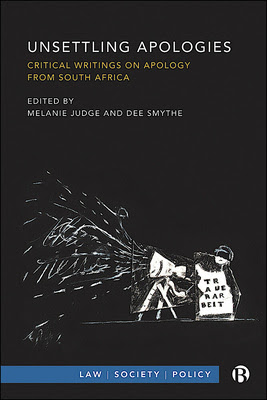
Colleagues of mine in African studies, Professors Melanie Judge and Dee Smythe published Unsettling Apologies: Critical Writings on Apology from South Africa.

Known for the truth and reconciliation processes that followed Apartheid, South Africa has been a font of experience and acquired wisdom about the role of transparency and truth in redressing mass atrocity. In this book, released in the fall from Bristol University Press, the South African editors compiled and co-authored some of the best and latest thinking and reflection on the function and debated efficacy of apology.

This is the précis.

There has recently been a global resurgence of demands for the acknowledgement of historical and contemporary wrongs, as well as for apologies and reparation for harms suffered. Drawing on the histories of injustice, dispossession and violence in South Africa, this book examines the cultural, political and legal role, and value of, an apology. It explores the multiple ways in which "sorry" is instituted, articulated and performed, and critically analyses its various forms and functions in both historical and contemporary moments. Bringing together an interdisciplinary team of contributors, the book's analysis offers insights that will be invaluable to global debates on the struggle for justice.

Even setting aside mass atrocities such as Apartheid, the theory of apology has resonance in tort law. "Apology laws" in the states seek to render apologies inadmissible as evidence in later litigation, especially in medical malpractice. Proponents posit that apology aids in healing and even averts litigation. That premise, and the efficacy of apology laws, is much studied and debated.

A masked Prof. Smythe previews the book at the annual meeting
of Law and Society in Lisbon, Portugal, in July 2022.

RJ Peltz-Steele CC BY-NC-SA 4.0
Judge and Smythe wrote the book's opening chapter, "The Power of Apology." The chapters thereafter offer a range of compelling titles. Smythe also co-authored, with educator Leila Khan, "Beyond Words: Apologies and Compensation in Sexual Offences." Smythe, a professor of public law on the faculty of law at the University of Cape Town, is a dear colleague who has been ceaselessly supportive of my research and teaching on African law and public policy.

Professor Sindiso Mnisi Weeks, a valued colleague at UMass Boston who generously has participated in my comparative law class in the past, contributed the chapter, "In Pursuit of Harmony: What is the Value of a Court-Ordered Apology?" University of Wisconsin constitutional comparatist Professor Heinz Klug authored, "Amnesty, Amnesia, and Remembrance: Self-Reflections on a 23-Year-Old Justification." Among all of the chapters, I especially appreciated the heart-rending history "On Not Apologising: Winnie Madikizela-Mandela and the TRC Hearing into the Mandela United Football Club" by Canadian Professor Shireen Hassim.

Abstracts of all chapters and the book's front matter are available at Bristol University Press Digital.

Saturday, May 20, 2023

EPA floats PFAS limits for drinking water

Rawpixel CC0 1.0
PFAS has been much on the lips of regulators, lately and at last. 

As I wrote in 2021, the movie Dark Waters (2019), based on a true story, first brought PFAS to my attention. I'm happy to report that we've since replaced almost all of our PFAS-coated cookware. And just yesterday, I followed the recent custom of removing a burrito from its plastic-coated-paper wrapper before heating it in the microwave.

When John Oliver gave his classic treatment to PFAS in 2021, Europe was moving to regulate it, but the United States was doing very little. Per John Oliver's invitation, I confirmed that my local water authority in Rhode Island was not testing for PFAS in drinking water.

Now, with Biden Administration support announced in March, the U.S. Environmental Protection Authority has a PFAS website and proposed regulations for drinking water. The proposal would drop acceptable levels of six PFAS chemicals from 70 to 4 parts per million (ppt).

That's a start, but not a solution. 

PFAS might now be in the drinking water of as many as 200 million Americans, The Guardian reported in March. Research shows human health risk upon any exposure to PFAS, so no safe level is known. The EPA's own guidelines since last year have called for voluntary limits on two PFAS chemicals at 0.02 and 0.004 ppt, a Harvard expert explained. Meanwhile, it's not clear that scientific testing is accurate enough to detect PFAS levels that low. Thus, the EPA proposal is vulnerable to criticism for not reaching the full range of PFAS chemicals and not setting maximum levels low enough. But the challenge truly to ensure human health might be practically insurmountable.

Spurred by burgeoning state regulation meanwhile, the private sector is ramping up capacity to test for PFAS nationwide. In February, Maine Laboratories became the first commercial lab in that state to offer testing. Maine Labs sells test kits for drinking water, waste water, ground water, and soil, with a two-week turnaround for results. Maine Labs's CEO is Katie Richards, a close friend and former college roommate of one of my sisters.

Friday, May 19, 2023

NYPD seizes adorable dog, person too, in retaliation for video-recording in public, attorney-plaintiff alleges

A New York legal aid attorney was arrested, along with her dog, when she started video-recording police, and then she sued for civil rights violation.

Harvey (Compl. ¶ 36)
The NYPD messed with the wrong person. As the complaint tells it, Molly Griffard, an attorney with the Cop Accountability Project of the Legal Aid Society (Equal Justice Works), was walking her dog, Harvey, in the Bedford-Stuyvesant neighborhood of Brooklyn when "she saw police officers remove a young man from a bodega, and drag him around the corner where they lined him up with other young men against a wall."

Griffard began video-recording with her phone. After she crossed the street at an officer's instruction, she started writing down NYPD car plate numbers. An officer refused to give her his business card upon her request, the complaint alleges. Instead, the officer handcuffed Griffard and arrested her, taking her and Harvey into police custody. She was held at the 79th precinct for eight hours, while Harvey, a nine-year-old Yorkie, was held in the kennel.

Admittedly, what caught my attention in the case was not so much the facts, head-shaking inducing as they are, but the story of Harvey. Journalist Frank G. Runyeon, reporting for Law360, and NBC News 4 New York, also were enchanted.

Griffard and her attorney, David B. Rankin, of Beldock Levine & Hoffman LLP, must have been conscious of Harvey's intoxicating adorableness, too, because they included gratuitous glamor shots in the complaint—as I've reproduced here. 

Harvey (Compl. ¶ 20)
At its fringe, the case might be said to implicate animal rights, or at least the rights of owners of domesticated animals. Courts in the United States and elsewhere in the world are coming around to the idea that domesticated animals such as cats and dogs have a value exceeding their market worth as personal property, especially in the area of tort damages when the animals come to harm.

Griffard make no such claim, though, rather using Harvey as evidence to demonstrate her emotional distress at being separated from him and being given no information about his whereabouts while they were held—and, between the lines, to tug at the heartstrings and demonstrate the utter absurdity of her arrest and detainment.

One paragraph of the complaint does allege that seven-pound "Harvey was traumatized by the incident and now takes medication to treat his anxiety disorder." And the count of unreasonable seizure points out that "Harvey missed his dinner."

The case is Griffard v. City of New York, No. 512993/2023 (Sup. Ct. Kings County filed May 2, 2023).

Thursday, May 18, 2023

Mass. court affirms big verdict against Big Tobacco

Autodesigner via Wikimedia Commons CC0 1.0
Last week, the Massachusetts Supreme Judicial Court affirmed a lung cancer victim's verdict against Marlboro maker Philip Morris (PM).

Arising from verdict in a $37m case against PM and co-defendants, including R.J. Reynolds Tobacco Co. and Star Markets, the decision broke no new ground, but might be instructive for students of product liability.

On appeal, PM did not "dispute that the plaintiffs introduced sufficient evidence of agreement between it and the other cigarette entities to deceive the public about the dangers of smoking.... Further, [PM did] not dispute the evidence of medical causation, i.e., that smoking causes the type of cancer from which Greene suffered."

Rather, PM asserted that the plaintiff failed to connect causally her choice to smoke to specific misrepresentations. The court wrote that PM viewed the evidence too narrowly, and that the plaintiff sufficiently "met this requirement by introducing evidence of her detrimental reliance on the conspiracy's misrepresentations regarding filtered cigarettes. [PM] represented that such products, including Marlboro Lights, delivered lower tar and nicotine and were a healthier alternative to regular cigarettes."

The plaintiff also met the burden of proving causation on a count of civil conspiracy. "The conspirators expressly misrepresented to the public that they would not have been in the business of selling cigarettes if cigarettes were truly dangerous," the court reasoned. Consequently, "the jury could have found that [the plaintiff] would have smoked less, or quit sooner, absent the conspiracy's campaign of fraud and deception."

PM also pointed to the court's 2021 adoption of the Third Restatement approach to causation (on this blog) to argue that the jury was erroneously instructed on "substantial causation." The court ducked the question by finding that counsel had not preserved their objection to the jury instructions.

Finally, the court upheld the award as against PM challenges to the trebling of damages under Massachusetts consumer protection law and the commonwealth's 12% judgment interest rate.

The case is Greene v. Philip Morris USA Inc., No. SJC-13330 (Mass. May 9, 2023). The unanimous opinion was authored by Justice Scott L. Kafker, who also wrote the opinion in the 2021 causation case.